What if every Facebook campaign decision supported a measurable business objective, rather than simply producing more activity? For a Singapore SME with limited time and in-house expertise, planning creative, choosing audiences and refining campaigns can quickly become a job of its own. A facebook marketing agency for small business can bring those moving parts together and help you see whether campaigns are generating relevant enquiries and sales.
Effective support should fit your goals, resources and budget, with reporting that connects campaign activity to outcomes. This guide explains what strategic Facebook marketing involves beyond publishing posts, which metrics help assess performance, and how audience choices, creative and ongoing optimisation work together. You’ll also learn how to prepare for agency support in Singapore, so you can decide what your business needs next.
Key Takeaways
- Organic content and paid campaigns have different roles, but can work together to support business goals.
- Turn a business outcome into a campaign plan by defining the audience, offer, creative and conversion action before launch.
- Measure Facebook performance with metrics tied to enquiries, conversions and sales, not likes alone.
- Prepare for agency support by clarifying your priority offer, target customer, conversion destination and available creative assets.
- A facebook marketing agency for small business can organise campaign management, reporting and optimisation around measurable objectives.
What a Facebook Marketing Agency for Small Business Actually Does
A Facebook marketing agency for small business plans and manages campaigns that connect a company’s goals with its audience, content and performance measures. Its role goes beyond publishing posts. It creates a process for deciding what to communicate, who to reach and what business outcome to track, giving a Singapore SME a clearer basis for marketing decisions.
That process can include both organic content and paid campaigns. Organic posts keep a business page active, share useful information and maintain relationships with followers. Paid advertising uses a budget to distribute selected messages to chosen audiences and encourage a specific action. As part of broader Social media marketing, the approaches can complement one another: organic content builds familiarity, while paid campaigns extend the reach of a timely offer.
How Facebook marketing supports small-business goals
Set the campaign objective according to what the business needs next. An awareness campaign introduces a brand or service to potential customers. An enquiry campaign invites people to submit a form or get in touch. A clinic may prioritise appointment enquiries, while a home-services business may want quote requests from the areas it serves. An online retailer may focus on product sales.
Each goal calls for a different message and conversion action. Likes can show that people noticed a post, but likes and reach alone don’t establish whether a campaign generated enquiries or sales. For SMEs coordinating social activity with search visibility, a broader digital plan can connect Facebook campaigns with SEO services in Singapore.
What agency support can include
Agency support can span the campaign lifecycle. It starts with the business objective, then aligns audience targeting, creative development and campaign setup with the action customers should take. Content scheduling and advertising are related but distinct: scheduled posts maintain a consistent presence, while paid campaigns distribute selected content to support a defined objective. Bid management and performance reviews help guide delivery as results come in.
- Audience targeting: define who the campaign is intended to reach and what matters to them.
- Creative development: shape the message and format around the offer and audience.
- Campaign management: set up advertising, manage bids and review delivery.
Reporting closes the loop. A useful report can show clicks, conversions, audience insights and ROI, helping the business assess whether a campaign is attracting attention or contributing to its commercial objective. If clicks rise but enquiries don’t, review the offer or conversion destination before simply increasing posting. That turns campaign management into a measurable improvement cycle rather than a stream of disconnected activity.
How a Facebook Marketing Agency Turns Business Goals into Campaigns
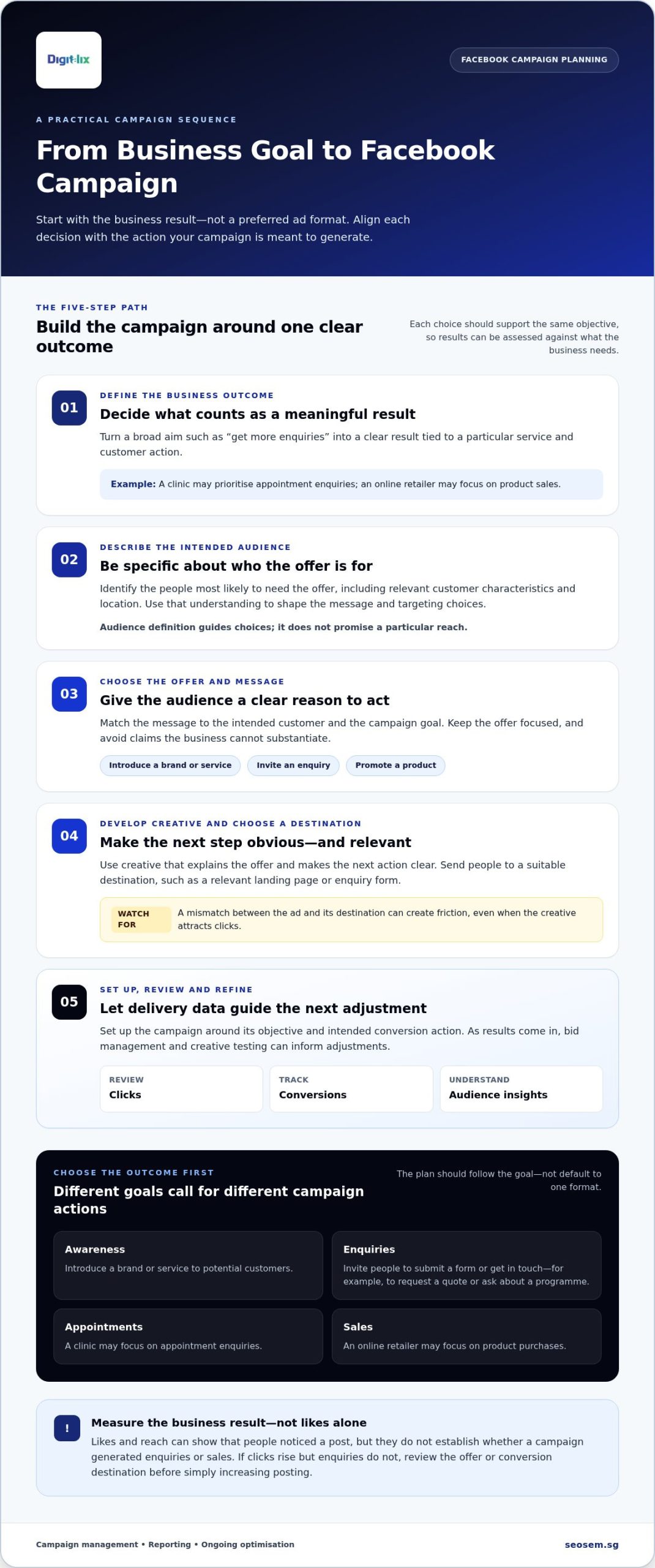
A Facebook campaign should start with the business result, not a preferred ad format. A facebook marketing agency for small business can translate an outcome such as qualified enquiries into decisions about the audience, offer, creative, destination and campaign setup. Each choice should support the same objective, so performance can be assessed against what the business actually needs.
For example, a Singapore enrichment centre seeking parent enquiries needs a clear next step for interested families. The campaign should connect its intended audience with a relevant programme message and a destination where parents can enquire. A different goal, such as introducing a new service, calls for a different message and campaign objective. The plan should follow the goal, rather than default to one format.
- Define the business outcome. Make the goal specific enough to guide decisions. “Get more enquiries” is a starting point. Clarify which service the enquiries should relate to and what action counts as a meaningful result. This gives the campaign a practical measure of success.
- Describe the intended audience. Identify the people most likely to need the offer, including relevant customer characteristics and location. Audience definition shapes the ad message, the concerns it addresses and where a person should go next. It guides targeting choices without promising a particular reach.
- Choose an offer and message. Give the audience a clear reason to act, such as learning about a programme or requesting information. Match the message to the intended customer and avoid claims the business can’t substantiate. A focused offer also makes campaign responses easier to interpret.
- Develop creative and choose the destination. Creative should explain the offer and make the next action obvious. Then select a suitable destination, such as a relevant landing page or enquiry form. A mismatch between the ad and destination can create friction, even when the creative attracts clicks.
- Set up, review and refine. Set up the campaign around its objective and intended conversion action, rather than applying the same format to every goal. As delivery data comes in, bid management and creative testing can inform adjustments. Reporting on clicks, conversions and audience insights helps show what is progressing and what may need refinement.
This sequence makes each campaign decision accountable to the goal. Digitalix’s Facebook / Instagram Marketing includes creative development, campaign management, bid management and reporting. SMEs planning broader digitalisation can also explore the SMEs Go Digital programme as an IMDA resource.
For details about Digitalix’s Facebook campaign support, visit Facebook marketing support for your SME.
How Small Businesses Can Measure Facebook Marketing Beyond Likes
A useful Facebook report connects campaign activity to a business objective. Likes, reach and clicks can indicate whether people are seeing or responding to an ad, but they don’t prove that it generated qualified enquiries or sales. A facebook marketing agency for small business should distinguish these early signals from outcomes, then explain what the results suggest the business should do next.
Start by agreeing what success means for the campaign. For awareness, reach and engagement help assess visibility and response. For lead generation, count relevant enquiries and examine how many progress after follow-up. For online sales, compare campaign conversions with the retailer’s sales records where available. A click is a step in the customer journey, not the same as a purchase.
Match Facebook metrics to the campaign objective
Choose a small set of measures that answer three questions: did the campaign reach people, did they take the intended action, and did that action have value to the business? This keeps reporting focused without treating every metric as a result.
| Objective | Metric | What it helps interpret | Possible next action |
|---|---|---|---|
| Awareness | Reach and engagement | Whether people saw or interacted with the message | Review the audience and creative if visibility or response is weak |
| Lead generation | Qualified enquiries and conversion rate | Whether responses match the intended customer and action | Refine the offer, form or follow-up process |
| Online sales | Conversions and sales data | Whether tracked actions correspond with recorded purchases | Compare the ad with the buying journey, then adjust the campaign or destination |
Interpret figures in context. A high click count with few qualified enquiries may point to a mismatch between the ad, offer and destination. Enquiries that don’t progress may call for a closer look at lead quality or follow-up, rather than an automatic increase in campaign activity. Attribution depends on the campaign setup, customer journey and available business data, so no single metric establishes Facebook’s full contribution.
Review trends over a suitable reporting period instead of drawing a firm conclusion from one snapshot. A single period may not capture a longer decision process, and one metric can hide friction further along the journey. Keep the objective and conversion definition consistent when comparing performance. Where possible, record business outcomes such as sales or appointments alongside platform reporting.
Transparent social media marketing reporting can bring clicks, conversions, audience insights and ROI into the same discussion. For additional background on planning and analytics, see Sprout Social’s guide to Facebook marketing for small business. The aim is not to report the most numbers, but to identify which signal deserves attention and which campaign decision it can inform.
How a Singapore Small Business Can Prepare for Facebook Agency Support
Campaign planning moves faster when you can explain what Facebook should achieve and what customers should do next. Before working with a facebook marketing agency for small business, gather practical details about your goals, offer, audience, conversion destination and existing creative. You don’t need a polished marketing plan. Clear inputs give the campaign team a stronger starting point and keep decisions tied to your priorities.
Prepare the essentials for campaign planning
- Choose one priority outcome. Decide whether the immediate focus is awareness, enquiries, appointments or sales. If several goals matter, rank them so the first campaign has a clear purpose.
- Identify the offer. Specify the product, service or promotion to feature. Note what makes it useful to the customer, any relevant conditions and the next step you want them to take.
- Describe your target customer. Share what customers need, what questions they ask and what influences their decision. For a local service business, define the areas it serves. A Singapore business may need distinct location-focused messaging for Orchard, the CBD, Jurong, Tampines, Woodlands, Buona Vista and Paya Lebar.
- Select the conversion destination. Point to the relevant website page, landing page, enquiry form or product listing. Check that it explains the offer clearly and makes the desired action easy to find. If an ad promises details about a service, the destination should provide them rather than send visitors to a general page.
- Collect existing creative assets. Bring together product or service images, brand guidelines, copy, customer questions and past campaign materials. These give the creative team useful context and show which messages or formats the business has already tried.
Keep the customer journey in view. If your online retail business sells through its own website as well as Shopee or Lazada, decide which destination the campaign should support and how you’ll recognise a resulting sale. The right choice depends on the offer and how customers complete their purchase. For a service business, a clear enquiry route may matter more than sending people to a general social profile.
Connect Facebook with other customer channels
Facebook can introduce an offer to people who may not be actively looking for it, while search can help a business appear when potential customers look for relevant products or services. A Singapore SME might use social campaigns to build awareness of a seasonal service and SEO services in Singapore to strengthen visibility for related searches over time. Treat the channels as parts of a coordinated customer journey, not interchangeable tactics.
Bring your goal, audience notes, priority offer, destination and creative assets to the planning discussion. That preparation makes campaign decisions more specific and gives future reporting useful business context.
What Working with Digitalix on Facebook Marketing Looks Like
Before choosing an agency, set a clear basis for reviewing its work: a defined business objective, campaign decisions that support it, reporting linked to outcomes and terms that suit your SME. This helps you assess whether campaign management goes beyond publishing posts or sharing activity figures; as highlighted by stratagon.com, moving from a tactical vendor to a strategic partner requires evaluating how directly marketing efforts connect to revenue growth. It also gives you a practical way to discuss what should happen next if performance changes.
Digitalix supports Singapore businesses with Facebook / Instagram Marketing, from creative development and campaign management to audience targeting, bid management and reporting. A dedicated account manager helps keep campaign activity aligned with your objective and the relevant destination on your website, such as a service page or enquiry form. That connection matters: the ad and page should set consistent expectations for potential customers.
Campaign management, reporting and evidence
Creative development shapes campaign messages around the offer and intended audience. As campaigns run, bid management supports delivery, while reporting gives you a view of clicks, conversions, audience insights and ROI. These measures help you review what people did after seeing an ad and consider whether the campaign needs refinement. They provide evidence for decisions, not a promise of a particular result.
Digitalix’s Social Media Marketing service is $800 per month. The service includes either four posts and a report or ad setup and a report. A healthcare provider case study reported 40% follower growth and a 25% appointment increase in three months. This is an example of results reported for that provider, not a forecast for another business. Outcomes depend on the business, campaign and customer journey, so use case studies as context rather than a guarantee.
Engagement terms are straightforward: Digitalix’s social media service is cancel anytime, with no forced contracts or three-month or six-month lock-ins. Work delivered is invoiced at month-end.
A practical next step for Singapore SMEs
Bring your priority business outcome, offer, target audience and preferred conversion destination to a discussion. Those details help frame the campaign approach and the measures that will make performance meaningful to your business. If your priority is enquiries, for instance, the discussion can focus on what counts as a useful enquiry and how reporting distinguishes it from a click.
A Facebook campaign can be a focused part of your customer acquisition activity. Connect its creative and delivery choices to a goal, then use reporting to guide considered adjustments. Digitalix can discuss those priorities with your team and outline a data-driven approach suited to your business.
Turn Your Next Campaign into a Clear Growth Decision
Your next Facebook campaign can do more than pursue an immediate response. It can help your business learn which messages resonate with potential customers and what questions they need answered before taking action. Use those insights to inform future campaigns, website content and customer conversations, so each round of marketing builds on what you’ve learned.
A facebook marketing agency for small business should make that learning practical: connect campaign activity to a business priority, interpret results in context and use them to guide the next decision. Start with the customer action that would make a meaningful difference to your SME, then build a measured approach around it. With a clear objective and open communication, Facebook marketing can become a more deliberate part of your growth plan.
Ready to make your next campaign more focused? Talk with Digitalix about Facebook marketing for your Singapore business.
Your next campaign can be a confident, evidence-led step towards stronger customer connections.
Frequently Asked Questions
Can a small business manage Facebook marketing without an agency?
Yes. An owner or staff member can manage Facebook marketing in-house if they have time to plan content, maintain the page and review campaign performance. This can suit a business with a simple offer and a manageable posting schedule. The trade-off is capacity: campaign setup, creative production and ongoing optimisation can compete with daily operations. Decide who owns each task and how you’ll assess its contribution to business priorities.
What does a facebook marketing agency for small business do?
An agency helps a small business plan, create, manage and assess social campaigns. Support can include audience targeting, creative development, advertising setup, bid management and performance reporting. It can also connect campaign activity with the company website, so a click leads to a relevant next step. The scope should reflect the business’s needs, internal capacity and campaign objectives.
How much should a small business budget for Facebook marketing?
Digitalix’s Social Media Marketing service is $800 per month and includes either four posts and a report or ad setup and a report. When planning, clarify which service scope fits your immediate need and the campaign objective. Consider the value of the offer, the action you want customers to take and how enquiries or sales will be handled. Review actual performance before making changes, rather than treating a budget as a guarantee of results.
How can a small business tell whether Facebook marketing is working?
Compare campaign results with a business measure, not just platform activity. A tuition centre, for example, could track how many Facebook enquiries become trial lesson bookings, while noting which enquiries are relevant to its classes. Keep a simple record of enquiry source, outcome and date alongside campaign reports. This helps identify whether the campaign is attracting potential customers and where follow-up or the customer journey may need attention.
How long does it take to see results from Facebook marketing?
There’s no fixed timeline for Facebook marketing results. Early campaign activity may appear before a business can judge its impact on enquiries or sales, especially if customers take time to decide. A seasonal promotion may generate a different response from a service that requires consideration and follow-up. Agree on review points that fit the campaign and customer journey, then use comparable periods and business records to assess progress.
Can Facebook marketing help a Singapore small business get more enquiries?
Yes, Facebook campaigns can encourage potential customers to enquire, although results depend on the offer, audience, creative and follow-up. A home-service business serving Tampines and Woodlands, for instance, can make its service areas clear so prospective customers can judge whether the offer applies to them. Make the enquiry step easy to understand, and track whether responses fit the business’s service and customer requirements.
What should I prepare before working with a Facebook marketing agency?
Prepare a short brief with your main business priority, the offer to promote, your intended customer and the action you want them to take. Also gather existing brand assets, relevant website or product links, and examples of common customer questions. If previous campaigns ran, include their reports and any available enquiry or sales records. This background helps the agency understand what has been tried and what the business needs to learn next.