A sponsored ad can bring shoppers to a product page, but it can’t make an unclear listing more persuasive. For sellers exploring Lazada marketing services in Singapore, a practical starting point is to keep product titles under 150 characters and structure them around the brand, product type, key specifications and a clear selling point.
It’s also reasonable to want a clearer view of ad spend before increasing it. Rather than setting a budget by guesswork, connect spending decisions to product economics and campaign performance. A 4x return on ad spend is presented as a healthy target for most Lazada product categories, but the right approach depends on whether you’re launching a product or scaling an established one.
This guide to Lazada marketing services Singapore covers practical listing improvements, sponsored advertising and budget planning. Learn how to make product pages clearer, use campaign metrics to guide decisions, and treat ROAS as a planning measure rather than a guaranteed result.
Key Takeaways
- Make product pages clear and persuasive so shoppers can understand the offer and decide whether it fits their needs.
- Set sponsored-ad budgets around product margins, stock availability and campaign goals rather than choosing a spend level at random.
- Use campaign performance data to decide which products and search terms deserve more investment.
- Assess results using sales and profitability alongside clicks, so increased traffic is not mistaken for business growth.
- Present discounts and promotional terms accurately to support shopper trust and align with Singapore’s e-commerce guidance.
Product listing optimisation
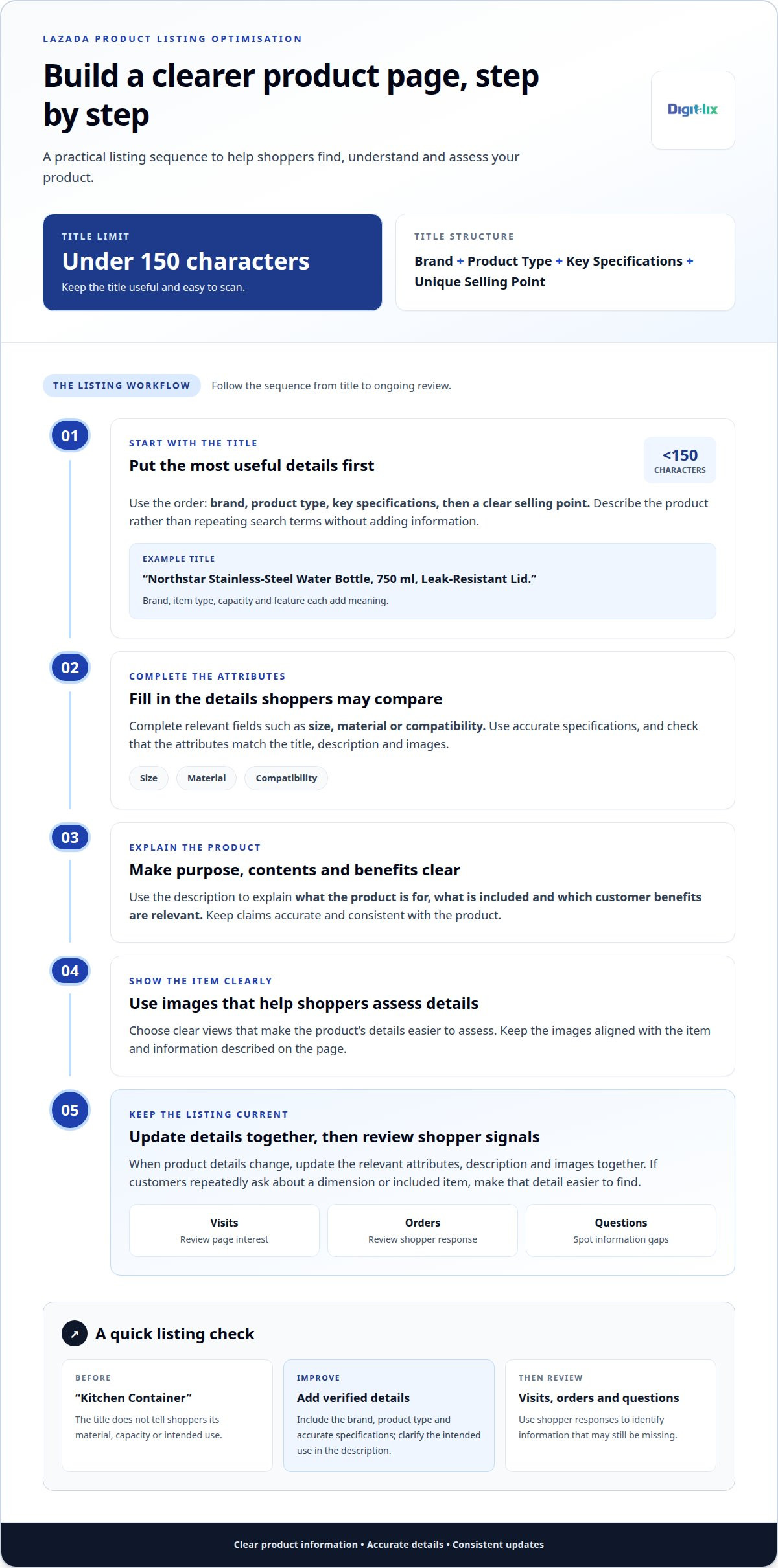
A Lazada product listing should make an item easy to find, understand and assess. Keep each product title under 150 characters. Use the structure Brand + Product Type + Key Specifications + Unique Selling Point. This order puts useful details where shoppers can scan them quickly. A title should describe the product, not repeat search terms without adding information.
For example, an illustrative title could read “Northstar Stainless-Steel Water Bottle, 750 ml, Leak-Resistant Lid.” The brand, item type, capacity and feature each add meaning. Sellers should use only accurate specifications and claims. A practical listing review also checks that the title matches the product attributes, description and images.
Review each listing in a consistent sequence:
- Title: Put the brand and product type first, followed by useful specifications.
- Attributes: Complete relevant fields, such as size, material or compatibility.
- Description: Explain the product’s purpose, contents and relevant customer benefits.
- Images: Show the item clearly from views that help shoppers assess its details.
A clear catalogue process matters when products appear across Lazada and Shopee. The e-commerce marketing services for Shopee and Lazada page relates to businesses coordinating marketplace activity across both platforms. Effective Lazada marketing services Singapore sellers use should connect listing improvements with accurate, consistent product information.
Example: improving a kitchen storage listing
Situation: A fictional seller’s title says only “Kitchen Container.” Shoppers cannot quickly tell its material, capacity or intended use.
Action: The seller revises the title to include the brand, product type and verified specifications. The description explains the item’s intended use, and images show it from useful angles.
Result: The updated page gives shoppers more specific information before they click. The seller can review visits, orders and customer questions to spot any remaining information gaps.
Apply the same approach across product types. Name compatible models for a laptop accessory only when those details are accurate; similarly, electronics sellers such as KEDAIKOMPUTER.COM benefit when exact hardware specifications and refurbished conditions are stated transparently. Describe a skincare listing’s contents and use plainly. Clear details help Lazada shoppers judge whether a product suits their needs.
Listing optimisation continues after publication. When product details change, update the relevant attributes, description and images together. If customers repeatedly ask about a dimension or included item, make that detail easier to find. Give each update a clear purpose and keep the listing aligned with the product.
For businesses reviewing their marketplace approach, listing quality is a practical place to start. Address specific information gaps, then assess shoppers’ responses through visits, orders and product questions.
Sponsored advertising and ad budgets
Sponsored advertising can increase the visibility of selected Lazada products. Set budgets according to product economics, campaign objectives and available stock. Start with a defined goal, such as testing demand for a new product or supporting an established listing. Set a spending limit that reflects the margin remaining after product and selling costs. This ties ad spend to commercial priorities, not clicks alone.
A practical budget plan covers product selection, spending limits and review rules. Choose products with accurate listings and enough stock to fulfil potential orders. Prioritise items that support the campaign goal instead of spreading spend evenly across every SKU. Set a limit for the test, then assess whether visits and orders justify continuing. Adjust the allocation when performance or stock conditions change.
- Choose the objective: Decide whether the campaign will test demand, support a priority product or drive sales during a promotion.
- Select listings: Prioritise products with clear details, a competitive offer and stock available for fulfilment.
- Set a spending boundary: Consider product margin and the amount available for customer acquisition.
- Review and adjust: Compare campaign activity with visits and orders, then shift investment towards stronger candidates.
For example, a fictional Singapore seller launches a new desk lamp on Lazada. The challenge is limited awareness, not proven lack of demand. The seller runs a controlled sponsored-ad test and compares visits and orders with the launch objective. The results help determine whether to continue testing, revise the offer or pause the campaign. Businesses considering Lazada marketing services in Singapore can use this staged approach to connect spending decisions with campaign evidence.
An established product calls for a different decision. Suppose a seller promotes a popular desk fan during a Lazada sale. The seller allocates budget to the listing while weighing stock and margin, then assesses whether the promotion supports profitable sales. This provides a basis for scaling or reducing investment, rather than treating increased exposure as success on its own.
Singapore campaign planning can account for Lazada’s 11.11 and 12.12 sales events. Prepare priorities around product availability and offer readiness. Avoid committing the entire budget before reviewing results. A staged allocation leaves room to respond to demand during the event. A campaign plan should connect event timing with products that are ready to fulfil orders.
Businesses seeking a structured review of campaign goals, product priorities and budget controls can discuss a Lazada campaign plan before scaling sponsored activity.
What results and metrics can sellers expect from Lazada marketing services?
Lazada campaign performance is best assessed through several measures, not clicks alone. Start with return on ad spend (ROAS), which compares attributed sales revenue with advertising spend. A ROAS of 4x or higher is presented as a healthy target for most Lazada product categories. Treat it as a reference point, then weigh product margin and campaign purpose before deciding whether performance is commercially sound.
Product stage changes the target. A new Lazada listing may temporarily accept a lower ROAS while building sales velocity. An established product should aim for 5x or higher. These targets are not interchangeable: a launch may prioritise early traction, while a proven listing needs to sustain efficient sales. Compare each product against its own stage and objective rather than applying one benchmark across the catalogue.
Track the path from ad exposure to business outcomes. Clicks indicate whether shoppers respond to an ad; orders and attributed revenue show whether that attention leads to purchases. Conversion rate helps reveal whether visitors complete orders, while ROAS relates attributed revenue to ad spend. Review the measures together: strong click activity with few orders suggests a different issue from low clicks and steady conversions.
- Clicks: Indicate whether the ad attracts shopper attention.
- Orders: Show whether visits lead to purchases.
- Attributed revenue: Connects campaign activity with sales value.
- ROAS: Relates attributed revenue to advertising spend.
Example, new product: A Singapore seller introduces a new reusable lunch box on Lazada. With limited sales history, an early ROAS below the established-product target does not explain performance on its own. The seller compares clicks, orders and attributed revenue with the launch objective. This supports a more informed decision about continuing the test or changing the campaign approach.
Example, established product: A fictional homewares seller promotes a popular rice cooker. The situation is an existing sales record, so the seller evaluates the campaign against the 5x or higher target. The action is to compare ROAS with order volume and product margin. The result is a clearer basis for increasing, maintaining or reducing investment, rather than scaling spend based on revenue alone.
Use a consistent review sequence for each Lazada campaign: confirm the objective, compare against the right product-stage benchmark, then assess clicks, orders, revenue and ROAS together. Record changes to targeting or offers so later reviews can distinguish their effects. This makes campaign reporting a practical decision tool, not just a dashboard of activity.
What risks, restrictions, or common mistakes should Singapore sellers know about?
Singapore sellers should avoid keyword stuffing, inaccurate promotions and product claims that shoppers could misunderstand. These practices can weaken trust and make a listing less useful. Before publication, check each title, promotion and product detail for clarity. Keep search terms relevant to the item and remove repeated phrases that add no useful information.
Promotional accuracy matters. According to the Competition and Consumer Commission of Singapore, Singapore’s enhanced e-commerce guidelines call for accurate display of discounts and promotions, and ready access to merchants’ relevant terms and conditions. The Ministry of Energy, Trade and Industry’s price transparency guidelines warn sellers that misleading advertising practices could break the law. Sellers should ensure the displayed offer matches its terms and explain applicable conditions clearly.
Example, promotion mismatch: A Singapore seller advertises a Lazada discount, but the product page shows different offer details. Shoppers may be unsure which price applies. The seller checks the wording across the ad and listing, then makes the terms easy to find. The result is a consistent offer shoppers can understand before ordering.
Product information can become inaccurate when inventory or specifications change. A seller, for example, may update a product variant but leave the old description in place. Review the affected listing after each product change, and align the title, attributes, description and images so shoppers see a consistent offer. Avoid claims the product details cannot support.
Example, keyword stuffing: A seller repeats “wireless earbuds” several times in one title to target more searches. The title reads awkwardly without giving shoppers useful extra information. The seller removes the repetition and keeps relevant product terms and accurate specifications. The result is a clearer title that describes the item rather than crowding it with phrases.
Sponsored exposure cannot fix a weak or misleading product page. If an ad attracts clicks but the listing omits an important condition, shoppers may leave without ordering. Review the destination page alongside each campaign. Confirm that the promoted product, price and offer details match the ad, and pause the promotion while correcting any mismatch.
- Search relevance: Remove repeated terms that do not clarify the product.
- Promotion consistency: Match displayed discounts with the offer’s terms.
- Product accuracy: Align listing details when a product or variant changes.
- Ad alignment: Ensure the promoted listing reflects the ad’s claims.
A final review before publishing can catch risks early. Read the Lazada listing as a shopper would: check the product identity, offer details and relevant conditions. Then compare the ad with its destination page. This simple process helps Singapore sellers keep marketplace information consistent and gives shoppers clearer grounds for a purchase decision.
For advertising, use relevant search terms, accurate promotions and product claims, and make sure the ad matches the listing’s product, price and offer terms. Make applicable conditions easy to find, and pause a campaign while correcting any mismatch.
Guide lazada
A practical Lazada selling workflow starts with account economics, product readiness and ongoing review. Before expanding a catalogue, map each product to its category, available stock and fulfilment process. Then check marketplace charges: standard Lazada Singapore marketplace sellers pay no monthly subscription fee, while seller commission typically ranges from 2 to 6 percent, varying by category. LazMall sellers may have different commission structures.
Use this sequence to organise the work:
- Map product economics: Record the selling price, product costs, category commission and promotion conditions for each item.
- Prioritise products: Start with items that have reliable supply, clear customer demand and enough margin to support marketplace activity.
- Prepare operations: Align stock records, order handling and delivery arrangements before promoting products.
- Organise the catalogue: Group related products logically and keep variants and specifications consistent across each product page.
- Review decisions: Compare orders, customer questions and stock changes, then update priorities and product information.
Category commission affects the amount retained from each sale, so include it in product-level planning. When comparing products in two categories, account for each category’s applicable commission rather than using one assumption across the catalogue. Standard marketplace sellers avoid a monthly subscription fee, but commissions and other product costs still apply. LazMall sellers should factor in their distinct commission structure when modelling margins.
Example, catalogue expansion: A Singapore homeware seller plans to add storage baskets and kitchen organisers. The catalogue is growing, with different product categories and supply needs. The seller maps the categories, reviews stock processes and models each product’s margin after applicable marketplace commission. The result is a prioritised range based on operational readiness and product economics, not catalogue size alone.
After launch, use customer feedback and operational changes to guide management decisions. If buyers repeatedly ask about a product’s dimensions, make that information easier to find. If a variant becomes unavailable, update its status and related details. Recurring order-handling delays call for reviewing the relevant process before increasing promotion. These steps connect marketplace performance with practical seller decisions.
Example, stock disruption: A seller’s best-selling organiser becomes difficult to replenish. Promoted demand now risks exceeding available stock. The seller adjusts product priorities and pauses activity that could outstrip fulfilment capacity. The resulting plan reflects current supply, while other ready products receive attention.
For sellers in Singapore, a sound Lazada routine connects category economics, catalogue quality and fulfilment readiness. Review all three before expanding activity, then use customer and order patterns to guide the next operational change.
Digitalix: Lazada Management
Digitalix provides Lazada Management for sellers who need a coordinated approach to marketplace growth. The service brings listing quality, campaign planning and performance review into one strategy, connecting advertising decisions with product goals. It can be useful when marketplace activity takes time away from core business priorities or listings and campaigns need more consistent management.
For sellers operating across marketplaces, Shopee Management can support a broader e-commerce plan. The focus is practical: align channel activity with business priorities and use performance data to guide decisions, without treating increased traffic as the only measure of success.
Contact Digitalix to discuss Lazada Management for your business.
Turn your Lazada plan into the next growth step
For sellers considering Lazada marketing services in Singapore, start by identifying which channel best supports the business’s priorities. Marketplace activity can sit alongside broader search visibility and paid campaigns, creating a more coordinated approach to customer acquisition.
Digitalix offers Search Engine Optimization (SEO), Search Engine Marketing (SEM), Shopee Management and Lazada Management. These services can help businesses align marketplace activity with search demand or manage more than one e-commerce channel. The best starting point depends on your product range, commercial goals and where focused support is needed.
Choose a clear business priority for the next stage, such as improving marketplace management or connecting Lazada activity with search marketing. A focused discussion can help shape a practical direction without assuming every channel needs the same investment.
Frequently Asked Questions
What are Lazada Singapore advertising fees, CPC rates, and minimum budgets?
Advertising spend, cost per click (CPC) and seller commissions are separate considerations. CPC and minimum spending requirements depend on the campaign setup and the platform’s current terms. Build a working budget around the products being promoted, their margins and the campaign objective. Account for category commission when assessing profitability, since advertising performance alone does not show how much revenue the seller retains.
How do sellers set up and manage a Lazada Singapore marketing campaign?
Give each campaign a clear objective and defined group of products before launch. Record its dates, promoted items, offer details and spending decisions. This makes later comparisons more useful, especially when several products or promotions run at once. During reviews, note what changed and why, so decisions to continue or adjust activity can be tied to the campaign’s original purpose.
How can sellers improve product listings and store visibility on Lazada Singapore?
Make the store’s product range easy to navigate, with related items grouped logically. Review shopper questions and feedback for recurring confusion, such as differences between variants or what an item is designed for. Address those gaps on the relevant product page. If buyers often ask which accessory fits a device, for example, clarify compatibility using accurate product information.
How long should sellers run a Lazada campaign before assessing it?
Assess a campaign when it has enough relevant activity for a useful comparison, rather than following an arbitrary timetable. Consider whether it attracted visits and generated orders, and whether its objective was testing demand or supporting an established product. If the promotion, product price or stock position changes during the campaign, record that context before comparing performance.
What should sellers investigate when Lazada ads receive clicks but few orders?
Review the full shopper journey from ad to checkout. Check that the promoted item matches the ad, key product information is easy to find and the offer is current. Look for recurring customer questions that signal an information gap. Unclear variant differences, for example, may prompt shoppers to leave before ordering. Address the specific friction point before changing several campaign elements at once.
How can sellers manage Lazada and Shopee activity together?
Keep separate records of products, promotions and results for each marketplace. The same item may need different descriptions or campaign priorities to suit each store’s catalogue and shopper behaviour. A seller can track a Lazada promotion separately from a Shopee promotion, for example, even when both feature the same product. This helps show which channel-specific changes are associated with customer response without blending the results.
What marketing services does Lazada offer sellers in Singapore?
The services discussed are product listing optimisation and sponsored advertising. Sellers can improve product pages and plan ad budgets around campaign goals, margins, stock and performance.