Audience fit and campaign goals matter more than simply putting an ad in front of more people. Facebook’s 11 advertising objectives fall into awareness, consideration and conversion categories, so choose the objective that matches the action you want people to take. For effective online marketing on Facebook, define that outcome first, then build your audience and content around it.
It’s easy to focus on reach or engagement, but these numbers matter only when they support a clear business goal. The right audience depends on who you need to reach, what they know about your business and what would prompt them to act.
This guide shows you how to set a campaign goal, choose an audience and create lead-focused content with a clear next step. You’ll also learn how to use campaign results to refine your approach for Singapore.
Key Takeaways
- Choose Facebook ad formats that suit the message and make the next step clear to potential customers.
- Refine audience settings around relevant customer traits, then adjust scheduling and spend based on campaign performance.
- Match the campaign objective to the stage of the marketing funnel you need to support.
- Use performance data to test creative variations and improve the ads that generate meaningful responses.
- Make lead-focused content easy to act on with a specific offer and one clear call to action.
1.1 What is Facebook and Facebook Marketing?
Facebook marketing uses Pages, posts and paid ads to introduce a business, engage potential customers and encourage action. Choose each format for a specific purpose, then assess results against that goal.
- Match the ad format to the message. Facebook ads can use images, videos, carousel cards and collection layouts. Image ads suit a single product or offer; carousel ads show multiple items, with at least two images. Video can demonstrate a service, while a collection can connect a lead image with product details. Facebook offered 11 campaign objectives across awareness, consideration and conversion categories, so select an objective that supports the action you want.
- Build clear copy and creative. Keep the main message focused on one benefit and one next step. Keep image-ad headlines and captions concise and focused on the message. Use a sharp image that makes the offer understandable without relying on dense text. For videos, present the key point early and include captions so the message remains clear when viewed without sound. Choose a format that fits the placement and the customer’s decision stage.
- Use organic post formats with intent. A Facebook Page can publish image posts, video, links and Stories. Use images to make a product or service recognisable, links to guide readers to a relevant page, and videos to explain a process or answer a common question. Stories disappear after 24 hours, making them useful for timely updates. For Singapore audiences, keep language, examples and offer details relevant to local customers.
- Protect audience data and campaign trust. In Singapore, handle personal data transparently: explain why it is collected, limit its use to that purpose, protect access and respect opt-out preferences. Apply the same care to lead forms and customer lists. Avoid targeting based on sensitive personal details. Privacy-conscious data practices support trust and reduce the risk of complaints or account issues.
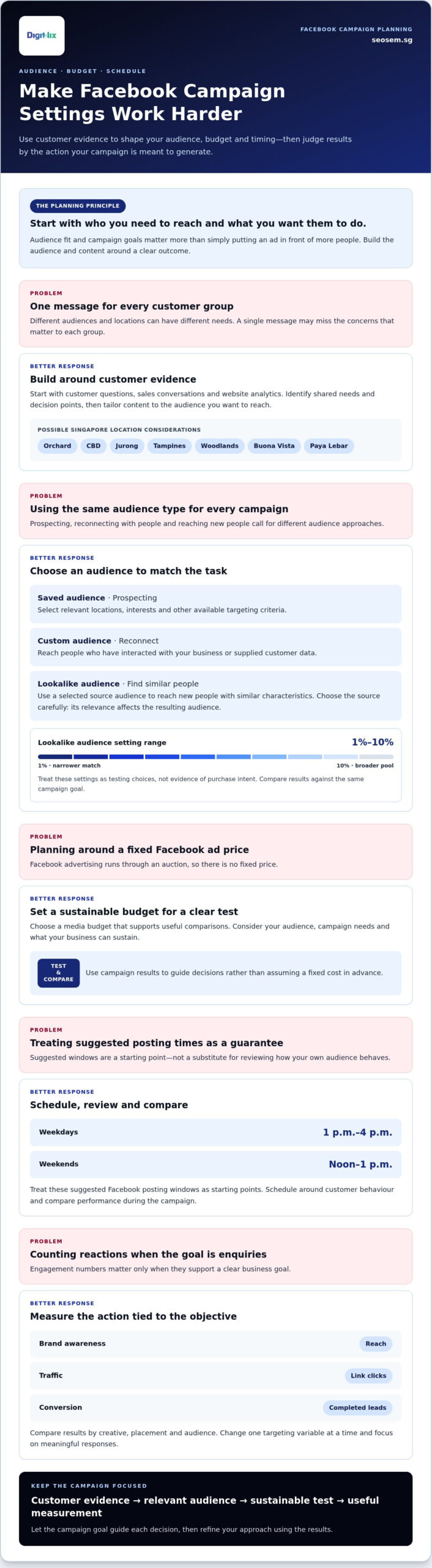
- Measure results and refine the format. Track the metric tied to the objective, such as reach for brand awareness, link clicks for traffic, or completed leads for conversion. Compare results by creative, placement and audience rather than relying on reactions alone. A common mistake is optimising for engagement when the business needs enquiries. Review the campaign structure and make one deliberate change at a time. A broader Singapore digital marketing strategy can also connect social discovery with search visibility.
Audience targeting, budgets and schedules
Build your Singapore audience using customer evidence, then set spending and timing to suit your campaign. These steps help keep your targeting and content decisions focused.
-
Research audiences and plan content
Start with customer questions, sales conversations and website analytics. Identify the needs, interests and decision points shared by likely buyers. For local targeting, consider where customers can realistically use your offer, whether in Orchard, the CBD, Jurong, Tampines, Woodlands, Buona Vista or Paya Lebar. Plan content around relevant needs, such as explaining service arrangements or comparing product features. Avoid using the same message for every location and customer group.
Use enquiry patterns to decide which topics deserve attention. If prospects ask about product options, create content that answers those questions. Record the audience, message and intended action together so analytics can later show which themes attract relevant responses. Keep the plan practical: each idea should address a real customer concern and suit the audience you want to reach.
-
Use saved, custom, and lookalike audiences
Create a saved audience for prospecting by choosing relevant locations, interests and other available targeting criteria. Use a custom audience to reconnect with people who have interacted with your business or supplied customer data. A lookalike audience can help you reach new people with characteristics similar to a selected source audience. Choose that source carefully, because its relevance affects the resulting audience.
Lookalike audience settings can range from 1-10% of the source audience. A smaller percentage creates a narrower match, while a larger percentage expands the pool. Treat these settings as testing choices, not evidence of purchase intent. Compare results against the same campaign goal, and avoid changing several targeting variables at once.
-
Grow audiences through business pages
Use your Facebook Page as a reliable place for potential customers to learn about your business and follow updates. Keep its description, contact details and recent posts consistent with the offer in your ads. Publish useful content that answers customer questions, then invite relevant engagement with a clear prompt. For a business serving Tampines and Paya Lebar, for example, local updates can make the Page more useful to nearby customers.
Review comments, messages and post analytics to identify topics that prompt meaningful responses. A neighbourhood service could explain how customers can prepare for an appointment, while a retailer could clarify product differences. Use these signals to refine future posts and audience selection. Measure enquiries and other valuable actions instead of treating follower count alone as a business result.
-
Set budgets and schedules
Choose a media budget that supports a clear test and allows useful comparisons. Facebook advertising has no fixed price because ads run through an auction. Use this as a planning reference, then consider your audience, campaign needs and what your business can sustain.
Schedule delivery around customer behaviour and review performance throughout the campaign. Suggested Facebook posting windows are 1 p.m. to 4 p.m. on weekdays, and noon to 1 p.m. on weekends. Treat these as starting points, then compare your own results. For a data-led plan, discuss Facebook campaign planning with a specialist.
Campaign objectives across the marketing funnel
Choose an objective that reflects the customer action you want your campaign to generate. Then organise its audience, budget and measurement around that outcome.
- Set the objective to match the funnel stage. Choose an advertising objective that fits whether you want to build awareness, encourage consideration or drive conversions. Use awareness when people need to recognise your business, such as a new Singapore service entering the market. Consideration objectives include traffic, engagement, video views, lead generation and messages. Choose conversion when the intended result is a valuable action, such as a completed purchase. Don’t select an objective just because its name sounds attractive. Identify the business outcome first, then choose the closest objective available in Ads Manager.
- Build the campaign in three clear tiers. Facebook’s ad structure has three tiers: campaign, ad set and ad. Set the campaign objective at the campaign level. Use the ad set to organise audience, placement, budget and schedule settings. Add the individual creative and copy at the ad level. This structure makes comparisons easier. For example, keep the objective consistent while testing different audience groups, or compare creative versions within a defined ad set. Avoid changing multiple settings together, because that makes performance differences harder to interpret.
- Align budget and schedule with the intended action. Allocate spend to the audience and funnel stage that support your priority. A brand-awareness campaign and a lead-generation campaign should not be judged by the same result. Decide how long the campaign needs to run, when customers are most likely to act, and whether the budget supports a meaningful test. Keep the schedule consistent during comparisons. If you change timing, audience and creative simultaneously, you won’t know which setting influenced delivery or results.
- Measure the outcome, then optimise deliberately. Select a primary metric that corresponds to the campaign objective. For awareness, review reach and delivery; for traffic, assess link visits; for lead generation, review completed enquiries. Compare each result with the intended action, not just reactions or video views. Use Ads Manager analytics to identify which ad set or creative contributes to the goal. Pause weak variations and develop the stronger message, while preserving the original objective. If your audience also uses Instagram, coordinate the message across placements and assess results against the same campaign goal.
Data-driven content and advertising decisions
Use campaign evidence to decide what to promote, which creative to refine and where paid advertising can support organic content. In Facebook Ads Manager, compare performance with the action each campaign is designed to generate.
Meta reviews ads against its advertising policies. Keep claims accurate, make sure the destination matches the ad, and avoid creative that misleads people or conflicts with platform rules.
-
Understand Facebook Ads as a paid platform
Use Facebook Ads when you need controlled promotion beyond organic distribution. In Ads Manager, select a campaign objective, define the audience and placements, then prepare the creative and destination together. A local retailer could promote a product page to people interested in its category. Treat each paid campaign as a testable investment: connect spending to an intended action instead of judging performance by impressions alone.
-
Review advertising policies and restrictions
Review the ad, audience settings and landing page as one complete experience before submitting it. Check that the offer is accurately described, the image supports the copy and the destination delivers what the ad promises. For example, an ad promoting a sale should lead to a page where customers can see that offer. Avoid unsupported claims, confusing terms or creative that could misrepresent the product.
- Test one content change at a time. Compare two versions of an ad, changing a single element such as the opening line, image or call to action. Keep the audience, placement and campaign objective consistent during that comparison. This helps you determine whether the creative change affected the result. For video, communicate the key message visually and use captions so viewers can follow along without sound.
- Read performance signals before changing spend. In Ads Manager, compare the metric tied to your objective with the next step customers take. For a traffic campaign, review link visits and whether the destination encourages further action. For lead generation, focus on completed enquiries rather than reactions. If organic posts attract useful questions, turn those themes into new creative. If paid ads attract clicks but few enquiries, review the message and landing page before increasing promotion.
- Connect paid and organic content. Use organic social media posts to answer common questions and identify messages that prompt meaningful responses. Promote a relevant post when paid reach supports a clear business goal. Avoid boosting every post simply because it received likes. A Singapore service business, for instance, can use an organic explainer to clarify its process, then advertise a focused enquiry offer to a selected audience.
Generating leads through Facebook content
Lead generation works when each piece of content helps a target audience move from interest to a clear enquiry. Use these steps to make online marketing on Facebook support a measurable next action.
- Build an offer around a customer need. Identify one problem your Singapore audience wants to solve, then provide a useful reason to respond. A corporate training provider could offer a course-planning checklist, while a software company could invite prospects to book a product demonstration. Make the value clear before asking for contact details. Avoid broad messages that attract engagement but give interested prospects no reason to enquire.
- Make each post advance the decision. Plan a content sequence: explain the problem, show how your solution works, then invite the reader to act. A short video can demonstrate a process; a customer question can become a clear explanatory post. Facebook connects billions of users, but your content still needs to speak to a specific target audience. Focus each post on one concern and one practical benefit.
- Use proof to make the next step credible. Show relevant examples, product details or a simple explanation of what happens after an enquiry. For example, an event venue could outline its booking process and explain what information a prospective organiser should provide. Keep claims consistent across the post, lead form and follow-up. Clear expectations help qualified prospects decide whether to share their details.
- Give every lead-focused post one call to action. Ask readers to take a single step, such as sending a message, completing a lead form or visiting a service page. Competing instructions divide attention. Make the CTA specific: “Request the event pack” tells an organiser more than “Learn more.” Ensure the destination matches the promise so people arriving from Facebook find the information they expect.
- Measure lead quality, not engagement alone. Track completed enquiries and assess whether they fit your business, rather than treating reactions as the final result. Compare which content attracts relevant questions, qualified requests and customer conversations. If a post earns clicks but few completed forms, simplify the form or clarify the offer. If messages lack buying intent, refine the audience or content angle in your online marketing on Facebook.
- Turn questions into the next content plan. Review comments and enquiries for recurring concerns, then answer them in future posts. A financial adviser might clarify which documents clients should prepare, while a professional association could explain membership benefits. This feedback loop helps brands create more relevant content and improve engagement without guesswork. Use Facebook analytics to compare topics and formats, then focus on content that supports meaningful enquiries.
Digitalix: Search Engine Optimization (SEO)
Digitalix can help businesses connect Facebook activity with stronger organic visibility in Singapore search results. Its Search Engine Optimization (SEO) service is a relevant next step when customers also search for your products or services, beyond discovering them in social feeds.
Consider SEO when your website needs clearer pages, stronger relevance to customer searches or a more consistent path from discovery to enquiry. Facebook can introduce your business to potential customers, while search visibility can help people find it when they are actively looking. Aligning these channels gives your marketing a broader role across the customer journey.
Contact Digitalix to discuss how SEO could support your business goals, or visit seosem.sg to learn more.
Turn campaign learning into your next growth move
Base your next decision on the customer signals your campaigns reveal. A question in the comments, a completed enquiry or a landing-page drop-off can point to a useful adjustment. Apply what you learn to your wider online marketing on Facebook, and tie each change to a business outcome rather than surface-level engagement.
Digitalix offers Facebook Marketing alongside Search Engine Optimization (SEO), Search Engine Marketing (SEM) and Shopee Management. These services can help businesses improve social campaigns, strengthen search visibility or connect marketing activity with their Shopee presence. Choose the focus that best fits your current growth priorities and the work your team needs help advancing.
Start with a clear objective and a practical next step. Consistent measurement can help you make informed campaign decisions as your business grows.
Build on what you learn and move forward with purpose.
Frequently Asked Questions
What is Facebook online marketing and how does it work?
Facebook online marketing combines a business Page’s organic posts with paid ads delivered through Meta’s advertising tools. Choose a goal, define an audience, publish creative, then review actions such as messages or website visits. For a Singapore florist, a seasonal arrangement post can build awareness, while an ad inviting customers to enquire can support lead generation. Connect each campaign to an outcome your business can deliver.
How much do Facebook ads cost in Singapore?
Facebook advertising has no fixed price because ads run through an auction. Actual spend depends on factors such as audience, competition, placements and campaign objective. Set a budget your business can sustain, then monitor delivery and results before making changes. Media spend and campaign management fees are separate costs.
How do I create a Facebook business page and set up Meta Business Suite?
Create a Facebook Page with your business name, category and useful contact details, then add a profile image, cover image and clear description. In Meta Business Suite, connect the Page and any relevant Instagram account, then organise access for the people managing content and advertising. Before publishing, check that the Page details match your website and that customers can easily understand what your business offers.
How do I target audiences for Facebook ads in Singapore?
Start with Singapore customers most likely to need your offer, then set relevant location and interest criteria in Ads Manager. For example, a neighbourhood service may focus its message on nearby customers, while an online retailer may target shoppers interested in its product category. Review audience size alongside campaign response. If enquiries are poorly matched, adjust one targeting factor and compare results against the same goal.
How do I create and launch a Facebook ad campaign step by step?
First, choose the business outcome and corresponding campaign objective. Next, create the campaign, configure the ad set’s audience, placements, budget and schedule, then add the ad creative, copy and destination. Preview the complete ad experience before submitting it for review. After launch, check delivery and the metric tied to your objective. Make measured changes, such as updating the destination or creative, rather than changing every setting at once.
How can I measure Facebook marketing performance using Meta Pixel and Conversions API?
Meta Pixel can record website actions in a browser, while Conversions API sends event data from a server. Together, they can help connect ad activity with actions such as viewing a product or submitting an enquiry. Set up events that reflect real business outcomes, test that they are recorded, and compare them with actual enquiries or sales. Handle data with privacy in mind and check for duplicate event reporting.