The ad budget is only one part of Facebook marketing in Singapore. A campaign can combine a business Page, organic content and paid ads to reach relevant audiences, encourage action and measure results. Targeting helps you reach potential customers, while retargeting can reconnect with people who have already engaged with your business.
It’s reasonable to want a clear view of costs before committing, especially when balancing media spend with campaign management and creative work. This guide explains how Facebook marketing works, how to target and retarget audiences, and what shapes a Singapore campaign budget. It also shows how to assess an agency’s approach.
We’ll begin with campaign basics, then cover audience setup, tracking and budget decisions. You’ll have a practical framework for judging whether Facebook suits your goals and what to consider before taking the next step.
Key Takeaways
- Separate ad spend from campaign management and creative costs to build a realistic budget.
- Define audiences around customer needs and behaviour, then refine targeting using campaign performance.
- Use tracking and retargeting to reconnect with people who have already engaged with your business.
- Assess an agency’s measurement approach, campaign structure and reporting before choosing a partner.
- Consider Digitalix’s Facebook Marketing service when you want a structured approach to campaign setup and optimisation.
What Is Facebook Marketing?
Facebook marketing combines a business Page, organic posts and paid campaigns to build awareness, encourage engagement and generate leads or sales. Singapore businesses can measure performance and ROI by linking campaign objectives to tracked actions, then comparing the value attributed to those actions with campaign costs.
Ad Formats and Shopping Campaigns
Choose an ad format that fits the action you want people to take: image and video ads can introduce an offer, carousel ads can showcase several products, and lead ads can collect enquiries. For an online store, Advantage+ Shopping Campaigns can support automated campaign delivery. Compare formats using the same objective, audience and conversion event to see which creative drives more meaningful results.
Budgets, Bidding, and Targeting
Set a campaign budget around the result you want, then choose a bidding approach that supports that objective. Build audiences around relevant customer characteristics and interests, separating groups when their needs differ. For example, a Singapore retailer could test new-customer targeting against people who have engaged with its Page, then shift spend towards the stronger result.
Analytics and Campaign Optimisation
In Meta Ads Manager, review reach, impressions, clicks, engagement, conversions and cost per result against each campaign objective. To assess ROI, compare tracked revenue or lead value with advertising and management costs, using consistent attribution settings. A high click-through rate matters only if those clicks contribute to a business outcome, such as completed purchases or qualified enquiries.
Agree on KPIs before launch, such as qualified leads, purchases or cost per acquisition. Agency reports should show results against those measures, explain optimisation decisions and distinguish campaign activity from business outcomes. Be cautious of guaranteed sales or fixed returns: performance depends on the offer, audience, creative and conversion experience, not media buying alone.
Agency fees can reflect campaign scope, creative production, reporting and optimisation responsibilities. Compare the work included and the measurement plan, not just the fee structure. For benchmarks, use your own baseline and campaign objective. Engagement, cost per lead and ROAS measure different outcomes and are not interchangeable.
Eligible Singapore SMEs may receive EDGE Grant support of up to 50%, depending on the activity, according to Enterprise Singapore. Enterprise Singapore states that EDGE Grant support is subject to an annual cap of S$100,000. Grant support can affect planning, so assess it alongside campaign goals and eligible activity.
Facebook campaigns can also sit alongside search visibility, since customers may discover a brand through both paid social and search results. A Singapore-focused SEO strategy can complement social media marketing when the goal includes capturing people actively searching for a product or service.
Audience targeting
Facebook and Instagram support visual discovery, TikTok focuses on short-form video, and Google Ads reaches people actively searching. To get started, create a Facebook Page, complete its business details, connect Instagram, then organise advertising access through Meta Business Suite.
Singapore Audience Reach
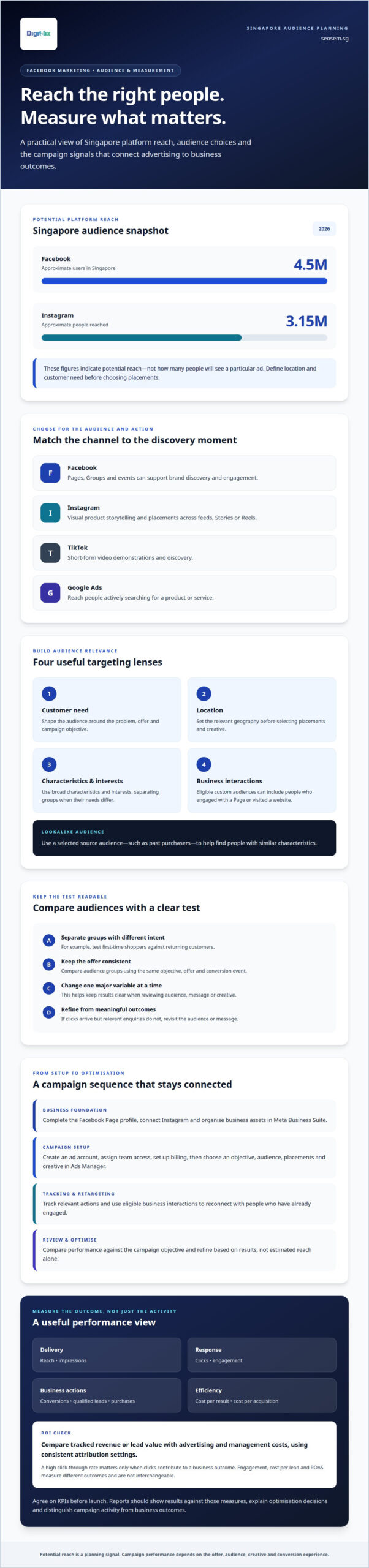
In 2026, Singapore had approximately 4.5 million Facebook users, while Instagram reached approximately 3.15 million people. These figures indicate potential reach, not the number of people who will see a particular ad. For Facebook marketing in Singapore, define the location and customer need before choosing placements across feeds, Stories or Reels.
Review delivery by platform in Meta Ads Manager. A neighbourhood café could test menu-led creative on Instagram alongside a Facebook offer for nearby diners. Compare audience response and meaningful actions rather than treating estimated reach as proof of campaign performance.
Audience Relevance and Adoption
Facebook can suit businesses whose customers discover brands through Pages, Groups or events. Instagram can complement it with visual product storytelling, while TikTok suits short-form demonstrations. For example, a tuition provider could use Facebook to explain course details and Instagram to show classroom content.
The number of businesses using a platform doesn’t prove it fits your audience. Consider the buying journey, offer and creative resources available to your team. For awareness, assess relevant reach and engagement. For enquiries, focus on completed forms and qualified conversations, not reactions alone.
Audience Targeting for Facebook Marketing in Singapore
Build targeting around customer needs, location and campaign objective. Meta can use broad characteristics, interests and custom audiences based on eligible business interactions. A custom audience may include people who engaged with a Page or visited a website. A lookalike audience can help find people with characteristics similar to a selected source audience.
Choose a meaningful source audience, such as past purchasers, and separate groups with different intent. A Singapore retailer could create distinct creative for first-time shoppers and returning customers, then review lead quality and conversions in Ads Manager. If clicks arrive but relevant enquiries don’t, refine the audience or message.
To plan Facebook marketing in Singapore, first complete your Page profile and connect your Instagram account in Meta Business Suite. Organise business assets, create an ad account, assign team access and set up billing. In Ads Manager, select an objective before defining the audience, placements and creative. Test audience groups with a consistent offer, changing one major variable at a time so the results stay clear.
If you want support planning audience tests, discuss your campaign goals.
Facebook advertising agency selection in Singapore
Choose an agency based on its campaign method, reporting and fit with your business goals. Assess how it connects paid advertising, organic posts and your website journey.
Agency Selection Criteria
Ask how the agency translates a business objective into campaign structure, creative and measurable KPIs. A lead-generation brand should see reports on qualified enquiries, not just clicks or reactions. Clarify who manages the Meta account, how often results are reviewed and how changes are explained. A sound plan connects the agency’s work to outcomes your team can assess.
Look for a clear testing process. For example, an agency could compare two audience groups using the same offer, then explain which produced stronger leads. Check that reports separate media spend from management work and identify the next optimisation step. This makes accountability visible without relying on promised sales figures.
Budgets and Bidding
Treat these as planning references, then size budgets according to your audience, offer, conversion goal and available creative.
Ask how the agency sets bids for the chosen objective and manages spend across tests. A campaign optimised for leads needs a different approach from one focused on awareness. Review cost per result alongside lead or purchase quality: the lowest click cost alone may not indicate stronger business performance.
Objectives and Placements
Meta Ads Manager offers campaign objectives that guide delivery towards outcomes such as awareness, traffic, engagement or conversions. Choose the objective that matches the next action you want customers to take. Then assess placements across Facebook and Instagram, including feeds, Stories and Reels, based on the format and audience.
Organic posts support ongoing interaction, while paid advertising gives a campaign a controlled budget and audience selection. A brand might publish product education on its Page, then promote a strong post to a relevant audience. Check whether the agency adapts creative to each placement instead of simply reusing one asset everywhere.
Advertising Rules and Restrictions
Meta reviews advertising under its platform policies, and ads may be restricted or rejected if they breach those rules. In Singapore, brands should also ensure that promotions and claims are accurate and customer information is handled responsibly. Before launch, review the ad text, image, destination page and offer together, rather than as separate pieces.
Ask the agency how it handles review feedback and policy changes, and who can edit the account. For website development, assess whether the landing page clearly matches the ad, works on mobile and makes the next step easy. A mismatch between an ad’s promise and its destination can weaken campaign results.
Use these criteria to compare proposals by scope, testing plan and reporting quality. If you need a structured approach to campaign management, discuss your Facebook advertising goals.
Facebook Pixel, custom conversions and retargeting
Reliable tracking connects Meta ad spend with actions on your website. Set up event measurement before launch, then use the data to evaluate conversions, retargeting and funnel performance.
Pixel and Conversion Tracking
The Meta Pixel records website actions, helping you understand which campaigns lead to enquiries or purchases. Conversions API can complement browser-based tracking by sending event data from a business’s server. Configure both around meaningful actions, such as a completed form or order, and test events before relying on them in reports.
A working guideline is at least S$1,500 per month in actual Meta ad spend for the algorithm to gather conversion data for optimisation. Meta’s learning phase is described as requiring 50 conversion events. If events are misconfigured or too rare, optimisation signals become less useful.
Custom Conversions and Retargeting
Use custom conversions to define valuable actions, such as visits to a confirmation page after a booking enquiry. Check that the event represents a completed outcome, not simply a page view. This helps reports distinguish genuine leads from casual browsing.
Retarget people who visited key pages or engaged with earlier campaigns. For example, show a product reminder to visitors who viewed an item but didn’t complete checkout. Exclude recent purchasers when the next ad promotes the same first-time offer. Match each audience with relevant creative and a clear next step.
Common Risks and Mistakes
Common risks include launching before testing tracking, changing several campaign variables at once and judging success through clicks alone. In Singapore, a lead-generation campaign should also assess enquiry quality, not just form submissions. A tracking audit can reveal broken events, duplicated conversions or gaps between an ad and its landing page.
Recorded six-month campaign examples show why results need context: a transportation-industry B2B campaign reported an 8.54% conversion rate and S$7.14 cost per lead. A finance B2C campaign reported a 13.67% conversion rate and S$21.28 cost per lead. Different audiences and offers make these figures comparisons, not universal targets.
Audit the funnel from ad click to completed action. Check the promise, page load, form fields and confirmation step, then test one change at a time. If tracking and optimisation need a coordinated plan, discuss your campaign requirements.
Facebook marketing costs in Singapore
A Facebook budget has two distinct parts: the media spend paid to Meta and the work needed to plan, create and manage campaigns. For Singapore SMEs, the practical takeaway is to set the advertising budget against a specific business outcome, then track whether it generates qualified enquiries or sales.
That range is a planning reference, not a fixed requirement. The right budget depends on your target audience, campaign objective, creative workload, bidding approach and conversion journey. A campaign with several audience tests or carousel variations needs different planning from a single local awareness promotion.
Separate the budget into clear categories before launch: Meta media spend, creative production, landing-page work and campaign management. Agency management pricing depends on scope and is provided after a quote request. Factors include campaign complexity, reporting needs and the amount of creative work. This separation helps businesses compare proposals without treating ad spend as the full cost of social media marketing.
Plan for testing as well as delivery. Set aside enough spend to compare audience segments and creative, then review performance against the intended outcome. For example, a retailer can compare product-focused carousel ads with a single-image offer, measuring purchases rather than likes. A service business might prioritise qualified enquiries and assess whether leads progress to consultations.
Budget consistency matters because frequent stops and starts can disrupt learning and make comparisons harder. Set a review schedule, such as checking delivery and results weekly, then make changes based on campaign data rather than a single day’s fluctuation. Record budget changes, audience updates and creative swaps so clients can see what changed alongside the results.
Customer information also affects campaign planning. Handle customer data responsibly, limit access to uploaded lists, and use clear processes for collecting and managing information. The PDPC can impose financial penalties of up to 10% of annual Singapore turnover on organisations with turnover above S$10 million, or up to S$1 million on organisations with turnover not above S$10 million.
Before committing, ask for a proposal that separates media spend from management work and identifies the campaign objective, measurement approach and optimisation schedule. This makes costs easier to evaluate and links each budget component to a task or result.
Digitalix: Search Engine Optimization (SEO)
Digitalix can connect your social campaigns with search visibility through Search Engine Optimization (SEO). If Facebook introduces your brand but customers later search for your products or services, SEO can help your website appear at that discovery moment. It’s a useful next step when you want to build organic visibility alongside paid social activity.
SEO focuses on how your website pages match relevant searches, answer customer needs and support a clear next action. For example, a Singapore business can align service pages with questions potential customers ask, then measure visits and enquiries from organic search. This adds another channel to your marketing mix beyond paid campaigns.
To discuss how SEO could support your digital marketing goals, contact Digitalix.
Turn your next campaign into a growth plan
Use your next campaign to build a clearer picture of what customers respond to. Define the business outcome first, then align the message, landing experience and measurement with that goal. A disciplined approach to Facebook marketing in Singapore can also show how social activity fits into your wider digital strategy.
Digitalix can support that broader mix through Facebook Marketing, Search Engine Marketing (SEM), Search Engine Optimization (SEO) and Shopee Management. These channels serve different customer journeys, from discovery and product research to active searches and marketplace browsing. Choose the combination that matches your priorities rather than adding channels without a defined role.
Bring your campaign objective and current marketing priorities to Digitalix. They provide a practical starting point for shaping the next step around your business.
With a focused plan and consistent measurement, your next campaign can become a stronger foundation for growth.
Frequently Asked Questions
How soon will I see results from Facebook ads?
Early campaign signals, such as click-through rate and cost per lead, often appear within 7 to 14 days. Stable, scalable results typically take 60 to 90 days. Use the first review to spot delivery or tracking issues, then assess whether enquiries become qualified leads. For example, a high number of form submissions matters less if they don’t match your target customers.
Do I keep ownership of my Facebook ad account?
Keep your business in control of its Facebook Page and advertising account by retaining administrator access. If an agency manages campaigns, grant it the access needed for its work rather than sharing personal login details. Before launch, confirm who can manage billing, audiences and campaign settings. This keeps account access clear if your internal team or agency changes.
Do you create the ad creative for me?
Yes, Digitalix provides creative ad development for social media campaigns. Share your offer, brand guidelines, product information and preferred call to action so the creative reflects your business accurately. For example, an online retailer can supply product images and key selling points for an ad concept. Review the final copy and visuals before launch to ensure they represent your brand.
How many people use Facebook in Singapore in 2026?
Facebook reaches approximately two-thirds of Singapore internet users. This provides context for assessing the platform’s potential, but it isn’t the same as your campaign’s eligible audience or actual delivery. In Meta Ads Manager, define the campaign’s location and audience first, then use estimated reach to compare audience options before launch.
What are the best Facebook marketing strategies for Singapore businesses?
Build your strategy around a specific customer action, such as booking a service or purchasing a product. Localise the offer and creative for the audience, then make sure the destination page supports the same message. A retailer serving Orchard and Tampines, for example, could tailor campaign messaging to relevant local promotions. Review lead or sales quality, not just engagement, before expanding.
How much does Facebook advertising cost in Singapore?
Your total spend depends on the Meta advertising budget and the campaign management work included, such as creative, testing and reporting. The budget is shaped by your objective, audience, competition and conversion goal. Management pricing depends on the scope of work and is provided after a quote request. Ask for a breakdown that separates media spend from management tasks.
What are Facebook ad benchmarks in Singapore for CPM, CPC, and conversion rates?
CPM, CPC and conversion rates measure different parts of a campaign, so no single benchmark fits every business. Compare each metric with your own previous campaigns using the same objective, audience and conversion event. A lower CPC is useful only if it brings relevant visitors who complete the intended action. Track results by placement and audience segment.
Which Facebook ad formats work best for Singapore audiences?
The strongest format depends on your offer and the action you want people to take. Use carousel ads to present several products or features, video to demonstrate how something works, and lead ads to collect enquiries within Facebook. Test each format with a consistent message and compare completed actions, not just views. Keep the design clear on mobile screens.