Facebook marketing can still work for Singapore SMEs in 2026, but results depend on reaching the right audience with a clear offer and a campaign built around a business goal. Effective Facebook marketing services in Singapore focus on more than getting clicks: they connect ad objectives, creative and follow-up to outcomes such as enquiries or sales.
It’s reasonable to ask whether Facebook deserves a share of your marketing budget, especially when costs and results vary by campaign. This guide explains when to boost a post and when to use Ads Manager, what affects advertising costs, and how to assess performance beyond clicks. It also covers how targeting, creative testing and ongoing optimisation can support a practical approach for an SME in Singapore.
Key Takeaways
- Match your campaign setup to its goal: a boosted post can extend a post’s reach, while Ads Manager gives you more control over objectives and optimisation.
- Build audiences around your customers and campaign purpose, then use performance signals to guide targeting decisions.
- Track meaningful actions, such as qualified enquiries or sales, so you can assess performance beyond clicks and impressions.
- Test different creative approaches and refine campaigns based on results rather than assumptions.
- Plan your budget around the audience, competition, campaign objective and follow-up process, not a fixed cost-per-result expectation.
Should I boost Facebook posts or use Ads Manager?
Boost a Facebook post to extend the reach of content that already exists; use Ads Manager when you need more campaign control. For Facebook and Instagram campaigns, the right option depends on your goal, audience and measurement plan.
Campaign Planning and Management
Facebook marketing services in Singapore can cover campaign planning, audience selection, creative development, setup and reporting across Facebook and Instagram. A sound plan links each campaign to a business objective, such as generating enquiries or promoting a product, then chooses placements and messaging to support it.
Boosting can work well when a post is already earning useful engagement and you want broader exposure. Ads Manager offers more control over objectives, placements, audience demographics and testing. For example, a local service business could boost a customer testimonial and run a separate lead campaign aimed at potential customers.
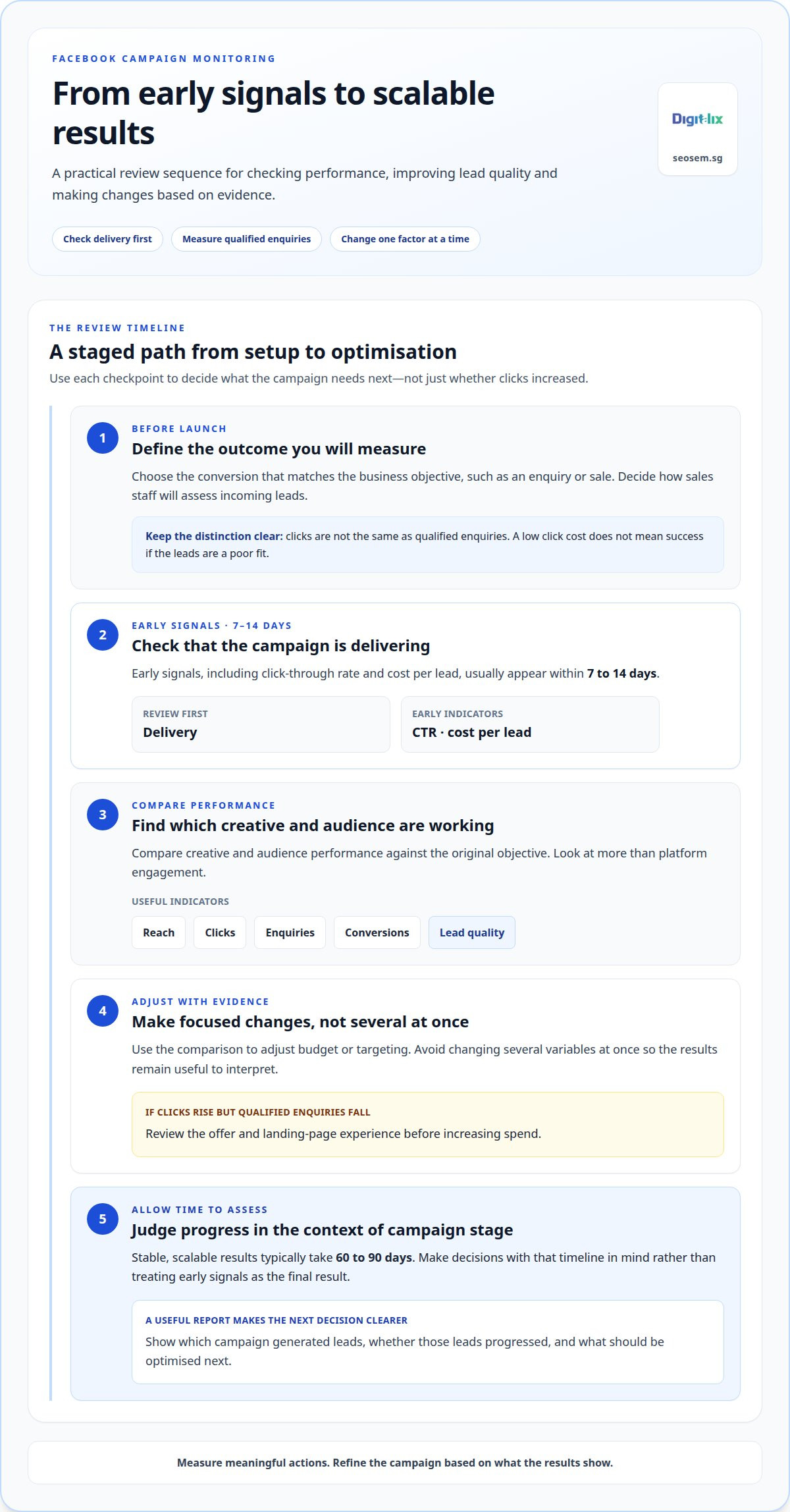
Before launch, define the conversion being measured and how sales staff will assess incoming leads. A campaign report should distinguish clicks from qualified enquiries, so a lower click cost does not automatically look successful when leads are a poor fit. A Singapore plan can also coordinate social discovery with search intent through search engine marketing in Singapore.
Monitoring and Optimisation
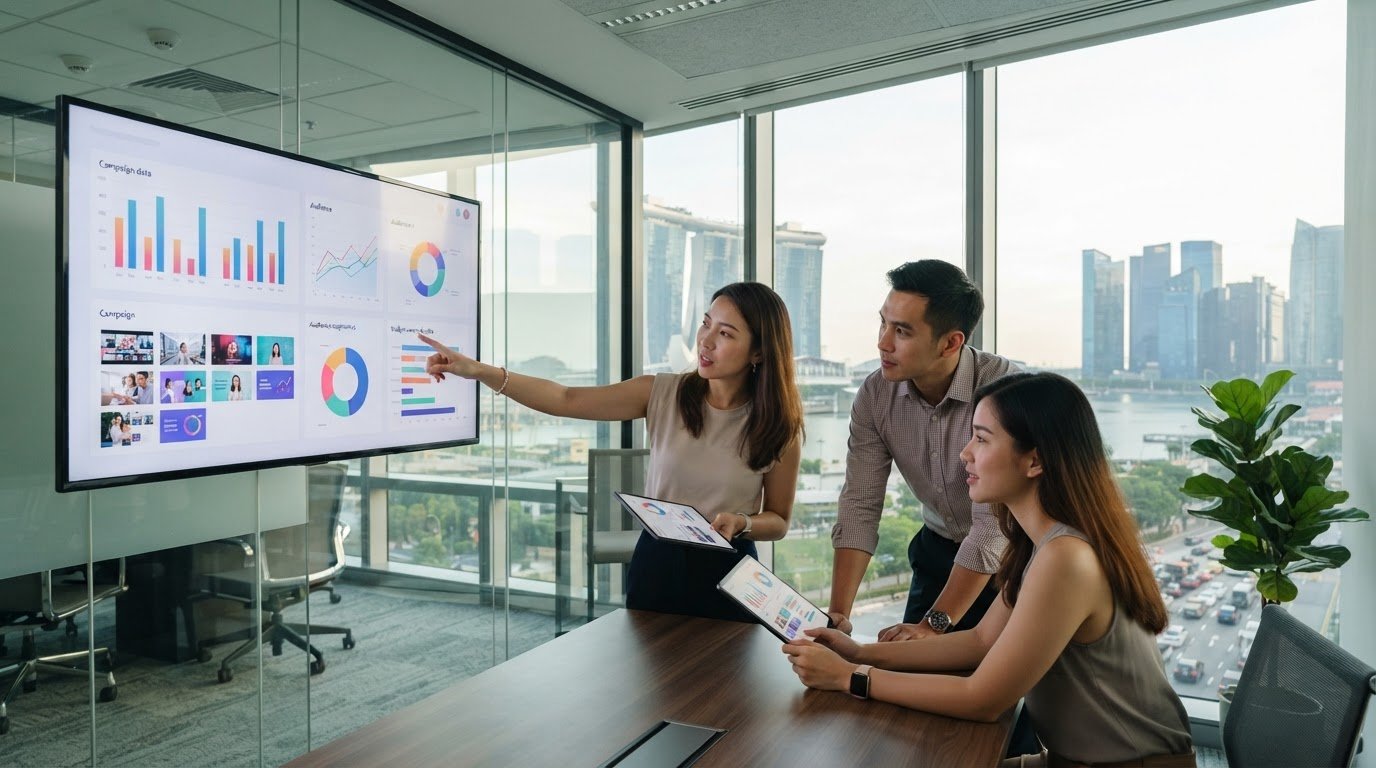
Campaign monitoring tracks delivery, click-through rate, cost per lead and lead quality against the original objective. Early signals, including click-through rate and cost per lead, usually appear within 7 to 14 days. Stable, scalable results typically take 60 to 90 days, so decisions should reflect the campaign’s stage.
Review campaigns in stages: check delivery first, compare creative and audience performance, then adjust the budget or targeting based on the evidence. Avoid changing several variables at once. If clicks rise but qualified enquiries fall, review the offer and landing-page experience before increasing spend.
Useful indicators include reach, clicks, enquiries and conversions, but results depend on the offer, audience and follow-up process. A good report explains which campaign generated leads, whether those leads progressed, and what to optimise next. This gives decision-makers a clearer picture than impressions alone.
Facebook marketing services in Singapore can include campaign strategy, account setup, creative coordination, ongoing optimisation and performance reporting. Look for reporting that connects ad activity to lead quality, not just platform engagement. That makes it easier to decide whether to boost successful content, build an Ads Manager campaign or revise the approach.
Audience targeting and Meta machine learning
Meta advertising tools estimated a potential Facebook advertising reach of approximately 3.8 million people in Singapore in late 2025. That figure indicates potential reach, not the number of people a campaign will actually reach or convert. Targeting should narrow that broad audience around customer relevance, while Meta’s machine learning uses campaign signals to help deliver ads.
Facebook’s potential ad reach represented about 75.5% of adults aged 18 and above in Singapore in late 2025. A separate measure placed Facebook ad reach at 64.6% of the total population. These figures use different population bases, so they describe potential coverage rather than a guaranteed audience size. Singapore had 5.33 million active social media user identities in late 2025, representing 90.6% of the population.
Start with audience research
Define your customer before choosing interests or demographics. A neighbourhood café in Orchard, Tampines or another Singapore district could focus on people near its outlet and tailor creative around dine-in offers. A business selling specialist equipment might target relevant job roles, interests and customer needs. In either case, audience settings should match the campaign objective and the business’s ability to serve those customers.
Interest targeting can help identify likely customer groups, but it is a hypothesis to test, not proof of buying intent. Compare audience responses using qualified enquiries, purchases or another meaningful conversion. If engagement comes from people outside your target customer profile, refine the message and audience criteria instead of treating high reach as success.
Use machine learning with useful signals
Meta’s delivery system can use campaign activity to find people more likely to take the selected action. Set a clear objective and a consistent conversion signal, then measure outcomes against lead quality or sales. Broad targeting can give the system room to learn; narrower parameters may make sense when the offer, location or customer profile calls for them.
Lookalike modelling uses existing customer or conversion data to find audiences with similar characteristics. Its usefulness depends on the source data: past buyers are more relevant to a sales goal than unrelated page interactions. Singapore’s Personal Data Protection Act is relevant when collecting personal data or uploading customer lists for custom audiences. Use a lawful basis and provide appropriate notice.
Globally, Facebook had 2.38 billion monthly active users, while 52% of Asia-Pacific internet users used Facebook in a given month. Those broad figures show platform scale, but a Singapore campaign still needs local audience signals. For help turning audience data into a targeting plan, discuss your campaign objectives.
Is Facebook Marketing Still Effective in Singapore in 2026?
Yes. Facebook marketing remains effective in Singapore in 2026 when advertising connects a relevant offer with clear conversion tracking. The Meta Pixel and Conversions API help measure actions after someone sees or clicks an ad, giving businesses evidence beyond reach and engagement.
The Meta Pixel records website events, such as viewing a product or submitting an enquiry. The Conversions API sends event information from a business’s server to Meta. Used together, they can provide a fuller view of activity, particularly when browser-based tracking misses events. Set up events to match real business goals, then check that reported conversions reflect actual customer actions.
For a lead-generation campaign, track a completed enquiry rather than counting every landing-page visit as a lead. A Singapore tuition centre, for example, could compare recorded form submissions with the enquiries its team receives. If Meta reports conversions but the team sees few genuine enquiries, review the event setting, form quality and lead-handling process.
Meta’s Advertising Standards apply to Facebook ads. In Singapore, the Personal Data Protection Act is relevant when collecting personal data or using customer lists for custom audiences. Use a lawful basis and provide appropriate notice when handling personal data. Tracking should support responsible data use, not bypass it.
Measurement should link advertising activity to business outcomes. Review impressions and clicks to understand delivery, then examine conversions, cost per lead and lead quality to assess commercial value. For example, a service provider might distinguish enquiries that match its service area and customer needs from incomplete or irrelevant submissions. This helps the team judge whether campaign performance supports sales.
Facebook can suit Singapore SMEs whose customers use the platform and whose offers can be explained through useful creative, clear benefits or timely promotions. Retail, education, hospitality and professional services can all test campaigns, but industry alone does not determine fit. Consider audience presence, offer relevance, conversion tracking and your team’s capacity to respond to enquiries.
Use a practical measurement sequence: confirm the intended conversion, test the Pixel event, compare event records with actual enquiries, then review lead quality alongside campaign results. Keep tracking settings consistent across campaigns so comparisons remain meaningful. This helps establish whether Facebook is generating useful demand rather than just attention.
Ad creative, optimisation and A/B testing
Creative influences whether a Facebook or Instagram ad earns attention, communicates value and prompts action. For awareness, lead generation or traffic, match the image or video, opening line and call to action to the campaign objective. A Singapore café promoting a lunch set could lead with the dish, state the offer clearly and direct nearby customers to its menu.
Give each concept one central message. A home-services business might test a before-and-after visual against a short customer testimonial, while keeping the offer and audience consistent. That makes the creative easier to assess. For video, make the first 2 seconds compelling: viewers may decide within 2-3 seconds whether to keep watching.
A/B testing compares versions to find out which creative better supports the campaign goal. Test one meaningful difference at a time, such as the headline, opening frame or call to action. If an ad set includes several unrelated changes, the results won’t show which element affected engagement or conversions. Keep the audience and objective consistent for a clearer comparison.
One recommendation is to test at least 2-3 different ads from each ad set. That gives Meta’s delivery system options while providing a practical basis for comparison. Assess outcomes against the purpose: an awareness campaign prioritises attention, while a traffic campaign examines visits and their quality. For lead campaigns, consider whether submissions fit the offer, not just how many arrived.
Creative fatigue can set in when the same audience repeatedly sees an ad and response weakens. Watch for changes in engagement and conversion quality, then refresh the hook, visual or message. You don’t need to replace every ad on a fixed schedule: some can keep performing for months, while others need adjustment sooner as audience response changes.
A 7x idea-generation formula can help develop 10 original ad concepts from varied angles. For a local fitness studio, those angles might include class experience, convenience, instructor expertise and a beginner-friendly message. Turn each into a distinct creative, then test versions rather than producing near-identical executions.
Use test findings to decide what to do next: keep the stronger concept, revise the weaker one or develop a fresh angle. Record the audience, creative, objective and result for each test. This creates a repeatable optimisation process, helping social media campaigns build awareness, engagement or traffic based on evidence rather than guesswork.
Facebook marketing costs for Singapore SMEs
Facebook advertising has no fixed price because Meta uses an auction. Spend depends on the audience, competition, placement, campaign objective and ad response. Set a business goal first, then decide how much media spend you can sustain while testing whether the campaign delivers useful outcomes. Brand awareness and lead generation require different measures of success.
These are different measures: outbound clicks take people away from Facebook, while all clicks also include other interactions with the ad.
That range shows why a low click cost alone does not establish campaign value. A lead is worthwhile when it fits the business’s target customer and has a realistic chance of becoming a sale. A specialist service with a considered buying process may accept a higher lead cost than a low-margin offer designed for quick purchases.
The analysed accounts represented approximately S$4 million in annual advertising spend. That figure describes the accounts collectively, not a recommended budget for an individual SME. To plan responsibly, connect the proposed spend to the expected sales value, lead-to-sale process and capacity to respond. Then review delivery and lead quality before scaling a campaign.
Keep media spend separate from an agency’s management fee. Agency pricing depends on the campaign scope and is provided after a quote request. Factors include campaign complexity, creative requirements, testing and reporting needs. A clear proposal should distinguish the advertising budget from the work involved in planning and managing the campaign.
For brand awareness, assess whether the campaign reaches relevant people and generates meaningful engagement. For lead generation, compare cost per lead with qualification and sales progress. If a campaign produces inexpensive enquiries that rarely match the service, for example, refine the offer or audience before increasing spend. This makes budget decisions more commercially grounded than optimising for clicks alone.
Use a staged approach: define the objective, allocate a test budget, monitor the right conversion measure and scale only when lead quality supports it. This helps Singapore SMEs control digital marketing spend while learning which Facebook advertising approach suits their business.
Digitalix: Search Engine Marketing (SEM)
Digitalix helps businesses in Singapore connect Facebook campaigns with Search Engine Marketing (SEM) when they want to reach customers through both social discovery and active search. Facebook Marketing can build awareness and generate enquiries, while SEM targets people searching for relevant products or services. Together, these channels offer different ways to attract demand and assess which interactions contribute to leads.
Turn to Digitalix when campaign planning, audience targeting or performance analysis needs a more structured approach. The team can align Facebook activity with your business goals and SEM strategy, so channel decisions reflect customer intent rather than clicks alone. For businesses selling through Shopee, Shopee Management can also support marketplace activity.
Contact Digitalix to discuss how Facebook Marketing and SEM can support your growth priorities in Singapore.
Turn your campaign plan into a growth decision
Start by deciding what a successful campaign should change for your business. Choosing Facebook marketing services in Singapore is about more than launching ads. It means setting a clear direction that fits your sales process and can adapt as customer behaviour changes.
Consider who you want to reach, what action you want them to take, and how your team will respond. These decisions provide a practical starting point for campaign planning and help keep future adjustments focused on business priorities.
Bring your goals and current challenges to a conversation with Digitalix, then decide on a practical direction for your business.
A focused plan gives your next marketing decision a clearer purpose. Start building toward sustainable growth in Singapore.
Frequently Asked Questions
Should I hire a Facebook marketing agency?
Hire an agency when campaign planning and optimisation are taking time away from core business work or require skills your team lacks. For example, a retailer preparing a seasonal promotion may need coordinated ad messaging, audience setup and performance analysis. An agency can manage that execution while your staff focus on stock, customer service and sales follow-up. Keep ownership of your offer, customer knowledge and business priorities in-house.
Do Facebook Ads work?
Yes, Facebook Ads can support business goals when the audience, offer and campaign objective fit together. A restaurant could promote a new menu to nearby potential diners, while a business selling complex services may use ads to start conversations rather than seek immediate purchases. Define a valuable outcome for your business before launch. Then assess whether advertising contributes to it, not simply whether people interact with the ad.
How Can My Business Benefit from Facebook Marketing?
Facebook marketing can help a business introduce its offer, maintain visibility and bring interested people into its sales process. A neighbourhood retailer, for instance, could use product-focused posts to help customers discover new arrivals, then direct interested shoppers to its ordering channel. Businesses can also use customer questions and comments to identify content topics. The strongest benefit depends on how well social activity supports the actual buying journey.
How Do I Choose the Right Facebook Marketing Company?
Choose a company that can explain its campaign approach in terms of your business goals, not just platform activity. Ask how it will handle account access, creative approvals, lead handover and reporting. A Singapore SME should also agree who responds to enquiries and how promptly sales information returns to the campaign team. These operating details help ensure marketing activity connects with customer service and sales rather than sitting apart from them.
How much should a Singapore business spend on Facebook ads?
Set the advertising budget according to your capacity to handle enquiries, the value of a new customer and the time available for testing. A firm with limited appointment slots should avoid generating more demand than it can serve. Separate media spend from management fees, and define what evidence would justify increasing or reducing spend. This keeps budget decisions aligned with operational capacity and commercial priorities.
Is Facebook still worth advertising on in Singapore?
Facebook may be worth testing if your intended customers use it and your business has a relevant message for them. A local enrichment centre, for example, might promote an open-house session to parents considering classes. Before committing to an ongoing campaign, identify the customer action you want and make sure your team can respond. Assess Facebook as one channel in your wider customer acquisition plan, not as a substitute for understanding buyer needs.
How much do Facebook marketing services cost in Singapore?
Service fees depend on the agreed scope, including campaign planning, creative work, account management and reporting. They are separate from the amount paid to run ads on Meta. For an accurate proposal, describe your business objective, campaign requirements and internal resources. This lets the work be scoped to your needs, rather than treating media spend as if it covers strategy or campaign management.
Which Facebook marketing agencies in Singapore are highly rated?
Ratings can vary across review platforms, so a rating alone may not show whether an agency suits your business. Digitalix provides Facebook Marketing alongside Search Engine Marketing (SEM), Search Engine Optimization (SEO) and Shopee Management. For Singapore SMEs, assess whether the proposed work matches your objectives and how clearly the agency explains campaign activity, reporting and next steps. Popularity alone does not prove fit.