A Facebook marketing agency in Singapore plans and manages campaigns to help businesses reach relevant audiences, generate leads and measure ad performance. With more than 3 million active Facebook users in Singapore, the platform gives businesses a way to connect with potential customers through audience targeting and paid advertising. An agency’s work can include campaign strategy, audience selection, ad creative, performance monitoring and ongoing optimisation.
But buying ad space is only one part of the job. Stronger results depend on how well a campaign supports the business objective, speaks to its intended audience and uses performance data to guide adjustments. This guide explains what an agency does, how Facebook audience targeting works and how social media management supports businesses of different sizes and industries. You’ll also learn what to consider when assessing an agency’s approach and how Facebook marketing can fit into a wider digital strategy.
Key Takeaways
- Define the campaign goal first, then align audience selection, creative and measurement with that outcome.
- Understand how a Facebook ads agency plans, launches and optimises campaigns across Facebook and Instagram.
- Assess how campaign strategy can adapt to different industries, business sizes and customer journeys.
- Build social media management around consistent content, audience engagement and performance review.
- Account for Singapore privacy requirements and Meta advertising policies when planning campaigns; consider SEO when you also need to reach people through search.
Audience targeting for a Facebook marketing agency in Singapore
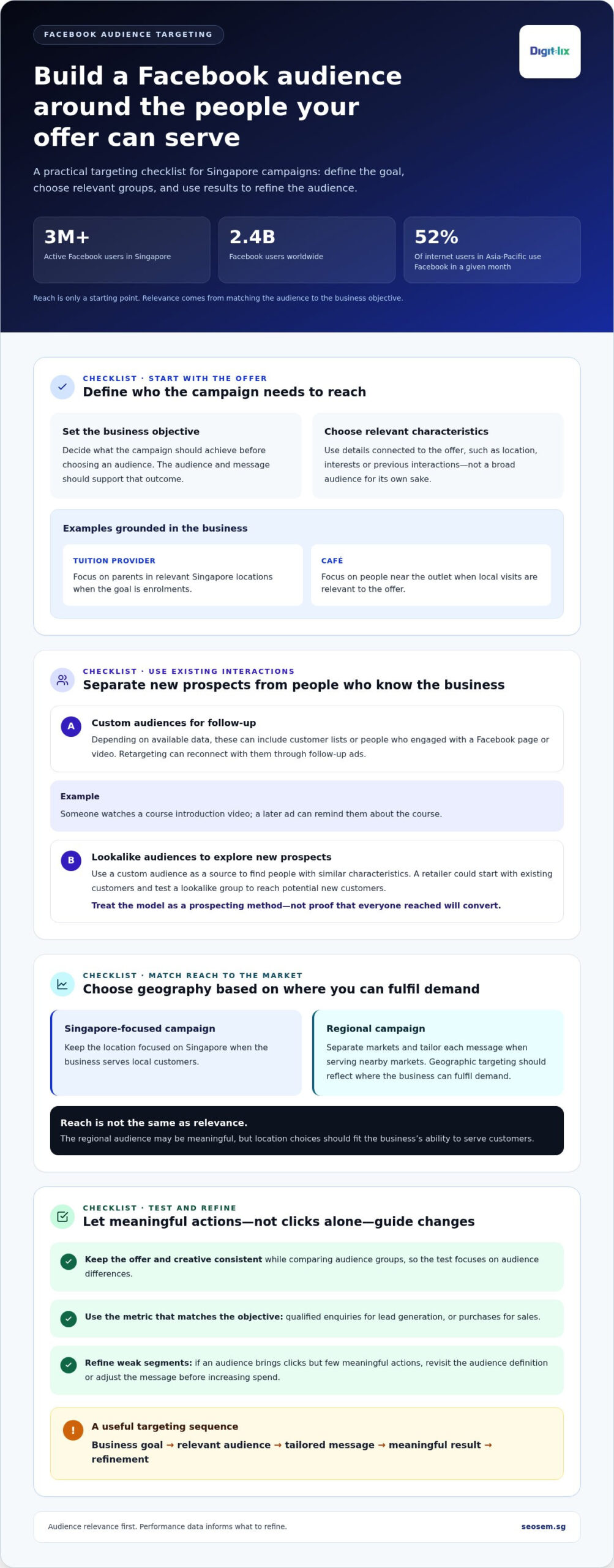
Facebook audience targeting helps advertisers focus campaigns on people more likely to value an offer. The platform had 2.4 billion users worldwide, while Singapore had over 3 million active users. That scale creates reach, but performance depends on defining a relevant target audience instead of pursuing every user.
How a Facebook marketing agency in Singapore builds audience segments
Start with the business objective. A local tuition provider seeking enrolments might target parents in relevant Singapore locations, while a café could focus on people near its outlet. Choose audience characteristics linked directly to the offer, such as location, interests or previous interactions. Then tailor the ad message to that group’s needs.
Custom audiences let advertisers reconnect with people who have already interacted with a business. Depending on the available data, these groups can include customer lists or people who engaged with a Facebook page or video. Retargeting uses these audiences for follow-up ads, such as reminding someone about a course after they watched its introductory video.
Lookalike modelling uses a custom audience to find people with similar characteristics. For example, a Singapore retailer could create a source audience from existing customers, then test a lookalike audience to reach potential new customers. Treat the model as a way to identify prospects, not proof that everyone reached will convert.
Facebook’s reach extends beyond Singapore. Fifty-two percent of internet users in Asia-Pacific use Facebook in a given month. This regional audience can matter to businesses serving nearby markets, but geographic targeting should reflect where the business can fulfil demand. Local campaigns can focus on Singapore, while regional campaigns can separate markets and tailor each message.
Improve targeting through structured testing. Keep the offer and creative consistent while comparing audience groups. Track the result that matches the objective, such as qualified enquiries for lead generation or purchases for sales. If an audience attracts clicks but few meaningful actions, refine its definition or adjust the message before increasing spend.
- Define the conversion goal and customer profile before building an audience.
- Separate prospecting audiences from custom audiences used for retargeting.
- Compare lookalike groups against other relevant segments using the same campaign objective.
Singapore SMEs may be eligible for up to 50% Productivity Solutions Grant support for specified digital marketing packages, according to Enterprise Singapore. Enterprise Singapore states that EDGE Grant support has an annual cap of S$100,000. Search visibility can complement social targeting when potential customers are actively researching a product or service. Organic search visibility in Singapore can support that discovery.
What does a Facebook ads agency actually do?
A Facebook ads agency turns a business objective into a planned, measured campaign. It sets the campaign structure, coordinates creative, manages placements and reviews performance. A Singapore service business might seek qualified enquiries, while an online retailer may prioritise completed purchases. Those goals shape the campaign setup and the metrics used to assess its contribution.
Campaigns can run across Facebook and Instagram, with creative adapted to each platform’s formats. An agency aligns the message, visuals and call to action, then checks whether people engage and take the intended next step. For commerce campaigns, the ad promise should match the product page or enquiry route. A mismatch can disrupt the customer journey and weaken conversions.
Campaign management typically follows a practical sequence:
- Plan: Set the business goal, conversion action and measurement approach.
- Launch: Build the campaign, prepare creative and publish across selected placements.
- Optimise: Review performance, test changes and adjust based on business outcomes.
Measurement should fit the campaign objective. Lead generation calls for tracking lead quality alongside cost per lead; sales campaigns should assess purchases and return on ad spend. Early signals, including click-through rate and cost per lead, usually appear within 7 to 14 days. These indicators can reveal setup issues, but sales teams should also assess whether leads progress into genuine conversations.
Business owners often ask what an agency manages and how to plan spending. The scope may cover strategy, account setup, creative coordination, monitoring, reporting and optimisation. The following comparison separates the main budget considerations without prescribing a fixed allocation:
| Budget element | What it covers | Planning consideration |
|---|---|---|
| Ad spend | Media delivery across selected placements | Set according to campaign goals, audience and testing needs |
| Agency management | Planning, campaign operations and performance review | Align scope with the work and reporting required |
| Creative production | Ad copy and visual assets | Consider the formats and variations the campaign needs |
There is no single recommended budget for every Singapore business. The suitable amount depends on the objective, audience, competition, creative requirements and volume of testing. Keep ad spend distinct from management fees, then assess performance against conversion value. Agency fees depend on campaign scope and are provided after a quote request.
For a practical discussion about Facebook and Instagram campaign goals, measurement and management scope, discuss Facebook campaign support.
Agency experience across industries and business sizes
Choose an agency for its ability to connect campaign decisions with your business model, not just its client list. A professional services firm needs qualified enquiries and effective follow-up. A retailer needs product-focused creative and a clear route to purchase. Ask how the agency adapts measurement, messaging and campaign structure to each sales journey.
Industry experience matters because customer decisions vary. A transportation-industry B2B Facebook campaign reported an 8.54% conversion rate over six months. A campaign for an international primary school increased leads by 103% and conversion rate by 96%. These examples show why case studies should identify the industry, goal, measurement and campaign period. A headline result without that context offers little guidance.
Business size also shapes the working model. A small Singapore business may need a focused campaign, straightforward reporting and a clear test plan. A larger company may need separate campaigns for product lines, locations or customer groups. Match the agency’s proposed workload to your internal capacity: someone must approve creative, respond to enquiries and act on campaign insights.
Set selection criteria around your objective and available resources:
- For lead generation: Ask how the agency defines lead quality and connects ad results with sales follow-up.
- For online sales: Look for experience measuring purchase actions, not engagement alone.
- For brand presence: Assess how content, audience response and paid distribution support the same message.
Meta Business Partner status and individual Meta certifications are different signals. Partner status relates to an agency’s relationship with Meta’s business ecosystem; certification indicates an individual’s platform knowledge. Neither replaces relevant industry experience, transparent reporting or a strategy tied to your goals. Review how the proposed team will apply its expertise to your account.
Choose channels based on customer behaviour. Facebook and Instagram can support discovery, engagement and retargeting. Search advertising can reach people actively looking for a solution. For example, a business with a considered purchase might combine social content that builds familiarity with search campaigns that capture active demand. Choose channels according to the customer journey, conversion path and team’s ability to manage enquiries.
Finally, assess the plan, not just the pitch. Ask about the campaign objective, reporting measures, testing approach and process for reallocating effort. A useful proposal explains what the team will learn from early performance and how those insights will shape the next phase. This makes agency experience relevant to your business, rather than a collection of unrelated claims.
Social media marketing and management
Social media management connects paid campaigns with regular publishing, audience responses and performance reviews. A community arts organisation, for example, might use Facebook posts to explain an upcoming programme, answer visitor questions and share event reminders. Each touchpoint supports a different step: introducing the activity, helping people decide and prompting registration. A management plan keeps those messages aligned instead of treating every post as a standalone task.
Build a content plan around business priorities. Give each post a purpose, such as explaining an offer, answering a common question or prompting an enquiry. Adapt Facebook and Instagram formats to the message, while keeping brand details and calls to action consistent. A calendar can coordinate publishing, creative approvals and campaign dates, helping teams prepare relevant content instead of improvising each update.
Community management needs a clear response process. Assign incoming comments and messages to people who can provide accurate answers. For a professional training provider, staff might route course questions to the enrolment team and direct programme enquiries to an approved information page. Track recurring questions: they can reveal which topics need clearer posts or better explanations.
Separate organic activity from paid performance. Organic posts maintain a consistent presence and provide useful information to followers. Paid ads use ad spend to extend selected messages to chosen audiences. Measure each according to its role: saves and meaningful comments can indicate engagement, while registrations or qualified enquiries show progress towards a business outcome.
Use a repeatable review cycle rather than judging the strategy by one post. Check publishing consistency, audience responses, referral activity and conversions. Then identify which content theme or format merits another test. Reporting only reach can obscure whether social media contributes to business goals. Stable, scalable Facebook advertising results typically take 60 to 90 days, so assess trends across a sustained period.
- Plan: Map content themes to business objectives and campaign activity.
- Publish: Review scheduled posts for accuracy, clarity and a relevant action.
- Respond: Assign questions to the person who can resolve them.
- Learn: Compare engagement and conversions, then refine the next content cycle.
The practical takeaway is to manage social media as an operating process, not simply a posting task. Connect publishing, community responses and paid promotion while keeping their roles distinct. Review the customer path from first interaction to registration or enquiry. This helps each post serve a purpose and gives the team a clearer basis for planning its next content cycle.
What Singapore privacy and advertising rules apply to Facebook marketing, including PDPA and Meta policies?
Plan Facebook marketing around two review tracks: Singapore privacy considerations, including the PDPA, and Meta’s advertising policies. Treat them separately. A campaign can pass an internal privacy review yet still need changes for platform approval. For each campaign, document the data used, the claims in the ads and the reviews completed before launch.
Start with a data map. List what the campaign collects, where it comes from and who can access it. For example, a lead form may request a name, contact details and an enquiry topic. Keep fields relevant to the stated purpose, explain their intended use clearly and limit access to staff handling those enquiries.
Customer lists and website activity need particular care. Before using personal data for audience matching or retargeting, record its source, purpose and permission status. Don’t add information simply because it might improve targeting. Set a retention process, restrict account access and remove data when it no longer serves the campaign’s documented purpose.
Review every Facebook and Instagram ad against Meta’s current advertising policies before publishing. Check the wording, image, landing page and offer as one experience. For example, an ad promoting a financial service should make accurate claims that match its destination page. A mismatch can confuse users and trigger platform review or rejection.
- Check claims: Keep product descriptions, prices and promotional terms consistent across the ad and landing page.
- Review creative: Examine text and imagery for misleading implications or sensitive personal references.
- Control access: Give campaign tools and customer data only to authorised team members.
- Keep records: Save the approved creative, data purpose and review decisions for each campaign.
For Singapore businesses, make privacy review part of campaign operations, not a last-minute approval step. Assign someone to review data use and someone else to check alignment with Meta policies. Keep the process consistent across Facebook and Instagram, especially when one campaign uses lead forms and another uses website retargeting.
Review the workflow whenever an offer, audience source or landing page changes. A new form field can alter the data collected; revised copy can change how an offer is understood. Record the change, repeat the relevant checks and update the campaign files. This creates a clear decision trail for internal teams and keeps advertising execution disciplined.
Digitalix: Search Engine Optimization (SEO)
Digitalix provides Search Engine Optimization (SEO) for businesses looking to strengthen their visibility when potential customers search online. SEO naturally complements Facebook campaigns: social advertising can introduce an offer, while SEO helps relevant pages appear in search results over time. Consider SEO when you want to attract people actively researching your products or services, rather than relying only on paid social reach.
For a connected approach, align search content with the offers and language used in Facebook Marketing and Search Engine Marketing (SEM). This can make campaign messaging more consistent across discovery and evaluation. Digitalix can help shape that approach around your business objectives and audience.
Contact Digitalix to discuss how SEO could support your digital marketing priorities.
Put your next campaign decision into action
Choose your next step based on the business outcome you want to improve. A Facebook marketing agency in Singapore can turn that priority into a practical campaign plan, with clear responsibilities for strategy, creative and performance review. Before moving ahead, decide what a valuable customer action looks like for your business and how your team will respond when it happens.
Digitalix can also support businesses that need a wider digital marketing mix. Search Engine Optimization (SEO) can strengthen search visibility, while Search Engine Marketing (SEM) targets paid search opportunities. Shopee Management is relevant when marketplace operations are part of your online sales strategy. Choose services according to your priorities, rather than adding channels without a defined role.
With a focused objective and a clear next step, you can build a more deliberate path from advertising to business growth.
Frequently Asked Questions
Do I keep ownership of my Facebook ad account?
Keep the account under your business’s control and give an agency access to manage campaigns. This makes it easier to retain account history, billing access and campaign data if your working arrangement changes. Limit permissions to what the team needs, and keep your own administrator access. Before launch, confirm who controls the page, payment method, tracking assets and any customer data used for advertising.
Do you create the ad creative for me?
Campaign work can include creative development, such as ad copy and visual assets. Digitalix also offers Content Creation to support assets for Facebook and Instagram campaigns. Share your offer, audience and brand guidelines to give the creative a clear direction. For example, an online store can provide product details and preferred imagery, then review drafts for accuracy before publication.
How much should I spend on Facebook ads in Singapore?
Set ad spend according to your campaign objective, target audience, competition and the value of a conversion. A lead campaign needs enough activity to assess enquiry quality, while an online sales campaign should account for purchase value and margins. Separate media spend from agency management fees in your planning. Start with a budget your business can sustain while gathering useful performance data.
How soon will I see results from Facebook ads?
You can review delivery and engagement signals after a campaign launches, but business outcomes depend on the offer, tracking quality and customer decision cycle. A form submission may happen quickly, while a considered service purchase can take longer. Define the result you want before launch, then monitor whether clicks become qualified enquiries or sales. Use that conversion evidence to guide adjustments.
What Facebook marketing agencies operate in Singapore?
Digitalix is a Singapore-based option for businesses seeking Facebook campaign support. A Facebook marketing agency in Singapore may handle campaign planning, audience setup, creative, optimisation and reporting. The scope varies by provider and business objective. Digitalix offers Facebook Marketing alongside digital marketing services, helping businesses connect social campaigns with wider online visibility goals. Assess the work you need against your campaign priorities.
Which Singapore Facebook marketing agencies specialise in my industry or business size?
Look for relevant sector experience and a delivery model suited to your team. Digitalix serves businesses of different sizes and works across areas including e-commerce, healthcare, finance and education. A good fit connects industry context to your sales process: a school needs enrolment enquiries, while an online retailer needs product interest and purchases. Match the proposed measures to that outcome.
How do Facebook marketing agencies in Singapore compare by services, experience, and client reviews?
Compare the actual scope, not just service labels. Check whether the work covers strategy, creative, campaign management, optimisation and reporting. Relevant experience should show how an agency approaches a similar sales cycle or audience. Read reviews for details about communication, transparency and the work delivered, rather than treating general praise as proof of performance. Then compare the proposed measurement plan with your business goal.
What services do Singapore Facebook marketing agencies offer, such as ad management, creative, and community management?
Services can include campaign strategy, paid ad setup, audience targeting, creative development, optimisation and performance reporting. Some providers also schedule organic posts or monitor engagement. Digitalix’s Facebook and Instagram marketing includes audience targeting, creative ad design and engagement monitoring. Decide internally who will respond to messages and comments, since engagement monitoring does not necessarily include full community moderation or customer service.