A Facebook marketing company in Singapore plans and manages campaigns, creates ad content, selects audiences, tests variations and tracks performance against business goals. The work goes beyond launching ads: it connects budget and optimisation decisions to outcomes such as leads, sales or enquiries. When comparing providers, look at both the services included and how clearly they report results.
Cost matters, but the lowest quote may not cover the same work as a complete service. Separate advertising spend from management fees, then compare what each proposal includes, from creative development and audience targeting to testing and performance reporting. This guide explains how Facebook advertising costs are structured in Singapore, what campaign management involves, how to assess performance and which service model may suit your business.
Key Takeaways
- Compare advertising spend separately from management fees, and assess what each package includes before weighing the total cost.
- Look for a campaign plan that connects objectives, creative, audience selection and ongoing optimisation across Facebook and Instagram.
- Use custom, lookalike and retargeting audiences for distinct stages of the customer journey rather than treating targeting as one setting.
- Assess performance with conversion-focused analytics and structured ad tests, not clicks or engagement alone.
- Use reviews and case studies to judge how an agency measures results, then consider whether Digitalix’s SEO or Facebook Marketing fits your next growth priority.
How much does Facebook advertising cost in Singapore?
Facebook advertising costs depend on media spend, campaign scope and creative requirements. Compare the work behind each proposal, not just its headline fee.
Paid Facebook Advertising
Paid Facebook advertising uses campaign objectives, audience settings and creative to reach selected people. A Singapore retailer, for example, can target local prospects with an offer and direct them to a product page. This approach focuses on Facebook placements; broader campaigns may also include Instagram or other digital marketing services. Compare how targeting, testing and reporting fit the agreed scope.
Facebook and Instagram Advertising
Meta advertising can run across Facebook and Instagram, with creative and placements suited to each platform. A campaign may use an Instagram Story to introduce an offer and a Facebook placement to reach another audience segment. This approach coordinates two social media platforms, while multi-channel advertising adds other channels. No business needs to put 100% of its social media budget into one platform.
For a full-funnel approach, map each step from first exposure to enquiry or purchase. Website and landing-page work can support the journey by giving advertising traffic a relevant destination. An agency’s fee depends on campaign scope, creative, targeting and reporting, and is provided after a quote request. Separate that fee from the advertising budget when comparing proposals.
Singapore SMEs may be eligible for up to 50% Productivity Solutions Grant support for qualifying digital marketing solutions, according to Enterprise Singapore. Singapore EDGE Grant support is subject to an annual cap of S$100,000, according to Enterprise Singapore.
| Option | Channels | Scope to compare |
|---|---|---|
| Paid Facebook | Audience targeting, creative, reporting | |
| Meta campaign | Facebook and Instagram | Placement mix, platform-specific creative, optimisation |
| Full-funnel campaign | Social media and website journey | Ad management, landing-page needs, conversion measurement |
Choose an option that aligns with your conversion goal, available creative and destination page.
To choose a Facebook marketing agency in Singapore, compare campaign scope, audience strategy, creative process and reporting against your business goal. Choose a proposal that explains how it will reach prospects and measure enquiries or sales.
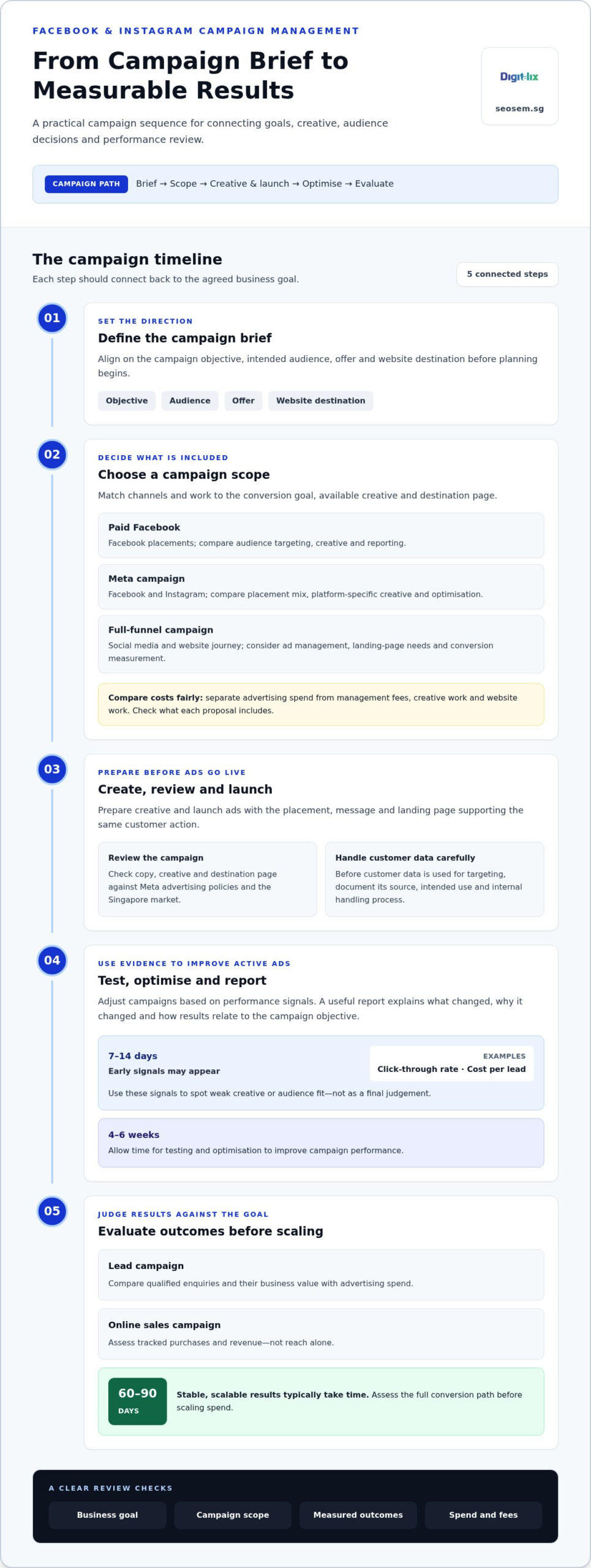
For Facebook and Meta advertising, follow Meta’s advertising policies and ensure ads and claims are appropriate for the Singapore market. Review the copy, creative and destination page before a campaign launches.
For PDPA-conscious campaigns, use customer information only for an explained purpose and manage access carefully. Before using customer data for targeting, document its source, intended use and internal handling process.
The process starts with a brief covering objectives, audience, offer and website destination. The agency then proposes a campaign scope, prepares creative, launches ads and reports performance for review.
Facebook advertising can suit small businesses and startups when the campaign goal, audience and landing page are clearly defined. A focused campaign can test an offer without adding channels that do not support its objective.
Before hiring, review the scope, account access, reporting and cancellation terms, and clarify how unused advertising spend is handled. Ask for an itemised quote that separates media spend from management, creative and website work.
Businesses comparing Singapore-focused search visibility with paid social can also explore SEO services in Singapore as another way to reach prospective customers.
Facebook and Instagram campaign strategy and management
Effective campaign management connects a defined business objective to launch decisions, optimisation and reporting. For Singapore businesses, the plan should also explain how Facebook and Instagram placements support that objective.
Campaign Strategy and Launch
A strategy sets the campaign objective, audience, offer, creative and destination before ads go live. For example, a Singapore service business could direct prospective customers to a focused enquiry page. Optimisation is different: it improves an active campaign using performance signals. Before launch, make sure the placement, message and landing page all support the same customer action.
Campaign Optimisation and Reporting
Optimisation adjusts active campaigns based on evidence, while reporting explains what changed and why. Early signals, including click-through rate and cost per lead, usually appear within 7 to 14 days. Use them to spot weak creative or audience fit, not to make a final judgement. A useful report connects each adjustment to the campaign objective and resulting activity.
Campaign Performance and Return on Investment
Return on investment measures outcomes against the resources used to generate them. For a lead campaign, compare qualified enquiries and their business value with advertising spend. For an online sale, assess tracked purchases and revenue rather than reach alone. Stable, scalable results typically take 60 to 90 days, so evaluate the full conversion path before scaling spend.
Budgets and Campaign Timelines
The required spend depends on the objective, audience, competition and creative rotation. Allow 4-6 weeks for testing and optimisation to improve campaign performance. Early engagement can appear sooner, but a short burst may not reveal whether results can scale reliably.
Placement decisions determine where campaigns appear across Facebook and Instagram. Depending on the audience and creative, a campaign might use Facebook Feed, Instagram Feed, Stories or Reels. Match the asset to the placement: vertical video suits full-screen viewing, while a product carousel can showcase several options. Review results by placement before reallocating budget rather than assuming one format will perform equally well everywhere.
Set reporting around the business outcome, then review delivery, clicks, conversions and lead quality together. A high click-through rate can still underperform if the landing page attracts unqualified enquiries. Compare results by objective, creative and placement, and record changes to give future optimisation decisions context. Visibility matters when it contributes to a measurable customer action.
For a focused campaign plan and ongoing management, discuss your Facebook and Instagram campaign goals.
Custom, lookalike and retargeting audiences
Audience targeting works best when each group reflects a distinct customer signal and campaign goal. In Meta Ads Manager, businesses can build custom audiences, use lookalike modelling or retarget people who have interacted with their content.
A custom audience groups people using a business’s existing customer or engagement data. For example, a Singapore retailer might create separate groups for past purchasers, website visitors and people who watched a product video. Each group has a different relationship with the brand, so the message should suit its stage in the customer journey.
- Existing customers: Share a relevant repeat-purchase offer or introduce a complementary product.
- Website visitors: Remind people about a product or service they viewed, using a suitable next step.
- Social media engagers: Follow up with useful details after someone interacted with a Facebook or Instagram post.
Retargeting uses earlier interactions to reconnect with potential customers. A home services business, for instance, could follow up with people who visited its booking page but didn’t submit an enquiry. Excluding people who have already completed the desired action helps keep the audience relevant and avoids spending on repeat conversions.
Lookalike audiences help campaigns reach new people who share characteristics with a selected source audience. A business could use a customer list or a group of high-quality leads as its starting point. Source quality matters: a list of valuable customers gives the model a more useful signal than a broad list of unqualified enquiries.
Singapore-focused targeting adds location and context to an audience plan. A café promoting a new outlet could focus its advertising on the intended catchment, while an online retailer serving the country may use broader geographic settings. A local agency should connect each audience to the offer, service area and landing page rather than treating Singapore as one uniform market.
Build audiences around the campaign objective, then assess them against actual lead or sales quality. Useful updates include removing people who have converted, refreshing outdated customer segments and separating prospecting from retargeting. If an audience generates clicks but weak enquiries, refine the message or source instead of simply expanding reach.
Keep the structure clear: use custom audiences for known interactions, lookalikes to find similar prospects and retargeting to support follow-up. This gives each campaign a defined role and helps assess which audiences contribute to meaningful outcomes.
Analytics, A/B testing and ROI tracking
Facebook advertising analytics show whether campaign activity leads to valuable business outcomes. Set the measurement plan before launch and connect each ad objective to a trackable action, such as a submitted enquiry or completed purchase.
Start with Meta Ads Manager to review delivery metrics such as impressions, clicks and cost per result. Add website analytics and event tracking to follow visitors beyond the ad. For example, a Singapore retailer can measure product-page visits, add-to-cart actions and completed orders. This separates attention from outcomes and shows where potential customers leave the journey.
Use A/B testing to compare one meaningful variable at a time. Test two headlines while keeping the audience, placement, offer and landing page consistent. Then compare the agreed outcome, such as qualified leads, rather than choosing the version with more reactions. Changing several elements together makes it harder to identify what affected performance.
Tracking should cover the path from ad click to business result. Configure events for important actions and check that they register correctly before assessing performance. A service business could track enquiry form submissions, then match those leads with its sales records. Meta Pixel and website analytics can help connect advertising activity with on-site behaviour.
Calculate return on investment using revenue attributable to the campaign, campaign costs and a consistent reporting period. A simple ROI calculation compares the gain from advertising with the amount invested. For lead generation, consider lead quality and sales outcomes, not just form submissions. A lower cost per lead may still be inefficient if those enquiries rarely become customers.
Attribution affects the conclusion, too. A customer might see an Instagram ad, return later through a branded search and then purchase. Review Meta reporting alongside website and sales data to understand that sequence. Use the same attribution approach when comparing campaigns, so changes in reporting don’t create a false impression of improved ROI.
- Before launch: Define the conversion, tracking event and reporting source.
- During testing: Change one variable and compare results against the same objective.
- At review: Reconcile ad spend, tracked actions and sales quality.
A clear dashboard should show the objective, spend, conversions and resulting business value. Record the dates and changes behind each test, then use those findings to guide the next optimisation. To align measurement with campaign goals, discuss your campaign tracking requirements.
Which Facebook marketing agencies in Singapore have the best reviews and case studies?
There isn’t one best agency for every Singapore business. Look for evidence relevant to your objective, measured clearly and detailed enough to show what the agency actually changed. Reviews can reveal patterns in service, while case studies help you assess campaign strategy and outcomes.
Look for reviews describing specific work, communication and reporting rather than general praise. A review mentioning campaign planning, creative feedback and lead quality offers more context than a star rating alone. Check whether several reviews describe consistent strengths and whether the feedback concerns paid social campaigns or another service.
Case studies should identify the business objective, campaign period, audience approach and measurement method. For example, reported Singapore transportation-sector Facebook campaigns achieved an 8.54% conversion rate over a six-month campaign. A reported Singapore finance-sector campaign achieved a 13.67% conversion rate over a six-month campaign. These figures offer context, not a guaranteed benchmark for a different business.
Other reported outcomes show why the metric must match the goal. A global B2B debt collection agency campaign reportedly increased leads by 233% and reduced cost per click by 58.96%. A SaaS healthcare management software campaign reportedly achieved a 7.2x return on ad spend. Lead growth, click costs and ROAS measure different outcomes, so compare each case with your own objective.
When reviewing evidence, use a consistent framework:
- Relevance: Does the case involve a similar sector, offer or customer journey?
- Measurement: Does it explain the conversion event and reporting period?
- Contribution: Does it describe the agency’s role, such as targeting, creative or optimisation?
- Business value: Does it connect ad results to qualified enquiries, sales or revenue?
A polished case study without a baseline can hide important context. Find out what changed during the campaign, which audience saw the ads and how the result was attributed. A conversion rate’s value depends on lead quality and the business’s ability to turn enquiries into customers. Reviews offer insight into collaboration; case studies show how the work performed.
For an informed comparison, prioritise providers whose evidence reflects your business model and explains both the result and the method. Treat a high rating as one signal, not proof of campaign performance, and compare like-for-like outcomes before deciding.
Digitalix: Search Engine Optimization (SEO)
Digitalix helps businesses build visibility beyond paid social with Search Engine Optimization (SEO), supporting discovery when people search online for relevant services. Consider SEO when Facebook campaigns generate awareness and your business also wants to reach people actively researching a solution. SEO can complement Facebook Marketing or Search Engine Marketing (SEM), with each channel supporting a different point in the customer journey.
Choose a mix that fits your growth priorities and digital presence. Digitalix can help you consider how SEO fits alongside your Facebook campaign strategy.
Turn campaign insights into your next growth move
Choosing a Facebook marketing company in Singapore is a practical step towards a more deliberate growth plan. Decide what you want customers to do next, then align campaign priorities with that outcome. A clear direction makes it easier to compare options and keep your marketing focused.
Digitalix can help you plan a Facebook advertising approach around your business goals and customer journey.
Take the next step when you’re ready to move your plans forward.
Frequently Asked Questions
What does a Facebook ads agency actually do?
A Facebook ads agency coordinates paid campaigns around a business’s marketing objective. Beyond managing the platform, it can organise approvals, align campaign messaging with a promotion and document account changes. For example, before a seasonal sale, the business and agency can agree on the offer, key product details and approval process. Clear roles help prevent outdated claims or unapproved promotions from going live.
How soon will I see results from Facebook ads?
Timing depends on the buying cycle, offer readiness and how quickly interested prospects make decisions. A low-consideration purchase may generate feedback sooner than a service requiring a consultation or internal approval. Before launch, agree on what counts as a meaningful result and how sales follow-up will be recorded. This helps you assess progress fairly without treating every early response as a completed sale.
Do I keep ownership of my Facebook ad account?
Your business should own its Facebook ad account and grant the agency the access it needs. Keep the business email and account ownership under your control, and document who can edit campaigns or manage billing. This matters if staff roles change or your working arrangement ends. Retaining ownership keeps the account’s history and settings attached to your business.
Do you create the ad creative for me?
Creative production depends on the agreed scope, so establish responsibilities before work begins. Your team can provide product details, brand guidelines, approved images and offer conditions; the agency can develop campaign assets when creative work is included. For a new service launch, agree on the key message and destination page before approving formats. A clear review process helps keep every asset accurate and consistent with your brand.
What Facebook marketing services do agencies in Singapore offer?
Services vary by agency and project, but may include campaign planning, paid social execution, creative support, account reviews or coordination with a business website. A Facebook marketing company in Singapore may also manage Instagram activity when it supports the campaign. Clarify whether the engagement covers strategy only or ongoing execution, and define deliverables, approval responsibilities and reporting in the agreed scope.
How much do Facebook marketing companies in Singapore charge?
There isn’t one standard charge across Singapore agencies. Cost depends on the scope and the work included. Factors include the breadth of work, creative requirements, platforms and reporting needs. Ask for a written scope that makes deliverables and billing clear, so you can compare equivalent work rather than relying on a headline figure.
What results and KPIs should a Singapore business expect from Facebook advertising?
Choose KPIs that reflect how your business earns and serves customers. A consultancy might track attended appointments and sales-qualified opportunities; an online retailer could examine repeat purchases or revenue per customer. Agree on definitions with the sales team before launch, especially for a “qualified” lead. This keeps reviews tied to commercial value and shows whether campaign activity supports the customer relationship beyond the first response.
What Facebook and Meta advertising rules apply to businesses in Singapore?
Follow Meta’s advertising policies and ensure ads and claims are appropriate for the Singapore market. Review campaign copy, creative and destination pages before launch. For customer-data targeting, document the data’s source, intended use and internal handling process.