A beautiful website that ranks on page five of Google isn’t an asset; it’s an expensive digital paperweight. Many business owners in the Lion City struggle with high-cost redesigns that yield no measurable ROI because they prioritise visual flair over technical performance. You’ve likely realised that in the competitive landscape of web design singapore, a site must do more than just look professional. It needs to function as a high-performance engine that converts visitors and adheres to local regulations like the PDPA and Smart Nation 2.0 initiatives.
This 2026 comparison guide provides the data-driven framework you need to build a site that outranks your competitors. We’ll compare the top agency models, evaluate no-code platforms against custom builds, and demystify the integration of local payment gateways and IMDA-supported digitalisation programmes. You’ll learn how to transition from a static page to a scalable salesperson that integrates seamlessly with your SEO and SEM strategies. We’ve mapped out the technical requirements and platform trade-offs to ensure your next digital investment delivers a calculated, long-term return.
Key Takeaways
- Shift your focus from visual aesthetics to lead generation by building a performance-driven site that acts as your top-performing salesperson.
- Navigate the trade-offs between SaaS platforms and custom builds to select a web design singapore solution that scales with your business growth.
- Learn why SEO-native architecture and PDPA compliance are non-negotiable requirements for any professional Singaporean website in 2026.
- Evaluate the strategic advantage of full-service agencies over freelancers to ensure your design, SEO, and SEM strategies are perfectly synchronised.
- Discover how to leverage IMDA-supported digitalisation initiatives to offset costs while building a high-converting digital presence.
The Evolution of Web Design in Singapore: Beyond Aesthetics to ROI
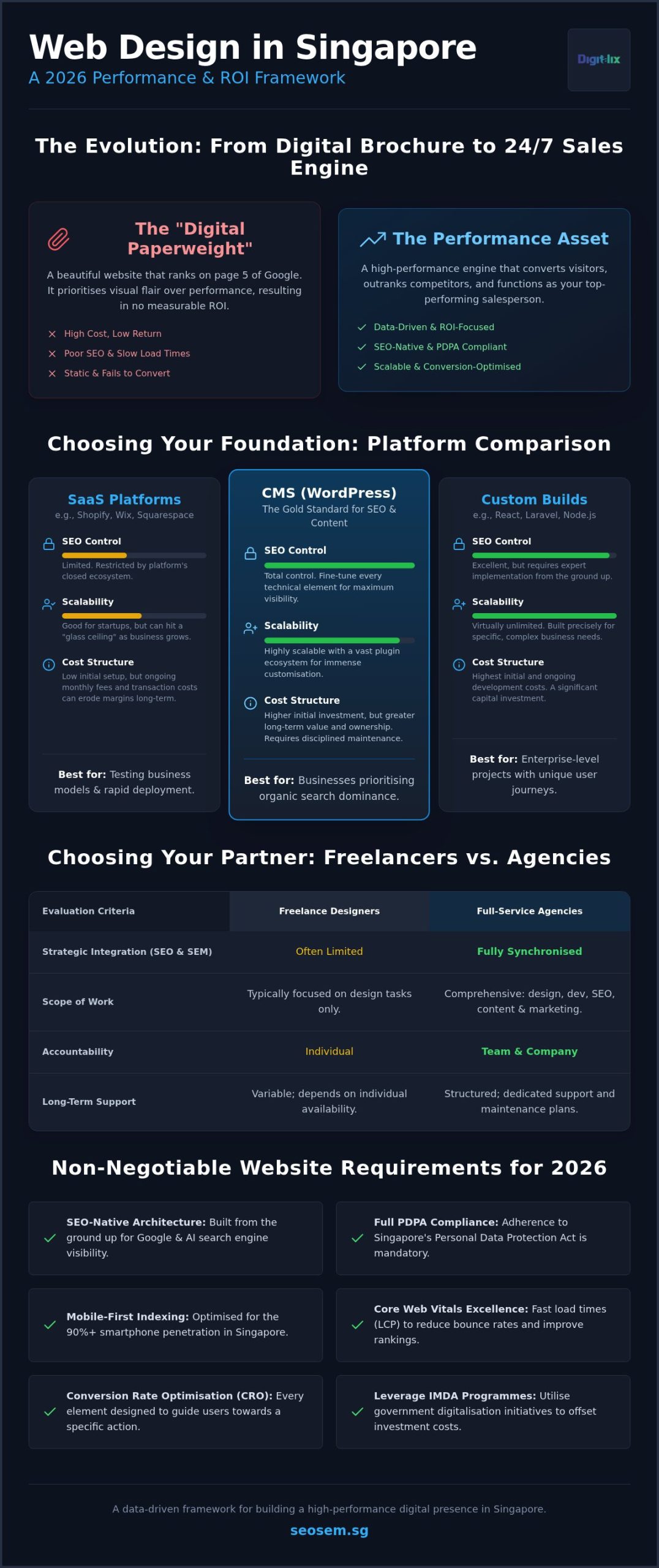
Web design in Singapore has moved past the era of digital brochures. In 2026, a high-performance website is defined by its ability to serve as a 24/7 salesperson that outranks competitors and converts cold traffic into loyal clients. While many SMEs still invest heavily in “pretty” websites, these often fail because they lack the technical infrastructure to rank on Google or satisfy AI-powered search engines. A site that looks stunning but takes four seconds to load is a liability in a market where 96% of the population is hyper-connected and expects instant results.
Why 2026 Demands a Performance-First Mindset
Modern site architecture must align with global web design principles while catering to the specific demands of the Singaporean digital economy. With smartphone penetration exceeding 90%, mobile-first indexing is no longer a suggestion; it’s the baseline for survival. Google’s Core Web Vitals now dictate visibility. If your site doesn’t pass the Largest Contentful Paint (LCP) test, you’re invisible to your target audience in Jurong, Tampines, or the CBD. We’ve transitioned into the age of Generative Engine Optimisation (GEO). Your site’s code must be structured so that AI models can easily parse and cite your data in conversational search results.
User intent in Singapore varies significantly by district and industry. A B2B user in the Jurong industrial estate searching for logistics solutions has different expectations than a retail shopper in Orchard Road. Your web design singapore strategy must reflect these nuances, guiding users through a logical funnel that addresses their specific pain points. At Digitalix, we ensure your site is built as an interactive lead-generation hub rather than a static page, integrating these technical requirements from the initial wireframe stage.
Key Takeaways for Singaporean Business Leaders
Success in the Smart Nation 2.0 era depends on a “trinity” of technical excellence:
- Speed: Instant load times to reduce bounce rates and improve user experience.
- SEO-readiness: Technical structures that support integrated SEO services in Singapore.
- Security: Full compliance with PDPA and MAS-level data protection standards.
Digitalisation isn’t just about moving online; it’s about strategic dominance. Every element of your site, from the navigation menu to the call-to-action buttons, must focus on Conversion Rate Optimisation (CRO). Don’t settle for a website that just sits there. Build a performance framework that justifies every dollar of your investment and scales with your business goals. By synchronising your web design singapore with a data-driven methodology, you turn a creative project into a measurable business asset.
Comparing Development Platforms: SaaS vs. CMS vs. Custom Builds
Choosing the right technical foundation for your web design singapore project is a strategic decision that dictates your long-term scalability and ROI. Startups often gravitate toward SaaS platforms like Shopify or Wix because they offer rapid deployment and low initial complexity. These platforms are excellent for testing a business model, but they often hit a “glass ceiling” when you require advanced technical optimisations or unique user journeys. As your traffic grows, the monthly subscription costs and transaction fees can begin to erode your margins, making a transition to a more flexible architecture necessary.
WordPress: The Powerhouse for SEO and Content
WordPress remains the gold standard for businesses that prioritise organic search dominance. Its open-source nature provides total control over the site’s code, which is why professional SEO services in Singapore typically prefer it. You can fine-tune every technical element, from schema markup to core web vitals, without being restricted by a closed ecosystem. The vast plugin ecosystem allows for immense customisation, but it requires a disciplined maintenance programme. Neglecting updates can lead to security vulnerabilities or speed degradation, so a structured approach to technical management is essential for sustained performance.
eCommerce Specialists: Shopify vs. WooCommerce
For local merchants, the platform choice often hinges on how well it integrates with the broader Singaporean digital ecosystem. If you’re leveraging e-commerce marketing services to sync your inventory with Shopee or Lazada, both platforms offer robust connectors. Shopify excels in ease of use and security, though it lacks the deep SEO customisation of WooCommerce. When evaluating these options, consider the integration of local payment gateways like PayNow and HitPay. While Shopify simplifies the setup, WooCommerce often provides a lower total cost of ownership for high-volume sellers who want to avoid per-transaction platform fees. Many local SMEs utilise the SMEs Go Digital programme to fund these technical integrations, ensuring their infrastructure is future-proof.
Fully custom-coded builds are generally reserved for large-scale enterprises with complex database requirements or specific security protocols that off-the-shelf solutions can’t meet. Regardless of the stack you choose, ensure you retain full ownership of the IP and source code. A significant red flag in the local market is the “hostage” model, where an agency builds your site on a proprietary system that you can’t move or modify. This lack of transparency limits your agility and creates a single point of failure for your digital presence. If you want to ensure your platform choice aligns with your 2026 revenue goals, you can speak with our technical consultants to review your current architecture.
Freelance Designers vs. Full-Service Agencies: A Strategic Comparison
Deciding who will build your digital presence is a pivotal choice that impacts your business for years. In the competitive landscape of web design singapore, the market is split between solo freelancers and full-service agencies. While the initial price tag of a freelancer might seem attractive for a budget-conscious SME, the long-term cost of a fragmented strategy often outweighs those early savings. A website isn’t just a collection of images; it’s a technical asset that must align with your broader marketing goals from the first line of code.
The Freelancer Model: Pros, Cons, and Risks
Hiring a solo designer offers high flexibility and lower upfront costs. This model works well for specific, small-scale tasks like creating a single landing page. However, the risk of siloed work is significant. A freelancer may excel at aesthetics but lack the deep technical expertise required for high-level SEO or complex database management. This often leads to aesthetic-only builds that look great but fail to appear on the SERPs. Managing multiple individual contractors for copywriting, development, and design also places a heavy administrative burden on business owners, often leading to inconsistent results and communication gaps.
Cheap web design frequently carries hidden costs in the form of technical debt. If a site isn’t built with a clean, scalable architecture, you’ll eventually face expensive redesigns to fix poor load speeds or security vulnerabilities. Within Singapore’s digitalisation support framework, the emphasis is increasingly on building robust, future-proof systems rather than temporary fixes. When evaluating a freelancer’s portfolio, don’t just look at screenshots. Click through to live sites and test their performance on mobile devices to see if they truly deliver on their promises.
The Full-Service Advantage: Integrated Digitalix Methodology
A full-service agency provides a cohesive digital ecosystem where every element is designed to drive revenue. At Digitalix, our team ensures that your site’s architecture directly supports your SEM strategy. This means landing pages are optimised for high quality scores in Google Ads, reducing your cost-per-click and maximising your budget. You gain a single point of accountability for your entire digital presence, from hosting and security to content creation and lead tracking.
Scalability is the primary benefit of the agency model. A site built by an agency is designed to grow with your business, whether you’re moving from a simple corporate portal to a complex e-commerce platform integrated with Shopee and Lazada. We focus on a data-driven methodology, ensuring your web design singapore investment serves as a measurable growth engine. By choosing an integrated approach, you avoid the pitfalls of technical debt and ensure your brand remains competitive in the evolving 2026 digital landscape.
Critical Selection Criteria: SEO-Ready Infrastructure and Local Compliance
A successful web design singapore project is built on a foundation of technical excellence and regulatory adherence. In 2026, you cannot afford to treat search visibility or data security as finishing touches. These elements must be integrated into the initial wireframe to ensure your site functions as a secure, high-performance business tool. Neglecting the technical infrastructure during the planning phase leads to “technical debt,” forcing expensive corrections later to meet modern performance standards.
SEO-Native Web Design: A Non-Negotiable in 2026
Search engines and AI-powered discovery tools prioritise sites with a logical, clean architecture. Your site’s URL structure, schema markup, and internal linking hierarchy must be mapped out before a single visual element is designed. This “SEO-native” approach ensures that every page is indexed correctly and cited by generative engines. Beyond basic indexing, your design choices directly influence user behaviour metrics. Intuitive navigation and fast-loading layouts reduce your bounce rate and increase “Time on Page,” which are critical signals for long-term ranking stability. If you’re unsure how your design aligns with current search algorithms, consult our SEO Agency Singapore Guide for a deeper dive into growth-focused partnerships.
Navigating the Singaporean Digital Landscape
Compliance with local regulations is a prerequisite for operating in the Singaporean market. By the end of 2026, the PDPA requires that NRIC numbers no longer be used for website authentication. Additionally, your company’s Data Protection Officer (DPO) contact information must be publicly listed on your site. Security isn’t just about legal compliance; it’s a vital “trust signal” for SMEs and CBD-based corporate clients. Your infrastructure must also support the mandatory three-day data breach notification window required by the PDPC. Adhering to these standards protects your brand reputation and ensures you remain eligible for government subsidies.
Building a site that meets these rigorous standards requires investment, but local businesses can leverage the Enterprise Development Grant (EDG), which covers up to 50% of costs for qualifying digitalisation projects. To maximise these benefits, your web design singapore partner must understand current IMDA TS CMT specifications and cybersecurity requirements. Speed is the final pillar of this infrastructure. Utilising local Singaporean servers or high-quality Content Delivery Networks (CDNs) ensures your site loads instantly for local users, satisfying both human visitors and the Core Web Vitals requirements that dictate search visibility.
Building Your Digital Legacy: The Digitalix Framework for High-Performance Design
Most agencies treat web design as an art project. At Digitalix, we view web design singapore as a rigorous performance framework. Our methodology begins with a deep discovery phase where we audit your competitors and identify search gaps. We don’t just build pages; we engineer conversion paths. By turning technical audits into visual excellence, we ensure your site outranks the competition while maintaining a premium brand identity. This data-driven process moves from discovery to deployment with a focus on strategic dominance, ensuring every pixel serves a business purpose.
A high-performance website must act as the destination for all your traffic sources. We synchronise our builds with your Social Media Marketing efforts to ensure a frictionless user journey. Whether a lead arrives from a LinkedIn post or a Facebook lead form, the landing experience is optimised for immediate action. This integrated approach prevents the “leaky bucket” syndrome where expensive social traffic bounces due to poor mobile design or slow load times. We prioritise high-converting layouts that turn social engagement into measurable revenue.
Our Strategic Approach to Web Design in Paya Lebar and Beyond
Headquartered at Paya Lebar Square, we understand the unique challenges faced by local SMEs. We use a “science-first” narrative to dictate every UI/UX decision. Data, not personal preference, determines where your primary call-to-action sits. This commitment to transparency means you always know the “why” behind our design choices. We don’t guess; we validate. Remember that a website is never truly “finished.” It’s a living asset that requires continuous optimisation to stay ahead of algorithm shifts and changing consumer behaviours in the Smart Nation 2.0 era.
Next Steps: Launching Your 2026 Digital Strategy
Success starts with preparation. Before beginning your web design singapore project, gather your brand assets, high-resolution imagery, and existing customer data. Set SMART goals that align with your bottom line. Are you aiming for a 20% increase in lead volume or a 15% reduction in bounce rate? Clear objectives allow us to measure the ROI of your build with mathematical certainty. We help you define these benchmarks during our initial strategy sessions to ensure the final product exceeds your expectations.
Ready to grow your leads? Let’s build your digital presence together.
Dominate the 2026 Digital Market with Strategic Design
We’ve explored how high-performance web design singapore has evolved into a technical science. Success in today’s landscape requires more than a visual upgrade; it demands an SEO-native architecture that satisfies both human users and AI discovery engines. Your choice of platform and agency partnership will dictate your ability to scale within the Smart Nation 2.0 framework. Don’t let technical debt or poor compliance hinder your growth.
Digitalix provides a data-driven UI/UX methodology that prioritises your ROI through rigorous testing and local expertise. Our team at Paya Lebar Square ensures your site is fully integrated with SEO and SEM strategies for immediate market impact. We demystify the technical complexities so you can focus on your bottom line. It’s time to transition from a static digital presence to a high-converting sales engine that works as hard as you do.
Let’s build your digital presence together and secure your competitive edge for the years ahead. We’re ready to help you outrank the competition and maximise your digital investment.
Frequently Asked Questions
How much does professional web design cost in Singapore for 2026?
Professional costs depend entirely on the technical complexity, number of custom templates, and the specific business objectives of your project. Factors such as e-commerce functionality, third-party API integrations, and advanced SEO-native architecture influence the final investment. While basic sites focus on visibility, high-performance frameworks are engineered for measurable ROI and long-term scalability in the local market.
What is the difference between a web designer and a web developer?
A web designer focuses on the visual aesthetics, user interface (UI), and user experience (UX) to ensure your brand’s identity is effectively communicated. A web developer builds the technical infrastructure, writing the code that makes the site functional and secure. For a high-performance web design singapore project, you need an integrated team that handles both disciplines to ensure the site looks good and performs technically.
Can I apply for government grants like the PSG for my web design project?
Qualifying Singaporean SMEs can leverage various digitalisation subsidies to offset their development costs. The Enterprise Development Grant (EDG) and the Productivity Solutions Grant (PSG) remain the primary vehicles for funding projects that focus on innovation or productivity. You should verify your latest eligibility through the Business Grants Portal or consult an IMDA-approved partner to navigate the specific 2026 requirements.
How long does it typically take to build a corporate website in Singapore?
A standard corporate build usually takes between 8 to 12 weeks from the initial discovery phase to the final launch. This timeline accounts for strategic wireframing, content creation, technical development, and rigorous user acceptance testing (UAT). More complex projects involving custom web applications or extensive e-commerce integrations may require additional time to ensure full compliance with local security standards.
Will my new website be mobile-responsive and SEO-friendly by default?
Every professional website must be mobile-responsive and SEO-friendly by default to survive the 2026 search landscape. This includes meeting Google’s Core Web Vitals and ensuring the site’s code is structured for Generative Engine Optimisation (GEO). If a site isn’t built with these technical foundations from day one, it’ll struggle to rank or provide a seamless experience for Singapore’s mobile-first population.
Do I own the source code and domain after the website is completed?
You should retain 100% ownership of your website’s source code, domain name, and hosting credentials upon project completion. At Digitalix, we ensure all intellectual property is transferred to the client to avoid the “hostage” model common with proprietary systems. This transparency allows you to migrate or scale your site independently as your business grows without being tied to a single provider.
How often should I update my website design to stay competitive?
A major design refresh is typically recommended every 2 to 3 years to keep up with evolving UI/UX trends and browser technologies. However, technical optimisations and security patches should be continuous. Frequent updates to your content and performance tuning are necessary to maintain your competitive edge and adapt to shifts in Singaporean consumer behaviour and search engine algorithms.
Does Digitalix provide ongoing maintenance and security updates?
We provide comprehensive technical support, security updates, and performance monitoring as part of our post-launch management services. This includes ensuring your site remains compliant with the latest PDPA regulations and MAS-level data protection standards. Continuous maintenance is essential for protecting your digital asset and ensuring it remains a high-performance web design singapore solution that drives leads 24/7.