| TL;DR: SEO is the work of making your website easy to find, easy to use and easy to trust, so that Google shows it to people already searching for what you sell. It runs on five parts: technical health, keywords, content, trust signals and off-site authority. Treat it as an operations job rather than a coding job and the whole thing becomes obvious. |
Most business owners in Singapore have been sold SEO as a technical mystery. Someone shows you a dashboard, says a few words about crawl budget and canonical tags, and quotes you a monthly retainer. You nod. You have no idea what you just agreed to.
Here is a more useful way in. Imagine you have opened a restaurant in a part of town where nobody knows your name yet. Google is the review app everyone checks before they decide where to eat. Everything you would naturally do to fill that restaurant has a direct equivalent on your website. That is all SEO is.
What is SEO, in one sentence?
SEO, or search engine optimisation, is the practice of shaping your website and its reputation so that search engines rank it highly for the terms your customers actually type. Rankings are the output. The input is a set of business decisions about speed, clarity, proof and reputation.
Why does the restaurant comparison work so well?
Because Google is trying to answer the same question a hungry person asks: of everything nearby, which of these is worth my time? Google cannot taste your food. It reads signals instead. How fast the door opens, how clearly the menu is written, whether anyone credible has vouched for you. Those signals map almost one to one onto ranking factors.
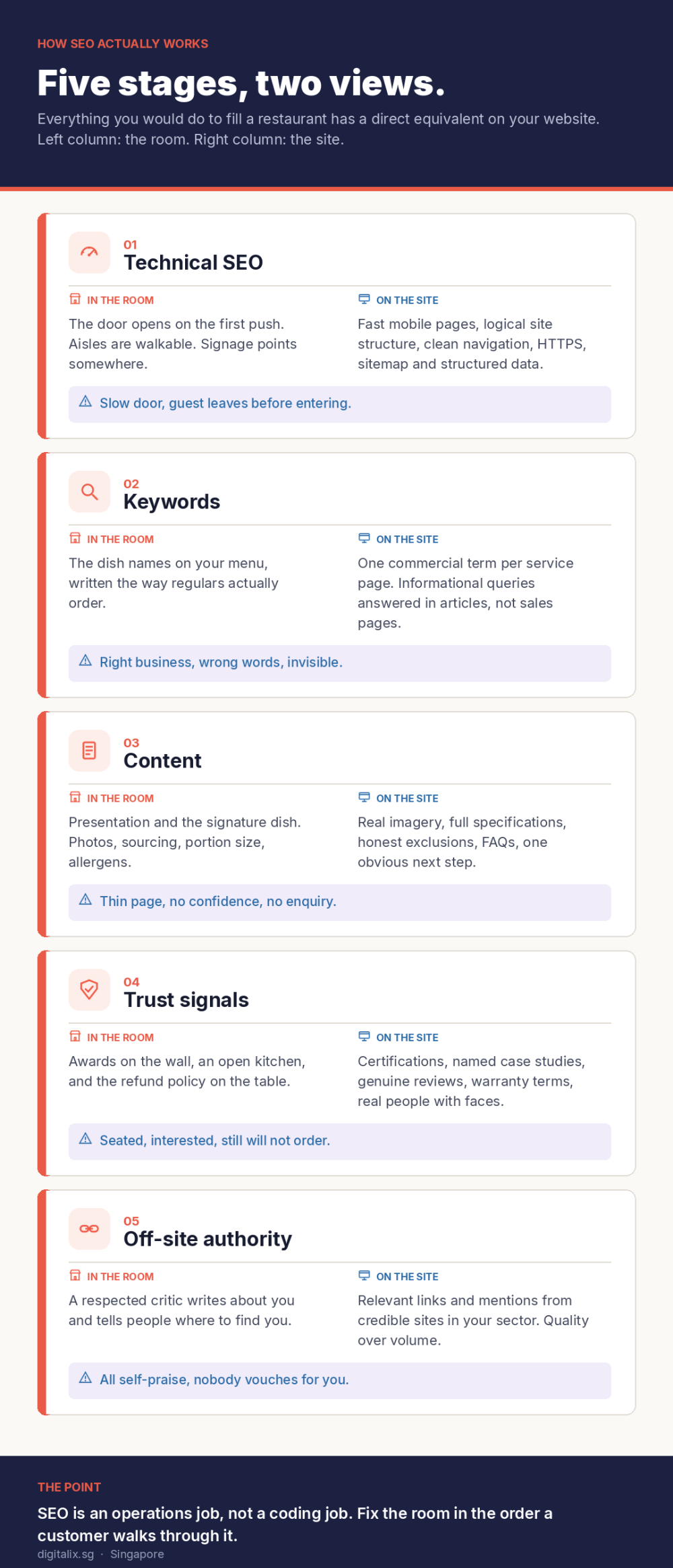
Five things decide whether a diner walks past or sits down. The same five decide whether you rank.
What is technical SEO, and why does site speed matter?
Technical SEO is your building. The front door has to open on the first push, the aisles have to be walkable, and the signage has to point somewhere.
On a website that means:
- Load speed. Pages that appear quickly, especially on mobile.
- Site architecture. A logical hierarchy where every important page is reachable in two or three clicks.
- Clean layout and navigation. A visitor should know where they are and what to do next.
- Mobile and security basics. Responsive design and HTTPS as a baseline, not an upgrade.
- Crawl hygiene. A working robots.txt file, a submitted XML sitemap, and structured data so Google can read your pages properly.
The speed part is not cosmetic. In the Google and Deloitte study Milliseconds Make Millions, which analysed roughly 30 million user sessions across 37 brand websites, a 0.1 second improvement in mobile site speed was associated with retail conversions rising 8.4 percent and average order value rising 9.2 percent. Lead generation pages saw bounce rates fall 8.3 percent. A tenth of a second is shorter than a blink, and it moved revenue.
Get this stage wrong and nothing else matters. A visitor who waits four seconds for your homepage has already tapped back to the results page and opened your competitor.
How do keywords actually work?
Keywords are the dish names on your menu. If your regulars ask for kaya toast and your menu says “artisanal coconut jam flatbread”, you will lose orders you should have won.
The job has two halves.
Commercial terms. These are the phrases people use when they are ready to buy. Someone in Singapore searching “commercial aircon servicing” is not researching a hobby. That phrase belongs in your page title, your H1 and your body copy, on the page that actually sells that service.
Informational terms. Someone searching “how often should aircon be serviced” is earlier in the journey. You do not force them onto a sales page. You write a genuinely helpful article, answer the question, and earn the right to be remembered when they are ready.
Both live in your on-page fundamentals: title tag, meta description and heading structure. Keyword research is simply finding out what your market says out loud, then using their words instead of yours.
What makes content good enough to rank?
Content SEO is presentation and the signature dish. Nobody orders from a blank sheet of paper with a price scrawled on it.
A page that converts and ranks usually carries:
- Real photography and video of the actual product, service or team
- A description written for a buyer, not a brochure, covering specifications, materials, dimensions or scope
- The awkward details spelled out: lead times, what is not included, who the product is not for
- A clear next step, whether that is an enquiry form, a WhatsApp button or a quote request
Thin content is the digital version of a menu with no photos and no prices. The visitor cannot picture the outcome, loses confidence, and leaves. Google measures that behaviour.
Why do trust signals decide whether you get the enquiry?
This is the stage most Singapore SME websites skip. The visitor has arrived, they like what they see, and they still do not fill in the form. They are sitting at the table refusing to order.
The fix is proof, placed where it is actually seen rather than buried on an “About” page:
- Certifications, licences and accreditations relevant to your trade
- Named client work and case studies with real outcomes
- Genuine reviews, with the source visible
- Warranty terms, returns policy and after-sales commitments stated plainly
- Real people: names, faces and credentials of whoever does the work
Trust comes first. Revenue comes second. In that order, never the reverse.
How do backlinks build authority?
Backlinks are your reputation around town. You can call yourself the best in Singapore on your own homepage all day, and it counts for nothing, because Google discounts what you say about yourself.
What counts is a credible, topically relevant third party writing about you and linking back. A trade association directory. An industry publication. A supplier’s partner page. A local news feature. Each relevant link is another respected voice saying you are real.
Volume is not the point. One link from a genuinely authoritative site in your sector will outperform fifty from directories nobody reads.
What should a Singapore SME fix first?
Work in the order the customer experiences you.
- Fix speed and mobile usability. Cheapest wins, immediate effect.
- Map keywords to pages. One primary commercial term per service page, no overlap.
- Rebuild your thinnest revenue page. Photos, specifications, FAQ, clear call to action.
- Surface your proof. Move credentials and reviews above the fold.
- Earn three relevant links. Associations, suppliers and industry media before anything else.
“The businesses that win in search are rarely the ones with the cleverest technical setup. They are the ones that made a decision about who they serve and then made that decision obvious on every page. Google is just the first customer reading it.” Digitalix
Frequently asked questions
Is SEO still worth it in Singapore in 2026?
Yes, though the goal has widened. You are now optimising for classic blue links, for Google’s AI summaries and for answer engines such as ChatGPT and Perplexity. The underlying requirements are the same: fast pages, clear answers, verifiable proof.
How long does SEO take to show results?
For a new or neglected site, expect three to six months before meaningful movement in competitive Singapore categories, and longer for high-value commercial terms. Technical fixes can show up faster.
Do I need to blog to rank?
Not always. If you sell three services in one city, well-built service pages may be enough. Blogging becomes valuable when your buyers research before they purchase, because that is where informational queries live.
What is the difference between SEO and paid search?
Paid search buys placement for as long as you fund it. SEO builds an asset that keeps returning traffic after the work stops. Most Singapore SMEs need both, with paid covering the gap while SEO compounds.
How do I know if my current agency is doing real work?
Ask for the specific pages changed, the keywords each page targets, and the links earned this quarter. Vague reporting about “optimisation activity” is a warning sign.
| Author
Written by the Digitalix team. Digitalix is a Singapore digital marketing agency delivering SEO, SEM, paid social and e-commerce operations for businesses across Singapore and the region. Last updated: 7 September 2026 Sources cited: Google and Deloitte, Milliseconds Make Millions (2020), analysing approximately 30 million user sessions across 37 brand websites. |