More channels don’t guarantee more customers. For Singapore businesses, digital marketing agency solutions work best when SEO, paid media, social media and content support the same growth goals, rather than competing for budget and attention. It can be difficult to know which services to prioritise, especially when clicks and engagement don’t clearly translate into leads or sales.
This guide explains how to assess each core channel and choose a practical mix for your business’s current stage. You’ll see how search builds visibility, paid campaigns capture demand, social media supports discovery and content helps move potential customers towards a decision. You’ll also learn how to connect channel activity to meaningful performance measures, so decisions are grounded in business outcomes rather than surface-level metrics.
Key Takeaways
- Connected digital marketing agency solutions align channel activity with business goals instead of treating every campaign as a separate task.
- SEO, paid search, social media and content play different roles in the customer journey. Choose channels based on audience intent and growth priorities.
- Build your marketing mix by setting a priority, defining your audience, selecting relevant channels and deciding how to measure progress.
- Look beyond clicks and engagement to assess outcomes such as qualified enquiries or completed sales.
- A coordinated approach can help Singapore businesses plan, execute and optimise digital marketing across the channels that fit their needs.
What digital marketing agency solutions can do for a Singapore business
Digital marketing agency solutions coordinate strategy, channel selection, execution and measurement around a business goal. Rather than commissioning separate tasks with no shared direction, a business connects each activity to a role in the customer journey. This gives an SME a clearer way to assess how marketing supports discovery, consideration, conversion and retention.
Digital marketing covers multiple online channels and approaches. For a useful overview of the discipline, see What is Digital Marketing? The practical question isn’t how many services a business can use. It’s which combination addresses its audience’s needs and provides useful information for making better decisions.
What makes a digital marketing solution different from a service list?
A service list names activities; a solution connects them. It starts with an objective and audience, assigns a clear role to each selected channel, then measures whether those activities support the intended outcome.
For example, SEO can help a business appear when potential customers research relevant services, while a focused landing page gives those visitors a clear next step. Social content can introduce an offering or build familiarity, and paid search can reach people actively looking for it. Each channel should contribute to the journey rather than operate as an isolated campaign.
An integrated digital marketing solution is a coordinated plan that connects business objectives, audience needs, channel activity and performance measurement. For Singapore-focused search visibility, a business might combine useful content and SEO with a relevant landing page. Digitalix provides SEO services in Singapore as part of that broader approach.
Which business goals can digital marketing support?
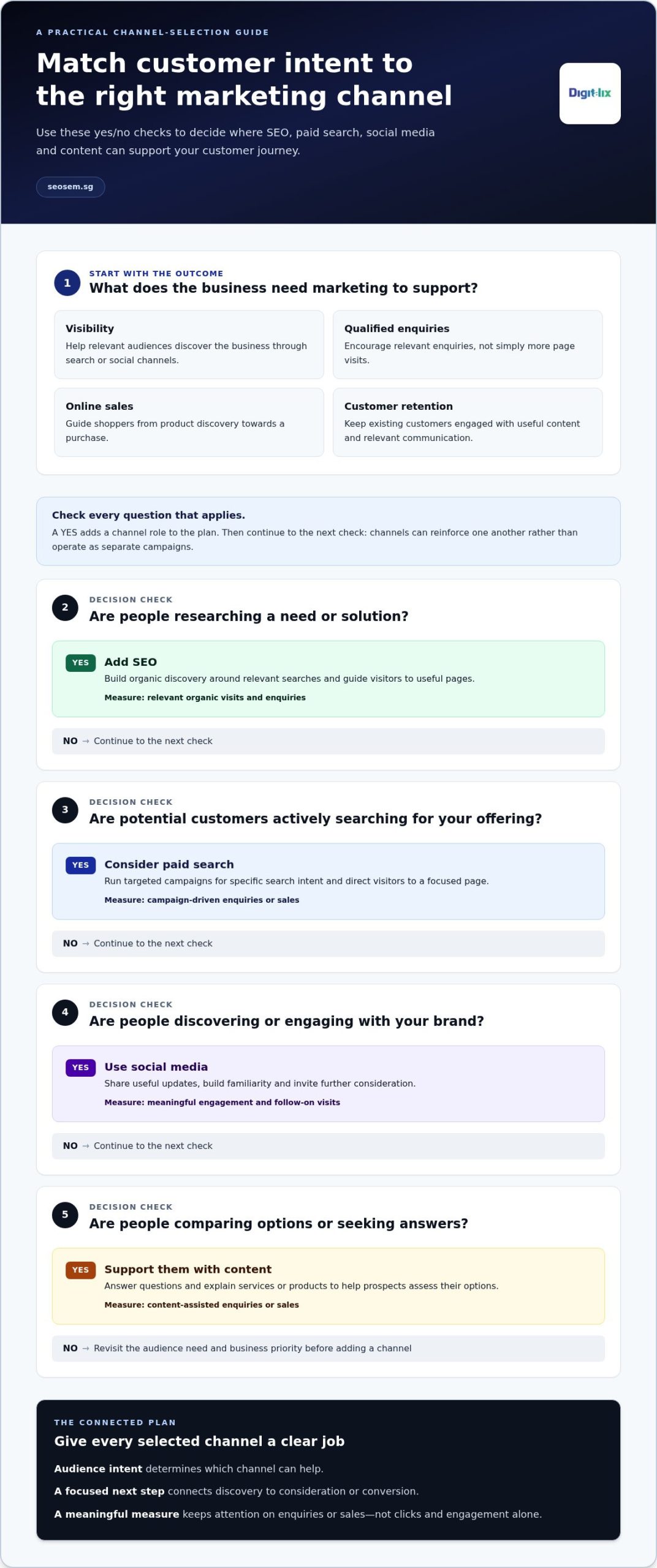
Choose channels according to the outcome you need and how your audience makes decisions. A local service business may prioritise enquiries, while an e-commerce seller may focus on completed purchases through its website or marketplaces such as Shopee and Lazada. Common goals include:
- Visibility: Help relevant audiences discover the business through search or social channels.
- Qualified enquiries: Encourage potential customers to make a relevant enquiry, not simply visit a page.
- Online sales: Guide shoppers from product discovery towards purchase.
- Customer retention: Keep existing customers engaged with useful content and relevant communication.
These priorities can change as a business grows. As Singapore businesses continue to digitalise, it’s useful to review how customers discover, compare and buy, then build a marketing mix around those behaviours. The right plan isn’t the one with the most channels. It’s the one that gives each channel a defined purpose and a way to assess its contribution.
How SEO, paid search, social media, and content work together
Each channel contributes differently to discovery and conversion. SEO builds organic visibility through relevant pages and ongoing website optimisation. Paid search uses advertising to reach people making active searches. Social media can introduce a business to audiences and sustain engagement, while useful content helps answer questions and build consideration. Strong digital marketing agency solutions connect these roles instead of treating each channel as a separate campaign.
When should a business prioritise SEO or paid search?
Prioritise SEO when you want to strengthen organic visibility around relevant searches and improve the website experience over time. Consider paid search when you want to run targeted campaigns for specific search intent. These approaches differ in execution, but both can support search visibility and direct relevant visitors to a useful next step.
Google Ads is one paid-search option. SEM covers paid search planning and campaign management, while SEO focuses on organic performance. Digitalix’s SEM services can be part of a coordinated search plan alongside its SEO work. The right balance depends on your business objective, audience behaviour and website readiness. Not every business needs to use both.
How do social media and content support the customer journey?
Facebook and Instagram marketing can help a business share useful updates, engage its audience and bring people back to relevant information. Content creation gives those interactions substance: a clear service explanation, product information or answer to a common question can help a prospect assess their options before enquiring or buying. For a Singapore-specific perspective on applying digital marketing in an SME context, see Digital Marketing Strategies for Singaporean SMEs.
| Channel | Typical audience intent | Role in the journey | Useful measure |
|---|---|---|---|
| SEO | Researching a need or solution | Build organic discovery and guide visitors to relevant pages | Relevant organic visits and enquiries |
| Paid search | Actively searching for an offering | Reach selected search audiences and direct them to a focused page | Campaign-driven enquiries or sales |
| Social media | Discovering or engaging with a brand | Build familiarity and invite further consideration | Meaningful engagement and follow-on visits |
| Content | Comparing options or seeking answers | Address questions and support a conversion decision | Content-assisted enquiries or sales |
These channels work best when they reinforce one another. A social post can direct an interested person to a detailed page; SEO can help that page reach people researching the same need; paid search can support a targeted campaign. Match each activity to its purpose, then assess it against that role rather than comparing every channel by clicks alone. Businesses planning a connected mix can find Digitalix’s contact details at Digitalix’s contact page.
How to choose a digital marketing mix that fits your business
The right mix starts with a business priority, not a long list of channels. For Singapore SMEs, digital marketing agency solutions should reflect customer needs, available resources and the digital assets already in place. Use this framework to turn a broad growth ambition into a practical plan:
- 1. Set one priority. Choose a clear outcome, such as improving visibility, generating qualified enquiries, increasing online sales or encouraging repeat business.
- 2. Define the audience. Identify who you want to reach, what they need and how they look for, assess or purchase relevant products and services.
- 3. Select channels. Choose activities that support the priority and that your team can manage consistently. A focused plan is often more practical than spreading resources across channels without a clear purpose.
- 4. Establish measurement. Set a baseline and decide what evidence will show progress. Track meaningful business actions alongside channel activity, then use the findings to guide future decisions.
How should Singapore SMEs prioritise digital marketing services?
Review your objectives, customer intent, available resources and existing digital assets together. For instance, if potential customers reach your website but don’t take the next step, examine the page’s information, usability and enquiry path before investing in more traffic-generating activity.
Prioritise work your team can support and measure, then expand when a new need becomes clear. This keeps digitalisation tied to business goals rather than channel trends. For businesses regulated by the Monetary Authority of Singapore (MAS), include an appropriate compliance review in campaign planning and follow the organisation’s established review processes.
When do web design and e-commerce marketing belong in the mix?
Web design and landing pages are relevant when visitors need a clearer route to enquire, learn more or purchase. Review whether the page communicates the offer and next step effectively. Marketplace marketing may also suit businesses with sales objectives on platforms such as Shopee or Lazada. Carousell can be considered when its marketplace context fits the audience and sales approach, rather than added by default.
Digitalix connects web design and marketplace marketing to business objectives. Its e-commerce marketing services for Shopee and Lazada can be part of a broader digital mix.
How to measure digital marketing solutions beyond clicks
Measure digital marketing by connecting channel activity to the business outcome it is meant to support. Impressions, clicks and likes show that people interacted with a campaign, but they don’t establish whether it generated a qualified enquiry, a completed sale or another meaningful result.
Clicks alone cannot prove business impact: they show activity, while outcomes reveal whether that activity supports the campaign objective. Digital marketing agency solutions become easier to evaluate when each channel has a defined role, a relevant success measure and a clear path from interaction to conversion.
Which digital marketing metrics should a business track?
Choose measures that reflect what each channel is intended to do. A practical report separates visibility and engagement indicators from business outcomes, then shows how the two relate.
- SEO: Review search impressions, rankings and organic clicks to understand visibility. Check engagement on relevant landing pages and whether organic visitors go on to make qualified enquiries or purchase.
- Paid campaigns: Track impressions, clicks and click-through rate alongside conversions, conversion rate and campaign efficiency. High click volume matters less if visitors don’t complete the intended action.
- Social media: Assess engagement in line with the content’s purpose. Shares or saves may indicate that useful material resonated; visits to a relevant page can show whether social activity encouraged further consideration.
- Content: Look at whether the right audience reaches and engages with the material, then assess its contribution to enquiries or sales where that journey can be measured.
Define conversions before reporting begins. A local service business might count a qualified enquiry, while an online seller may focus on completed orders. Clear definitions make channel comparisons more useful and keep activity metrics in perspective.
How can businesses use reports to improve campaign decisions?
A report should help answer three questions: what is working, where potential customers are dropping off, and what should be tested next? If a page attracts relevant visitors but few enquiries, review its content, usability and next step. If a campaign receives clicks without meaningful conversions, examine the audience, message and destination page.
Use these findings to prioritise controlled adjustments, then review the results against the original objective. Optimisation is an ongoing process, not a one-off setup task. Avoid treating a single metric as a verdict; interpret it in the context of the channel’s role, audience behaviour and conversion data. Digitalix uses a data-driven approach to campaign optimisation, helping businesses make informed decisions without relying on unsupported benchmarks or promised returns.
How Digitalix can build a connected digital marketing solution
Digitalix brings together the channels and digital assets that fit your business objectives, rather than treating every service as a default requirement. The process starts with what the business needs to achieve, then connects audience, channel, destination and measurement. Based at Paya Lebar Square, Digitalix works with Singapore businesses to shape a practical plan around local customer needs and business priorities.
What can an integrated Digitalix engagement bring together?
A connected engagement can link search visibility with paid campaigns, social activity, useful content and pages designed to support enquiries or sales. Digitalix offers SEO, SEM, Google Ads management, Facebook and Instagram marketing, content creation, web design, landing page design, and Shopee and Lazada marketplace management. The combination depends on the customer journey: a search-led service business may need relevant organic pages and a clear enquiry path, while a marketplace seller may focus on platform activity aligned with its sales goals.
For businesses building local organic visibility, Digitalix’s SEO services in Singapore can form part of a wider plan alongside other relevant channels. The aim is to give every activity a purpose and a destination, so campaigns support the same business outcome.
What should happen after the initial strategy is defined?
Strategy should lead to clear execution, review and adjustment. First, agree on the priority audience, channel roles and intended outcomes. Next, develop or refine the campaign assets, such as content, landing pages or marketplace activity, and launch the selected work. Then review performance against the agreed measures and use the findings to adjust campaigns, pages or channel emphasis.
- Plan: Align business goals, audience needs, channel choices and measures.
- Execute: Put the selected campaigns and digital assets into action.
- Review: Compare activity and outcomes with the objective.
- Optimise: Apply evidence from performance to the next set of decisions.
This ongoing cycle helps keep marketing relevant as priorities and customer behaviour change. It also fits Singapore’s wider digitalisation context, including the Smart Nation 2.0 focus on trust, growth and community, without treating a national initiative as a substitute for a business-specific strategy. Digitalix’s data-driven approach keeps campaign optimisation tied to the goals set for your organisation.
A focused discussion can clarify which channels deserve attention first and what a connected plan should measure. Digitalix’s contact page provides a direct way to reach the agency.
Build a digital marketing mix around measurable growth
Effective digital marketing starts with a clear business priority, then connects the channels that can support it. SEO, paid search, social media and content each play different roles, so choose a mix that reflects your audience and the outcome you want, whether that’s qualified enquiries, online sales or stronger customer retention.
Measure more than clicks. Match each channel to a meaningful goal, review how people move from discovery to conversion, and use performance data to guide ongoing optimisation. That gives your business a more coherent basis for deciding what to refine, continue or prioritise next.
Founded in 2016, Digitalix supports Singapore businesses with SEO, SEM, social media, content and web design. A tailored discussion can help connect those capabilities to your goals and clarify practical next steps.
With a focused plan and clear measures, your next step towards sustainable digital growth can be a confident one.
Frequently Asked Questions
What do digital marketing agency solutions typically include?
A digital marketing agency can coordinate services such as SEO, SEM and Google Ads management, Facebook and Instagram marketing, content creation, web design, landing page design, and marketplace management for Shopee or Lazada. The right combination depends on your goals and audience. For example, a business may use search to attract people researching a service, then guide them to a focused page where they can enquire.
How do I choose the right digital marketing solutions for my business?
Start with one priority, such as improving visibility, generating qualified enquiries or increasing online sales. Then define your audience, review your existing website and content, and select channels that match how customers discover and evaluate your offer. Businesses serving customers in Orchard, the CBD, Jurong, Tampines, Woodlands, Buona Vista or Paya Lebar should also consider which locations are relevant to their actual audience.
Can SEO and Google Ads work together?
Yes. SEO and Google Ads can support search visibility in complementary ways. SEO focuses on organic visibility and ongoing website optimisation, while Google Ads lets a business run paid campaigns for selected searches. Both can direct potential customers to relevant pages. Reviewing their performance together can help clarify which searches attract useful visits and whether those visits lead to enquiries or sales.
How much do digital marketing agency solutions cost in Singapore?
Costs depend on the scope of work, channels selected, campaign complexity and whether the engagement involves ongoing management or project-based work. SEO, paid search, social media management and content creation can require different levels of planning and execution. There isn’t one suitable price for every Singapore business. Define your priority and required scope first, then assess proposals against the work and measures they include.
How can a Singapore SME measure digital marketing performance?
Match metrics to your business goal. For SEO, review organic search visibility and relevant website engagement; for paid campaigns, assess conversions alongside clicks and campaign efficiency. Social engagement and content performance should be judged by their intended role. Then track business outcomes, such as qualified enquiries or completed sales. A regular performance review helps an SME identify what to test or optimise next.
Do digital marketing solutions include website design and content creation?
They can. Website and landing page design can give campaign visitors a clear path to enquire or purchase, while useful content can explain an offer and answer questions during consideration. Digitalix provides web design, landing page design and content creation alongside SEO, SEM and social media marketing. The right scope depends on whether your current pages and content support the action you want visitors to take.
How long does it take to see results from digital marketing?
There’s no single timeline for every channel or business. Results depend on factors such as the campaign objective, audience, competition, existing website and chosen activity. Paid campaigns can provide performance data as they run, while SEO involves ongoing optimisation and organic visibility can develop over time. Set realistic measures for each channel, review performance consistently and use the findings to guide adjustments without assuming a guaranteed outcome.