What if your next marketing dollar generated activity but didn’t move a business goal? It’s a common concern for Singapore businesses weighing SEO, paid ads, social media and other channels. A digital marketing solutions company should do more than manage campaigns. It should connect channel choices to customer behaviour, coordinate execution and show how performance relates to leads, sales or growth.
This guide explains how to match digital marketing channels to your business goals, measure results and build a coordinated plan for Singapore’s market. You’ll learn what to look for when comparing a full-service partner with individual channel providers, including how strategy, reporting and optimisation should work together. The aim is a clearer basis for deciding where to focus your budget and how to turn marketing activity into meaningful business outcomes.
Key Takeaways
- Start with a business objective, then select channels based on the role they can play in reaching it.
- A digital marketing solutions company should coordinate relevant channel work without assuming every business needs every service.
- Compare integrated and single-channel approaches by their coordination, focus, measurement and resource requirements.
- Track business outcomes, such as qualified enquiries, alongside activity metrics like website visits.
- Use a practical fit checklist to assess channel expertise, reporting, communication and ongoing optimisation.
What a Digital Marketing Solutions Company Does for Singapore Businesses
A digital marketing solutions company coordinates strategy, channel execution and measurement around a business’s objectives. It starts with what the business needs to achieve, then connects suitable marketing activity to that goal and tracks relevant outcomes. The work may span search visibility, paid campaigns, social media, content and website improvements, but the right mix depends on the business. A single-channel provider focuses on one area; a solutions partner considers how selected channels can work together without assuming every business needs them all.
An integrated digital marketing solution connects business objectives, selected channels, campaign execution and measurement in one coordinated plan. For a Singapore SME, that could mean improving local search visibility and enquiry quality while making it easy for prospective customers to take the next step on a landing page. A retailer may instead prioritise product discovery and online sales. The useful measure is not how many services are bundled, but whether each activity supports a commercial priority.
Digital marketing includes a range of online channels and methods, as outlined in this Digital Marketing Overview. The strategic task is to choose and coordinate the parts that fit the audience and objective, rather than treating every channel as a checklist item.
How a digital marketing solutions company connects strategy and execution
A sound plan moves from business objective to audience, channel selection, campaign activity and measurement. If a local professional services SME wants more relevant enquiries, the plan might focus on reaching people actively seeking its services, answering their questions and directing them to a clear enquiry page. SEO, paid search or landing page design may each play a role, depending on the audience and the website’s starting point.
Strategy should set channel priorities, not a preset service bundle. Digitalix tailors SEO, SEM, social media, content and website work to business priorities, then connects the activity so a campaign and its destination support the same goal. Because channels can take different paths to an outcome, measure each according to its purpose instead of expecting all activity to produce results on the same schedule.
Which Singapore business contexts shape the plan?
The plan should reflect who buys, how they decide and where they shop. A business serving local consumers may need to strengthen local discovery and make enquiries straightforward. Search behaviour and customer needs can differ across areas such as Orchard, the CBD, Jurong, Tampines, Woodlands, Buona Vista and Paya Lebar, so consider the locations and audiences relevant to your offer when planning local content. A B2B firm may need informative content and a clear route for prospective buyers to start a conversation. An ecommerce seller may benefit from marketplace discovery through Shopee or Lazada when those platforms fit its selling model; Carousell may suit a different type of offer.
Singapore’s digitalisation initiatives, including IMDA’s SMEs Go Digital programme, provide useful context for businesses considering digital capability. They don’t determine which channel will create demand. The plan still needs to reflect the company’s audience, commercial priorities and capacity to manage the work. That keeps channel decisions practical, coordinated and accountable.
Which Digital Marketing Channels Should a Singapore Business Combine?
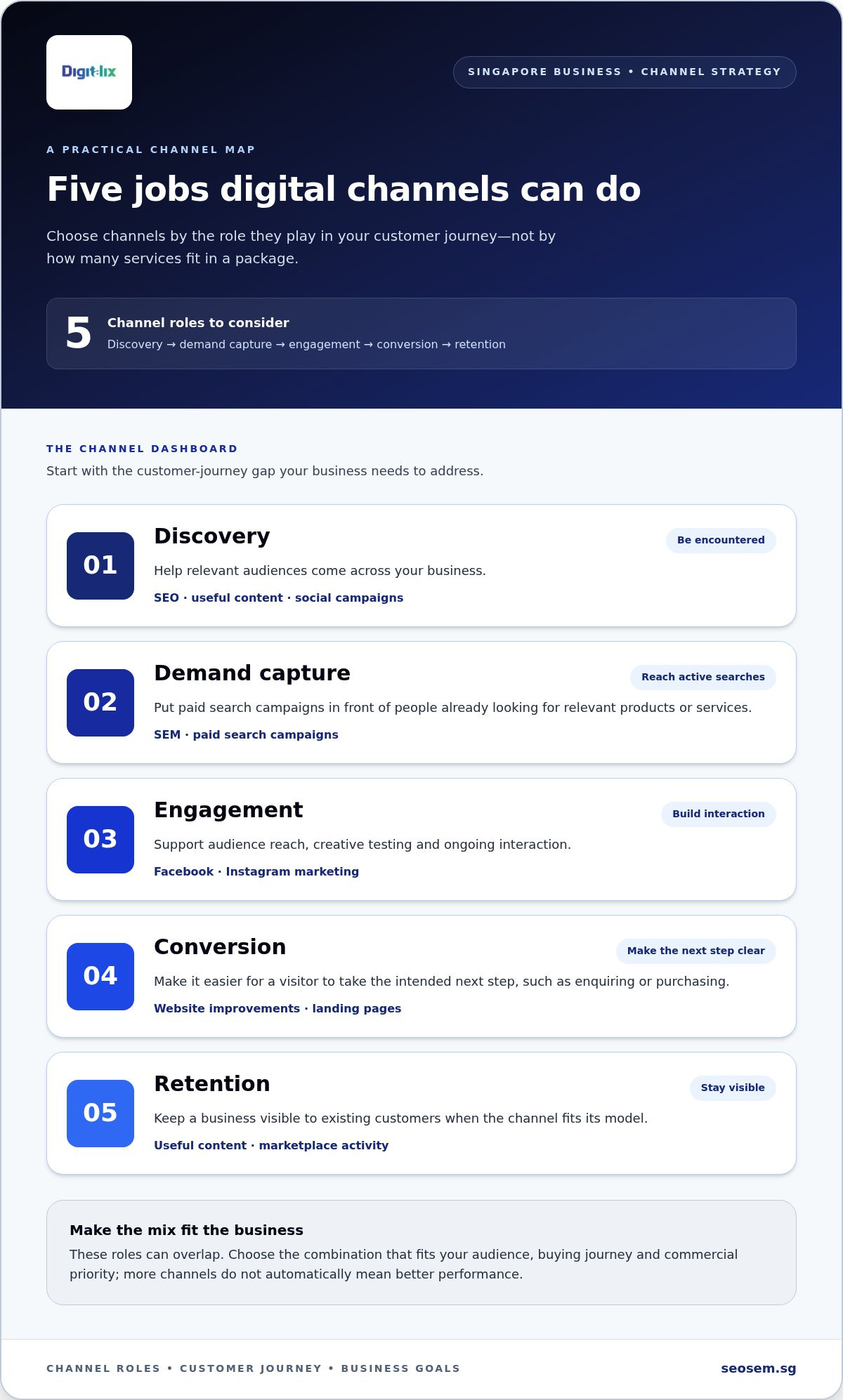
Choose channels by the job they need to do, not by how many appear in a package. A practical mix can support discovery, capture existing demand, build engagement, improve conversion or encourage repeat interest. The right combination depends on your audience, buying journey and commercial priority. A digital marketing solutions company should make those roles clear and show how the channels connect.
Use this as a starting point, then prioritise based on the gap in your customer journey:
- Discovery: SEO, useful content and social campaigns can help relevant audiences encounter your business.
- Demand capture: SEM can put paid search campaigns in front of people already looking for relevant products or services.
- Engagement: Facebook and Instagram marketing can support audience reach, creative testing and ongoing interaction.
- Conversion: Website and landing page improvements can make the next step clearer, whether that is an enquiry or purchase.
- Retention: Useful content and marketplace activity can keep a business visible to existing customers when those channels fit its model.
These roles can overlap. A social campaign may introduce a product, while a well-structured product page helps turn interest into a purchase. But more channels don’t automatically mean better performance. The time and work required to execute each channel vary, so set expectations around the role of each activity rather than promising immediate or guaranteed results.
When should businesses prioritise SEO, SEM or social media?
Prioritise SEO when your business wants to build discoverability for relevant searches over time. It can support a longer-term presence in search results, with progress shaped by competition, content and website readiness. Businesses developing this channel can explore SEO services in Singapore.
SEM is suited to capturing search intent through paid campaigns. It can bring targeted visibility while campaigns are active, but needs ongoing optimisation against relevant business outcomes. Facebook and Instagram marketing may be a stronger fit when the goal is to reach defined audiences, test creative approaches or build engagement. For an SME introducing a new service, for example, social activity might introduce the offer while search campaigns address demand from people actively seeking it.
Where do content, websites and marketplaces fit?
Content helps audiences discover an offer, understand how it meets a need and make a more informed decision. Its value increases when the next step is clear. A campaign can attract attention, but a confusing website or landing page may make it harder for visitors to enquire or buy. Web design and landing page design should support the campaign’s purpose with relevant information and a direct route to action.
Marketplaces belong in the mix when customers already shop there and the platform suits the business model. A seller whose customers browse Shopee or Lazada may prioritise marketplace visibility and listing activity; a business that relies on direct enquiries may have different needs. Match the channel to how customers find and purchase the offer, rather than adding platforms by default. Shopee and Lazada management can support businesses that include those marketplaces in their ecommerce plan.
To shape a channel mix around your goals, discuss a digital marketing plan with Digitalix.
Integrated Digital Marketing Solutions vs Single-Channel Campaigns
Integrated marketing coordinates selected channels around a shared business objective. A single-channel campaign concentrates effort on one specific need. Neither approach is automatically better: the right choice depends on what the business needs to change, the resources available and how success can be measured. A digital marketing solutions company should make those trade-offs visible rather than treating a broader scope as a goal in itself.
| Consideration | Integrated approach | Single-channel approach |
|---|---|---|
| Coordination | Connects selected channels and customer touchpoints under a shared objective. | Concentrates activity within one channel, with fewer cross-channel dependencies. |
| Focus | Can support different stages of a customer journey, provided each channel has a defined role. | Targets a narrower need, such as improving search visibility or campaign conversion. |
| Measurement | Combines channel-level indicators with the shared business outcome. | Can make it simpler to isolate and assess one channel’s contribution. |
| Resource needs | Requires coordination across activity, creative, implementation and reporting. | Usually involves a narrower scope, which may suit limited capacity. |
| Suitable situations | Useful when several connected customer touchpoints need attention. | A practical starting point when the objective or available resources are focused. |
Integration doesn’t mean launching every channel at once. A plan can start with one priority channel and add another only when it has a clear role. Breadth can become generic if the objective, ownership and measures are vague. The test is whether each activity contributes to the same priority, not whether the plan includes a long list of services.
When is a single-channel approach the better starting point?
A focused campaign can make sense when the business has one immediate objective, such as strengthening organic search visibility or improving the conversion path from an existing campaign. Define the audience, activity, review period and business measure before launch. For example, a business improving a landing page could assess whether the change supports more relevant enquiries, rather than relying on page visits alone.
A defined test can help clarify audience response and expose practical issues before a business expands its marketing activity. Assess the channel against a measure that fits its job. Search visibility work and paid campaign activity have different timelines and indicators, so judge each on relevant evidence without assuming a specific result or timeframe.
How can an integrated plan avoid becoming unfocused?
Keep the plan disciplined: choose one primary business objective, then assign a small number of supporting channel roles. Make ownership explicit across strategy, creative, campaign management and reporting. This reduces gaps, such as a campaign running without an agreed destination or a report listing activity without explaining its relevance to the objective.
For finance-related marketing, route claims through the appropriate MAS-related review process before publication. This is a review safeguard, not an interpretation of regulatory requirements. Clear priorities and responsibilities help an integrated plan stay coordinated and manageable.
How to Evaluate Performance and Improve a Digital Marketing Plan
Effective measurement connects marketing activity to business outcomes. A digital marketing solutions company should help establish what success means, identify a useful baseline and interpret results in context. Use a consistent process so your team can see what is working, where the customer journey is slowing down and what to adjust next.
- Set the business objective. Define the intended outcome, such as more qualified enquiries, ecommerce purchases or stronger visibility for relevant search topics.
- Record a baseline. Capture current performance before making changes. Note the period covered and factors that could affect comparisons, such as campaign changes or seasonal demand.
- Choose channel KPIs. Select measures that reflect each channel’s role and link them to the main objective. Avoid collecting metrics simply because a platform makes them easy to access.
- Build a useful report. Bring channel data together with relevant website and sales information. Make clear which measures show activity and which indicate commercial progress.
- Optimise based on evidence. Review results, identify a specific issue or opportunity, make a focused change and assess what happens before deciding on the next action.
Which KPIs should businesses track across channels?
Choose KPIs that match the objective. Organic search visibility can indicate whether relevant pages are becoming easier to find. Paid search reporting can show campaign activity, while qualified enquiries help assess whether that activity is reaching potential customers. For ecommerce, track meaningful actions such as product views, add-to-cart activity and completed purchases where measurement is available.
Separate leading indicators from business outcomes. Impressions, clicks and visits help explain reach and interest; they don’t prove that a campaign generated valuable demand. A rise in visits alongside few qualified enquiries may point to a mismatch between the audience, offer or landing page. There’s no universal benchmark that suits every business, so compare performance with its own baseline and objectives.
How should Singapore teams review and optimise campaigns?
Set a review rhythm that gives the team enough relevant data to make a decision while allowing important issues to surface promptly. For paid search, review campaign performance alongside the quality of enquiries or purchases, then refine targeting, keywords or landing page alignment where evidence supports a change. A business evaluating paid search strategy can explore how a Google Ads agency in Singapore can connect campaign management with performance review.
Test one meaningful variation at a time where practical, such as different creative, audience approaches or landing page content. Record what changed and what result you expected. Attribution can be imperfect: someone may see a social post, later search for the business and then enquire. Interpret platform reporting alongside sales feedback and the customer journey, rather than treating one channel’s attribution as the complete picture.
IMDA initiatives and Smart Nation 2.0 provide local digitalisation context, but they don’t show whether a specific campaign is performing. Keep decisions grounded in your own objectives and observed results.
Choosing a Digital Marketing Solutions Company in Singapore
The right partner should connect marketing decisions to your commercial priorities, not simply present a long menu of channels. Use this practical fit check to assess whether a digital marketing solutions company can work with your goals, your team’s capacity and the outcomes you need to understand.
- Objectives: Can the partner turn your business priorities into clear marketing goals and channel roles?
- Channel expertise: Does its experience match the areas you need, such as organic search, paid campaigns, social media, content or website improvement?
- Reporting: Will reports distinguish campaign activity from business outcomes, such as qualified enquiries or ecommerce actions?
- Communication: Are responsibilities, points of contact and decision-making processes clear?
- Optimisation: Does the approach include reviewing performance and making informed adjustments, rather than simply maintaining activity?
What should a clear agency engagement explain?
A clear engagement sets out the agreed goals, responsibilities, deliverables, reporting approach and how review decisions will be made. It should also establish what the agency needs from your team, such as product information, approvals or sales feedback. This keeps strategy connected to execution and helps prevent delays caused by unclear ownership.
Marketing can generate enquiries, but your team also needs a workable process to respond and follow up. Align campaign activity with the people, tools and internal capacity available to handle interest. If lead follow-up is limited, that constraint should inform campaign priorities and expectations from the outset.
How Digitalix can support a coordinated growth plan
Digitalix tailors channel priorities to business needs rather than applying one fixed package. For a business seeking stronger search visibility, SEO can build organic discovery over time. Where capturing active search demand is a priority, SEM management can support paid campaigns and ongoing optimisation. Facebook and Instagram campaigns can serve audience reach and engagement goals, while content creation can help explain an offer and support informed decisions.
Website work matters when the campaign destination needs to make the next step clearer. Web design and landing page design can support a more coherent path from discovery to enquiry or purchase. For an ecommerce business whose strategy includes Shopee or Lazada, marketplace management can form part of the coordinated plan alongside relevant content and campaign activity. The channel mix should reflect the business model, not an assumption that every service is necessary.
Digitalix is based at Paya Lebar Square and was founded in 2016. The agency’s Singapore focus is relevant to businesses considering local search and digital marketing, including those serving customers in Orchard, the CBD, Jurong, Tampines, Woodlands, Buona Vista and Paya Lebar. An engagement should still be guided by a clear objective, relevant channel expertise, transparent reporting and a shared approach to optimisation.
Turn Your Next Marketing Decision Into a Clear Growth Step
Your next move doesn’t need to be a bigger campaign. It needs to be a more deliberate one. Identify the business priority that matters most now, decide what evidence would show progress and make sure your team can act on the opportunities marketing creates. That gives every channel a clear purpose and keeps investment tied to business needs.
The right digital marketing solutions company should bring structure to that process: align the plan with your objectives, make responsibilities clear and use performance insights to guide the next decision. Start with a focused conversation about where your growth plan stands and what you want to improve. From there, you can shape a practical direction that suits your business and gives your team a clearer path forward.
With a clear priority and a coordinated plan, your next stage of growth can begin with confidence.
Frequently Asked Questions
What does a digital marketing solutions company do?
A digital marketing solutions company organises the work behind online campaigns, from planning and content coordination to implementation and review. To make an initial discussion productive, prepare a short brief with your main offer, target audience, existing marketing assets and any approval constraints. That context helps shape recommendations around your business rather than assumptions about your sector.
How do I choose a digital marketing solutions company in Singapore?
Look for a working process that gives your team visibility into the campaign, not just a final report. Ask how access to website and advertising accounts is handled, how work is approved, and where campaign assets and decisions are documented. These details matter if staff change or priorities shift. For Singapore-focused work, consider whether the content and examples fit the customers your business serves, whether they are in Orchard, the CBD, Jurong, Tampines, Woodlands, Buona Vista or Paya Lebar.
Is it better to use one digital marketing company or separate specialists?
Consider the coordination burden as well as specialist depth. Separate specialists can make sense if your team already has someone who can manage briefs, approvals and shared timelines. A single partner may simplify collaboration if internal coordination is limited. Before deciding, map who will own account access, campaign calendars and handovers. This practical workload can matter as much as channel expertise itself.
Can a digital marketing solutions company help a small business in Singapore?
Yes. A small business can benefit from support that fits its available time and internal expertise. Decide who will provide product details, approve marketing materials and handle incoming customer questions. For instance, a business owner who manages approvals personally may need a straightforward review process and a manageable content schedule. Clear capacity planning helps prevent marketing tasks from competing with daily operations.
How do you measure whether digital marketing solutions are working?
Check that the measurement setup captures actions accurately before relying on reports. Submit a test enquiry, confirm that it appears in the right system and make sure your team can distinguish genuine prospects from spam or duplicate submissions. Agree on how staff will record enquiry outcomes, too. A consistent record of what happened after an enquiry gives marketing reviews more useful context.
Which digital marketing channels should a Singapore SME start with?
Before choosing, review the questions customers ask, the pages they visit and the points where they hesitate or drop off. Existing enquiries and sales conversations can reveal what information is missing or unclear. Then consider what your team can maintain consistently, including content approvals and customer responses. This initial review helps an SME choose a manageable starting point based on real operating conditions.
Can SEO, Google Ads, and social media marketing work together?
Yes, but consistency across campaign materials is essential. Use the same offer details, product names and call to action wherever a customer encounters the campaign, then make sure the destination page reflects that promise. Shared campaign naming and tagged URLs can also make visits easier to interpret across reports. These practical controls help reduce confusion for customers and improve campaign analysis.