What if your Facebook campaigns generated fewer reactions but more qualified enquiries, bookings or sales? For Singapore businesses, the goal isn’t simply to attract attention. Effective facebook marketing connects each campaign objective to what your audience needs and what your business can measure.
It can be hard to tell whether a campaign is built for reach, engagement or conversions, especially when clicks don’t turn into customers. This guide explains how to align Facebook campaigns with your growth goals, choose meaningful measures and connect creative, audience targeting and landing pages into a more useful customer journey. You’ll also learn how to look beyond surface-level engagement and assess whether your activity is contributing to outcomes that matter to your business.
Key Takeaways
- Use organic posts and paid campaigns for different stages of the customer journey, from awareness to enquiries and sales.
- Match the campaign objective to the action you want people to take, then make sure the post-click experience supports that action.
- Measure facebook marketing against its goal: reach and engagement for awareness, and clicks, leads or business outcomes when evaluating response.
- Build a practical plan by setting a goal, defining your audience, developing a relevant message, then launching and reviewing performance.
- Use reporting on clicks, conversions, ROI and audience insights to guide decisions about targeting, creative and campaign optimisation.
Facebook Marketing: What It Can Do for a Singapore Business
Facebook marketing uses organic content and paid campaigns to reach audiences and support defined business objectives. It can include publishing useful posts, building a community presence and distributing advertisements to selected audiences. Its value depends on what it helps the business achieve, not simply how often the business posts. For context on the platform’s development and business role, see this overview of Facebook as a platform for businesses.
In practical terms, Facebook marketing uses relevant content and paid distribution to move a chosen audience towards a measurable goal, such as an enquiry, appointment or purchase. That keeps the plan accountable. Attention, engagement, enquiries and sales are different stages of a customer journey, not interchangeable measures of success. A post can attract attention without prompting a response; an enquiry can show intent without becoming a sale.
For Singapore SMEs, start with the customer’s need and the commercial goal. A posting schedule is a delivery decision, not a strategy. First identify what customers need to understand or do, then choose the message and activity that can help them take that step. Businesses developing a broader organic discovery plan can also consider SEO services in Singapore alongside social activity.
How Facebook marketing supports different business goals
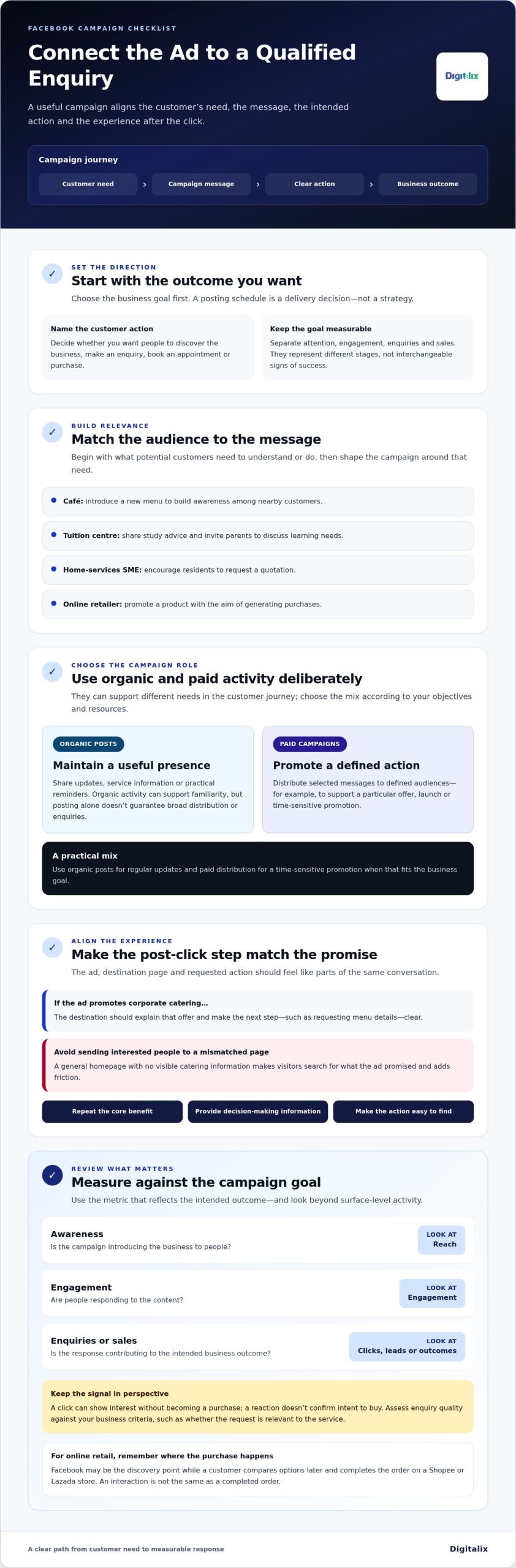
Each objective calls for a different message and measure. A neighbourhood café might introduce a new menu to build awareness among nearby customers. A tuition centre could share study advice and invite parents to discuss learning needs. A home-services SME might encourage residents to request a quotation, while an online retailer could promote a product with the aim of generating purchases.
For e-commerce, Facebook may be the discovery point rather than the checkout. Someone might see a product post, compare options later and complete the purchase on the seller’s Shopee or Lazada store. A click or interaction can indicate interest, but it isn’t the same as a completed order. Set expectations for what the platform is meant to influence, then assess the outcome accordingly.
Organic content and paid campaigns play different roles
Organic posts let a business share useful updates and maintain an active brand presence. A clinic, for example, might post service information or practical health reminders. Organic activity can support familiarity and give customers a place to see what the business communicates, but posting alone doesn’t guarantee broad distribution or enquiries.
Paid campaigns distribute selected messages to defined audiences. They can be useful when a business has a particular offer, launch or action to promote. The right balance depends on resources and objectives. An SME might use organic posts for regular updates and paid distribution for a time-sensitive promotion. Another business may prioritise community content. In either case, choose the mix deliberately and connect each activity to the customer action it is intended to support.
How Facebook Marketing Connects Audience, Message and Conversion
Effective facebook marketing links four decisions: what a potential customer needs, what the campaign says, what action it asks them to take and what happens after they respond. A break in that chain can waste attention. For example, an office manager exploring catering options may click an ad about corporate meal plans, then leave if the destination page offers no clear information or next step.
The campaign objective matters because it guides what outcome the campaign is designed to pursue. An awareness campaign focuses on discovery, while a lead-generation campaign is built around an action such as submitting an enquiry form. Choose an objective that reflects the intended result, then check that the creative and destination support it.
Match the campaign objective to the intended action
Set expectations according to the customer’s stage. Awareness introduces a business to people who may not know it. Consideration gives interested prospects useful information. Conversion encourages a defined response, such as requesting an appointment or completing a lead form. A campaign promoting a new corporate catering service might explain the offer, then direct interested office managers to request menu details.
Don’t judge every campaign by the same metric or expect every audience to act immediately. Reach can indicate exposure, while a completed form is evidence of a more direct response. Neither number alone establishes whether a lead is commercially valuable. Assess enquiry quality against your business criteria, such as whether the request is relevant to the service being promoted.
Keep the ad promise consistent with the landing page
Make the audience, creative and destination feel like parts of one conversation. If an ad promotes corporate catering, the landing page should explain that offer and present a clear next step, such as submitting an enquiry. Sending people to a general homepage with no visible catering information makes them search for what the ad promised and creates unnecessary friction.
A relevant destination page turns an ad click into a clear next step by carrying the same offer, message and action through to the response. Keep the page focused: repeat the core benefit, provide the information needed to make a decision and make the intended action easy to identify. Digitalix provides landing page design and development to connect campaign messages with a focused destination.
Clicks and reactions show activity, not necessarily business value. A person may click out of curiosity, while a reaction doesn’t confirm intent to buy. Compare the response with the outcome that matters: relevant enquiries, completed appointments or sales. If an ad attracts clicks but the page produces few meaningful actions, review the message, audience fit and destination before increasing distribution.
Connecting these elements takes coordinated planning across targeting, creative and the post-click experience. Learn more about how to plan a measurable campaign journey with Digitalix.
Facebook Marketing Metrics: Measure Outcomes, Not Just Activity
Useful measurement starts with the campaign objective. A campaign designed to build awareness should be assessed differently from one intended to generate enquiries or sales. In facebook marketing, the right metric shows whether the intended action is happening, supported by diagnostic measures that help explain why.
A visible campaign metric shows activity; evidence of commercial impact shows whether that activity contributed to a valuable business outcome. Reactions, reach and follower growth can indicate that people saw or interacted with content, but they don’t prove that a prospect is suitable, an appointment was booked or a sale was made. Keep those distinctions clear when reviewing performance.
| Campaign stage | Useful indicators | What they help you assess |
|---|---|---|
| Awareness | Reach and impressions | Whether the message is being delivered to an audience |
| Engagement | Reactions, comments, shares and other interactions | Whether people are responding to the content |
| Consideration | Link clicks and other relevant clicks | Whether people are taking an initial step to explore the offer |
| Lead generation | Completed lead forms or enquiries | Whether the campaign is prompting the intended response |
| Business outcome | Conversions, sales and ROI | Whether campaign activity is associated with outcomes that matter commercially |
Choose a small set of useful performance indicators
Set one primary measure that directly reflects the objective, then use a few supporting indicators to diagnose performance. For awareness, reach may be primary, with engagement helping show how people respond. For a lead campaign, completed enquiries matter more than reactions; clicks can show whether people are moving towards the form. For an online sale, track conversions and assess ROI where the necessary business data is available.
Audience insights add useful context. If a campaign receives clicks but few completed enquiries, review whether the audience matches the offer and whether the next step is clear. Strong engagement is encouraging, but follower growth or reactions alone aren’t proof of revenue. Ask what action occurred and whether it fits the business goal.
Use reporting to decide what to improve next
Review performance against the original objective, not isolated daily fluctuations. Consider the reporting period as a whole, compare the primary measure with supporting indicators, then identify where the journey may be weakening. Lower click interest may point to a message or creative issue; clicks without conversions may be a reason to review the landing page or the clarity of the offer.
Detailed reporting on clicks, conversions, ROI and audience insights can turn results into practical decisions. Digitalix’s Facebook and Instagram marketing includes creative ad development, continuous bid management and performance reporting. Use the findings to decide what to adjust next. The goal isn’t to maximise every number, but to understand which measures indicate progress towards the outcome the business set.
Build a Facebook Marketing Plan for a Singapore Audience
A practical Facebook marketing plan gives every campaign a clear job, from defining its business goal to reviewing what happened after launch. For Singapore SMEs, ground decisions in customer needs and available resources, then connect Facebook with the rest of the customer journey, including the business website, Instagram or a marketplace such as Carousell. Local context matters too: a business targeting customers in Orchard or the CBD may need a different message from one reaching households in Jurong, Tampines, Woodlands, Buona Vista or Paya Lebar.
Use this workflow to keep the plan focused:
- Set the goal. Choose one business outcome, such as enquiries for a home renovation service or product sales for an online retailer.
- Define the audience. Describe who the campaign needs to reach through their needs, intent and relationship with the business.
- Develop the message. Present a relevant offer and a clear next step, using creative that matches the audience and destination.
- Launch with a baseline. Record the starting point and decide when results will be reviewed before the campaign goes live.
- Review and refine. Compare performance with the original goal, identify what may be limiting results and decide what to test next.
Define the audience and campaign message
Useful audience planning goes beyond broad labels. Consider what someone is trying to solve, how ready they are to act and whether they already know the business. A local bicycle repair shop might speak to residents looking for routine servicing, while an online retailer could introduce a product to new prospects and direct interested shoppers to its website or Carousell listing.
Keep the creative direct and locally relevant. Explain the offer in plain language, make the next action easy to understand and ensure the destination continues the same message. If customers need service details before enquiring, make that information easy to find rather than relying on the ad to answer every question.
Launch, monitor and refine with a clear process
Set a baseline and reporting cadence before assessing performance. Decide which primary measure reflects the goal and which supporting indicators can help explain it. Review results at planned intervals rather than reacting to every short-term change. This gives the campaign a consistent basis for decisions and helps separate a genuine pattern from normal fluctuations.
Creative testing can compare different message approaches while keeping the campaign objective consistent. For example, an online retailer could test a product-benefit message against a convenience-focused message, measuring both against the same intended action. Change one clear element, record what was tested and use the results to guide the next iteration. Avoid changing the objective and multiple creative elements at once, as that makes it harder to understand what influenced the difference.
Facebook should support, not replace, the wider customer journey. A business website can provide detailed information, Instagram can extend the social presence and Carousell may suit product discovery or selling. For regulated sectors, review the requirements that apply to the business and its advertising before launch. A general campaign checklist may not cover every sector.
How Digitalix Can Support Facebook Marketing in Singapore
Digitalix supports Singapore businesses with campaign planning, audience targeting, creative development and ongoing bid management. The focus is to make campaign decisions serve the business objective, rather than treating ad setup as a standalone task.
What managed facebook marketing can bring together
Planning establishes what the campaign needs to achieve. Targeting defines the audience, while creative development shapes how the offer is presented. Ongoing bid management supports optimisation as the campaign runs. Digitalix’s Facebook / Instagram Marketing service brings these elements together for businesses managing social campaigns.
The journey continues after someone clicks. Digitalix also provides Landing Page Design & Development, helping carry the campaign message through to a destination with a clear next step.
Set clear expectations for measurement and improvement
Before a campaign begins, agree on its objective, what action counts as progress and how performance will be reviewed. A retailer may focus on product enquiries or purchases, while a service business may value suitable appointment requests. These criteria give the campaign a clear basis for review. Outcomes depend on the business, audience, campaign and conversion journey, so past performance should not be treated as a promise of future results.
Digitalix reports a healthcare-provider result of 40% follower growth and 25% more appointments in three months. This is a reported outcome, not a guarantee, and it should not be attributed to Facebook alone. Results for another business will depend on its circumstances and campaign context.
Digitalix’s Facebook marketing service is Cancel Anytime, with no forced contracts and no three-month or six-month lock-ins. This gives businesses flexibility as they assess campaign activity against their goals.
A clear objective and a coordinated campaign process give your business a stronger foundation for making informed decisions about social activity.
Turn Your Next Campaign into a Clear Growth Step
Digital marketing keeps changing, but a disciplined learning habit can help your business adapt without relying on guesswork. Treat each campaign as an opportunity to understand what resonates with Singapore customers and make stronger facebook marketing decisions over time.
Consistent evaluation helps turn the next campaign into a more informed step towards sustainable growth.
Frequently Asked Questions
Is Facebook marketing still effective for Singapore businesses in 2026?
Yes, it can be effective when the platform suits your customers and the campaign supports a clear business goal. A Singapore retailer, for example, might use Facebook to introduce a product, then direct interested shoppers to its online store. Assess whether the activity reaches relevant people and contributes to an action your business values. Simply having a presence on the platform does not guarantee results.
How much does Facebook marketing cost in Singapore?
Costs depend on the campaign scope, advertising budget, creative needs and level of management. Digitalix’s Social Media Marketing service is $800 per month and includes 4 posts + report or ad setup + report. The right option depends on whether your priority is an organic posting schedule or paid campaign support. Define the intended outcome and review performance against it as the campaign runs.
Can Facebook marketing work for B2B companies?
Yes. A B2B company can use Facebook to introduce its expertise, share useful resources or encourage a relevant business enquiry. For instance, a local software consultancy could promote a guide to a business challenge and invite interested organisations to request a discussion. Since a business buyer may need time to evaluate a supplier, assess whether enquiries match your target client profile and progress to meaningful sales conversations.
What is the difference between Facebook marketing and Facebook advertising?
Facebook marketing refers to a business’s overall use of the platform to support its goals, while Facebook advertising refers specifically to paid campaign activity. A marketing plan may include audience and message planning as well as ad management. Understanding the distinction helps you decide what work is needed and how each activity contributes to the customer journey.
How long does Facebook marketing take to show results?
There is no fixed timeline for results. Views or interactions may appear before enquiries or sales, and those early signals don’t guarantee a business outcome. Timing depends on the offer, audience, creative and steps customers take before converting. Set a review period that fits your objective and look for a meaningful pattern rather than treating a brief change in performance as conclusive evidence.
Do I need a website for Facebook marketing?
No, a website isn’t essential for every campaign. Depending on the customer journey, you could direct people to a Facebook page, a lead form or a marketplace listing. A website can be useful when customers need more information before enquiring or purchasing, while a marketplace may suit a product-led journey. Choose a destination that gives people the information they need and makes the intended next step clear.
How can I tell whether Facebook marketing is generating qualified leads?
Define what makes a lead qualified before launching, using criteria that reflect your business, such as service fit, location or readiness to proceed. Then review enquiry details and track whether suitable prospects move into sales conversations. A high form-submission count alone may not show lead quality. Consistent follow-up records help reveal which enquiries are relevant and whether campaign activity is contributing to business opportunities.