A busy Facebook Page isn’t automatically an effective marketing channel. To understand how to do Facebook marketing, connect useful content, a consistent posting schedule, audience-focused ads and responsive customer support to clear business goals. Measure which activities generate meaningful engagement, enquiries or sales, then adjust your plan based on the results.
It’s easy to focus on posts and ad creative because both are visible and can reach potential customers. But performance also depends on what you publish, when you publish it, how you handle replies and whether campaign data guides your next decision.
This guide explains how to build a practical Facebook marketing workflow for a Singapore business, whether you’re serving customers in Orchard, the CBD, Jurong, Tampines, Woodlands, Buona Vista or Paya Lebar. Learn to set objectives, plan content, schedule posts, shape ad audiences, respond to customers and assess results without relying on vanity metrics. Treat customer questions as part of the marketing experience, not an afterthought.
Key Takeaways
- Set a clear business goal for each Facebook activity, then choose content and calls to action that support it.
- Build a content calendar around useful themes and schedule posts consistently, rather than publishing just to stay visible.
- Match each ad’s audience and creative to its objective, then use campaign data to guide adjustments.
- Make customer support part of the Page experience by monitoring messages and responding with clear, helpful answers.
- Use Digitalix’s Facebook Marketing support when you need a more structured approach to planning, campaigns and performance.
Audience engagement and customer support
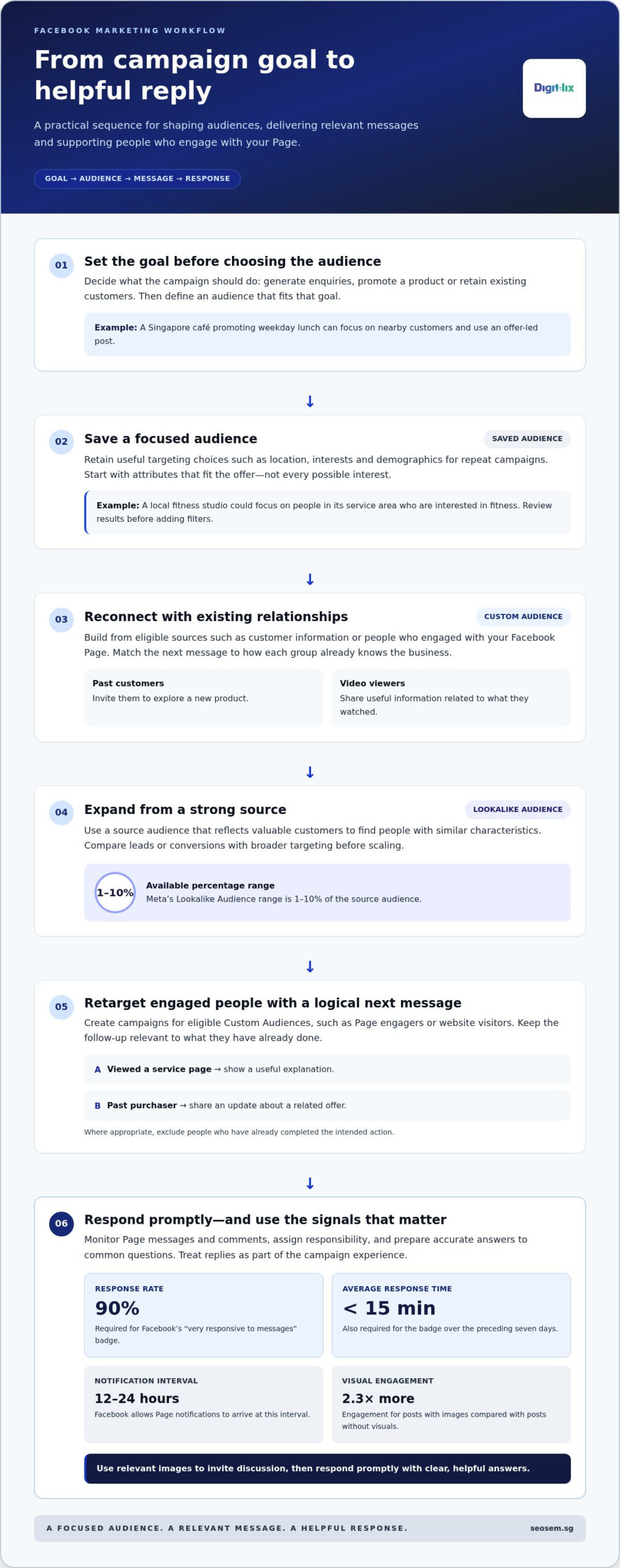
- Set a goal before choosing an audience. Decide whether the campaign should generate enquiries, promote a product or retain existing customers. Then define the audience by its relationship to that goal. For example, a Singapore café promoting weekday lunch can focus on nearby customers and use an offer-led post. Pair Facebook activity with SEO services in Singapore when you also want customers to discover your business through search.
- Build a saved audience for repeat campaigns. Saved Audiences let you retain targeting choices such as location, interests and demographics. Start with attributes that fit your offer, not every possible interest. For a local fitness studio, consider people in its service area who are interested in fitness. Review results before adding filters so you can see which choices bring relevant engagement.
- Use Custom Audiences for existing relationships. Create a Custom Audience from eligible sources, such as customer information or people who engaged with your Facebook Page. Match the source to the next action: invite past customers to explore a new product, or share useful information with people who watched a video. Keep the message relevant to how that audience already knows the business.
- Test Lookalike Audiences against a strong source. A Lookalike Audience helps reach people with characteristics similar to a source audience. Meta’s available percentage range is 1-10% of that source audience. Begin with a source that reflects valuable customers, rather than treating every Page interaction as equal. Compare the campaign’s leads or conversions with broader targeting before scaling.
- Retarget people who have already engaged. Build a campaign for eligible Custom Audiences, such as Page engagers or website visitors. Give each group a logical next message. Someone who viewed a service page might see a useful explanation, while a past purchaser could receive an update about a related offer. Where appropriate, exclude people who have already completed the intended action.
- Make replies part of the campaign plan. Check Page messages and comments regularly, assign responsibility, and prepare accurate answers to common questions. Facebook’s “very responsive to messages” badge requires a 90% response rate and an average response time under 15 minutes over the preceding seven days. Use notification settings to support monitoring; Facebook allows Page notifications to arrive every 12 to 24 hours. Posts with images receive 2.3 times more engagement than posts without visuals, so use relevant images to invite discussion, then respond promptly and helpfully.
What is Facebook marketing?
Facebook marketing combines organic publishing and paid advertising to reach an audience, encourage action and build customer relationships. Businesses learning how to do Facebook marketing should match each format to a clear objective and audience.
How to Do Facebook Marketing: Compare Organic Marketing and Paid Ads
1. Compare organic posts with paid ads by matching each to a distinct role. Organic publishing builds a Page presence through updates, conversations and useful content. Paid advertising promotes selected messages to audiences chosen for a campaign objective. Facebook’s advertising objectives are grouped into awareness, consideration and conversion categories, with 11 objectives listed. Select the objective that reflects the action you want, then assess results against that goal.
In Singapore, ad costs depend on factors such as audience, objective, competition and delivery choices. Set a spending limit in Ads Manager and monitor delivery instead of assuming there’s one fixed market rate.
How to Do Facebook Marketing: Create Posts, Images, and Videos
2. Choose a post format that makes the message easy to understand. Use a single image for one product feature, a carousel to show related items, or video to demonstrate a process. Facebook carousel ads include between two and ten cards. Stories disappear after 24 hours, while Reels are short videos described as 15-60 seconds. Select the format that best explains the offer.
- Build each ad around one objective and format. For awareness, use a clear image or short video to introduce a brand. For consideration, use a carousel to explain options or a video to show how a service works. For conversion, direct people to a relevant purchase or enquiry destination. Avoid combining unrelated offers in one creative, which can weaken the message.
- Separate organic and paid performance. Organic reach comes from publishing to your Page audience; paid ads use campaign delivery to reach selected audiences. Compare comments, shares and clicks for organic posts with results tied to each ad objective. Don’t judge both approaches by the same metric: a brand-awareness ad and a sales campaign serve different purposes.
- Reduce common creative and account risks. Review the Facebook Business account, Page permissions, billing details and ad destination before publishing. Check that the creative matches the offer and the landing page works on mobile. Avoid misleading claims, outdated promotions and unlicensed content. These checks help prevent review issues and audience confusion.
- Coordinate connected channels and local promotions. Keep Facebook and Instagram messages consistent, then use WhatsApp as a contact route when it suits the campaign. A Singapore retailer could promote a local store event with matching social posts and clear dates. Keep the destination, promotion details and customer response process consistent across channels.
For support aligning campaign objectives with advertising execution, discuss your Facebook campaign needs.
Ad performance measurement and analytics
Measure Facebook marketing against the action each campaign was designed to generate. Separate Page and post engagement from paid results, then use analytics to decide what to improve.
Measure Page and Post Performance
- Review Page and post metrics together. In Meta’s Page insights, compare reach and engagement with actions such as link clicks, comments and messages. A post that earns attention but few relevant visits may need a clearer call to action. A Singapore retailer can compare product posts with educational updates, then use the stronger response to guide future content.
- Assess the quality of interaction. Track whether comments and messages show genuine interest, not just activity. Note common questions and whether the business Page can answer them usefully. If a post attracts reactions but few enquiries, test a more specific next step. Compare Facebook and Instagram results separately, since each platform may attract different audience behaviour.
Measure Marketing Results
- Connect campaign metrics to the business goal. For lead generation, review completed enquiries and their cost; for sales, assess purchases and return on ad spend. The average Facebook conversion rate for sales across industries is 8.25%, while Facebook marketing is associated with an average conversion-rate improvement of 9.21%. Treat these figures as benchmarks, not forecasts for an individual campaign.
- Give a new campaign time to produce useful evidence. Meta recommends keeping an ad budget consistent for at least seven days to gather accurate performance analytics. Facebook ads generally take three to seven days to exit the learning phase, and the learning phase usually ends after an ad receives 50 results for its selected objective in one week. Avoid frequent edits that disrupt comparison.
- Compare outcomes before changing targeting. Review results by creative, placement and audience interests, then change one major variable at a time. Facebook ads typically achieve an overall return on ad spend between 2.5 and 4, but your own performance depends on campaign setup and business economics. Check whether attention leads to valuable actions before shifting budget.
- Turn each reporting cycle into a decision. Record the objective, audience, creative, spend and outcome for every campaign. Keep an ad that meets its goal, revise one that attracts clicks without conversions, and pause one that fails to deliver useful results. Use consistent reporting definitions across Facebook and Instagram to make channel comparisons meaningful.
Content, schedule and ad-targeting optimisation
In Ads Manager, choose a campaign objective, define the audience, set placements and budget, then publish the ad. Review delivery and results to optimise, changing one major variable at a time.
- Choose one clear campaign outcome. Decide whether the campaign should build awareness, generate enquiries or encourage purchases. Match the objective to the action you want people to take, then use creative that supports it. For example, a Singapore retailer launching a new product can introduce its key benefit before directing interested shoppers to the product page.
- Start with a broad, relevant audience. Define the locations and interests that fit the offer, then avoid adding filters without a clear reason. One recommendation is to build an advertising audience of at least two million people before narrowing it according to ad performance. A small Singapore service business can still target relevant people through appropriate location settings and customer interests.
- Prepare creative for mobile placements. Use a square image ad of at least 1080 x 1080 pixels, with a concise caption under 125 characters. Keep the headline within 40 characters and the description within 30 characters. Check that the main benefit and call to action remain clear when the ad appears on a phone screen.
- Make video work without sound. Almost 90% of Facebook videos are watched without sound, so add readable captions and make the first 5-10 seconds visually compelling. Show the product or service early. For a Singapore tuition centre, a short lesson demonstration can quickly communicate the teaching approach, even when viewers watch silently.
- Adapt Stories creative to the placement. Prepare Facebook Stories assets in a 9:16 aspect ratio so the vertical format uses the screen effectively. Keep important text and branding away from areas that interface elements may cover. Use one direct message per Story, such as announcing a new menu item or promoting a local event, rather than shrinking a crowded feed graphic.
- Test and refine with controlled changes. Compare versions that differ in one meaningful element, such as the image, opening line or audience interest. Track which variation better serves the campaign objective, then apply that learning to the next ad. Avoid changing several settings at once, or you won’t know whether the creative, audience or placement caused the performance shift.
Social media content calendars and scheduling
A content calendar turns social media activity into a planned sequence, not a last-minute task. Map each Facebook post to its audience, purpose, publishing date and conversion measure.
- Choose a planning window and business theme. Create a calendar in a spreadsheet or Meta Business Suite, then group posts around customer needs. A Singapore retailer might plan product education, customer questions and seasonal promotions as separate themes. Give each entry a purpose, such as building awareness, driving visits or answering a common question. This structure helps the team spot gaps before producing content.
- Assign a format and owner to every entry. Record whether each post will use a photo, video, Story or link, alongside its caption and destination. Name the person responsible for drafting, approval and publishing. For example, a service business can assign a staff member to check appointment details before a booking post goes live. Clear ownership reduces conflicting edits and missed tasks.
- Schedule posts, then use local timing as a test. Weekday afternoons, typically between 1 p.m. and 4 p.m., are recommended posting times. Treat this window as a starting point, then compare reach and engagement in Page insights against your own audience’s activity. A Singapore business serving shift workers may find another publishing time suits its customers better.
- Set a sustainable publishing pace. More posts do not automatically create more useful attention. Facebook Pages with fewer than 10,000 followers that posted more than 60 times a month received 60% fewer clicks per post than Pages posting five times or fewer. Use that comparison as a warning against volume for its own sake. Prioritise relevant posts your team can maintain and support.
- Build response time into the calendar. Assign someone to monitor comments and Messenger after scheduled promotions go live. A post about a store event may prompt questions about location, opening hours or availability. Add a response owner and prepared information to the calendar entry so customer queries receive consistent answers while the promotion is active.
- Review calendar performance and refine the next cycle. Track each post’s format, theme, publishing time and outcome in a simple reporting sheet. Compare clicks, meaningful comments and completed actions instead of judging success by likes alone. If a product explainer generates visits but few enquiries, revise its next call to action. Carry the learning into the next calendar rather than repeating underperforming content unchanged.
Digitalix: Search Engine Optimization (SEO)
Digitalix helps turn Facebook activity into a more structured marketing programme through Facebook Marketing. It’s a practical next step when content planning, audience targeting or campaign measurement needs a consistent strategy. For Singapore businesses seeking visibility beyond social platforms, Search Engine Optimization (SEO) can support discovery through relevant search results, while Search Engine Marketing (SEM) can complement paid social campaigns.
Choose support based on the gap you need to address. If your Page needs clearer content and campaign execution, focus on Facebook Marketing. If potential customers also need to find your business through search, consider SEO alongside your social activity. The right approach connects channel activity to business goals and tracks performance with relevant metrics.
Contact Digitalix to discuss your Facebook marketing and search priorities in Singapore.
Turn your Facebook plan into your next growth step
Your next move is to decide how Facebook should contribute to the wider customer journey. A campaign can introduce your business, while your website or online shop gives interested people a clear next destination. Keep that path coherent, from the first message to the action you want customers to take.
Knowing how to do Facebook marketing means making deliberate choices and learning from each campaign. As your priorities develop, Digitalix can support Facebook Marketing alongside Search Engine Optimization (SEO), Search Engine Marketing (SEM) and Shopee Management. These services can help businesses address social campaigns, search visibility and marketplace activity within a broader digital strategy.
Bring your goals and current marketing priorities to Digitalix. Together, you can identify a practical next step that fits your business and gives your marketing a clearer direction.
Frequently Asked Questions
What is advertising on Facebook?
Facebook advertising is paid promotion delivered to audiences selected in Meta Ads Manager. A business chooses a campaign objective, audience, placement, budget and creative, then monitors results against the intended action. For example, a Singapore home bakery could promote festive ordering to local customers and direct them to an order form. Paid ads differ from ordinary Page posts because campaign settings control who is reached and what outcome the campaign optimises for.
How do you create a Facebook business page in Singapore?
Create a Facebook Page for your business, then make it useful before inviting customers to follow. Choose a recognisable business name and category, add a concise description, and provide accurate contact and opening information. Use branded profile and cover images, then select a relevant action button, such as calling or messaging. For a Tampines salon, include its location and booking route so visitors can quickly understand what it offers and how to enquire.
How do you define a Facebook marketing strategy and target audience?
Start with a business outcome, such as enquiries for a Jurong service or visits to a Woodlands shop. Describe the people most likely to act, including their location, needs and relationship with your business. Then choose content or advertising that addresses their specific concern. A new café might focus on nearby office workers seeking lunch, while an established venue could tell returning customers about a new menu.
How often should a business post on Facebook?
Post at a pace your team can sustain while keeping each update useful to customers. A neighbourhood retailer with limited new product news may publish fewer, stronger updates than a venue sharing menus, events and customer information. Review Page insights and customer responses to see whether posts continue to attract attention. If quality drops or publishing leads to unanswered comments, slow down and use the calendar to plan more relevant updates.
How do you target audiences on Facebook while complying with privacy rules in Singapore?
Use Meta’s audience tools thoughtfully and handle customer information with care. For a Singapore campaign, prioritise location, broad interests or Page engagement, and use customer data only when you have a proper basis to do so. Explain how you’ll use information when collecting it, restrict access to people who need it, and honour requests to stop marketing. Keep audience lists secure and review them regularly for relevance and appropriate use.
Can you reuse the same Facebook post on Instagram?
You can adapt a Facebook post for Instagram, but review the format and caption before publishing. A square product image may suit both platforms, while a vertical Story or Reel needs creative designed for that placement. Check that any link, contact route or call to action works for the audience seeing it. Tailoring the presentation helps each post feel native rather than like a direct copy.