Google rankings don’t come from a secret formula. A search engine optimization strategy works by helping Google discover and understand useful pages, then matching them to relevant searches. For Singapore businesses, that means building visibility through clear content and sound technical foundations, not relying on keyword repetition.
It’s understandable to focus on rankings, but appearing in search is only part of the picture. Google crawls pages, adds eligible content to its index and ranks results for each search. No website is guaranteed a place in the index or a top position.
This article explains how these steps work and how content quality, keyword research and technical SEO support visibility. It also explores how generative engine optimization can make content easier for AI-powered search experiences to understand and cite.
Key Takeaways
- Understand how Google discovers, indexes and ranks pages, and why inclusion in search results isn’t guaranteed.
- See how clear titles, headings, URLs and meta descriptions help present each page to searchers.
- Learn to align useful, original content with the needs behind relevant search queries.
- Use keyword research to guide content without forcing exact phrases where they don’t read naturally.
- Explore how structured, authoritative content can support visibility in both traditional results and AI-generated answers.
1. What is search engine optimisation (SEO), and how does it support a search engine optimization strategy?
SEO improves a website so search engines can understand its pages and people can find them in unpaid results. A strong plan connects visibility with useful information and relevant business goals. For a Singapore business, that means reflecting its services and local customers’ needs, rather than targeting broad phrases without a clear audience.
SEO and paid search serve different roles. SEO supports visibility in organic results, while paid search places advertisements in search results. A business can use both: paid campaigns provide ad visibility as organic pages build relevance over time. The right mix depends on the business goal, audience and available campaign resources.
| Approach | How it appears | Strategic role |
|---|---|---|
| SEO | Unpaid organic results | Builds visibility through relevant pages and content |
| Paid search | Search advertisements | Provides visibility through paid campaigns |
How on-page SEO strengthens a search engine optimization strategy
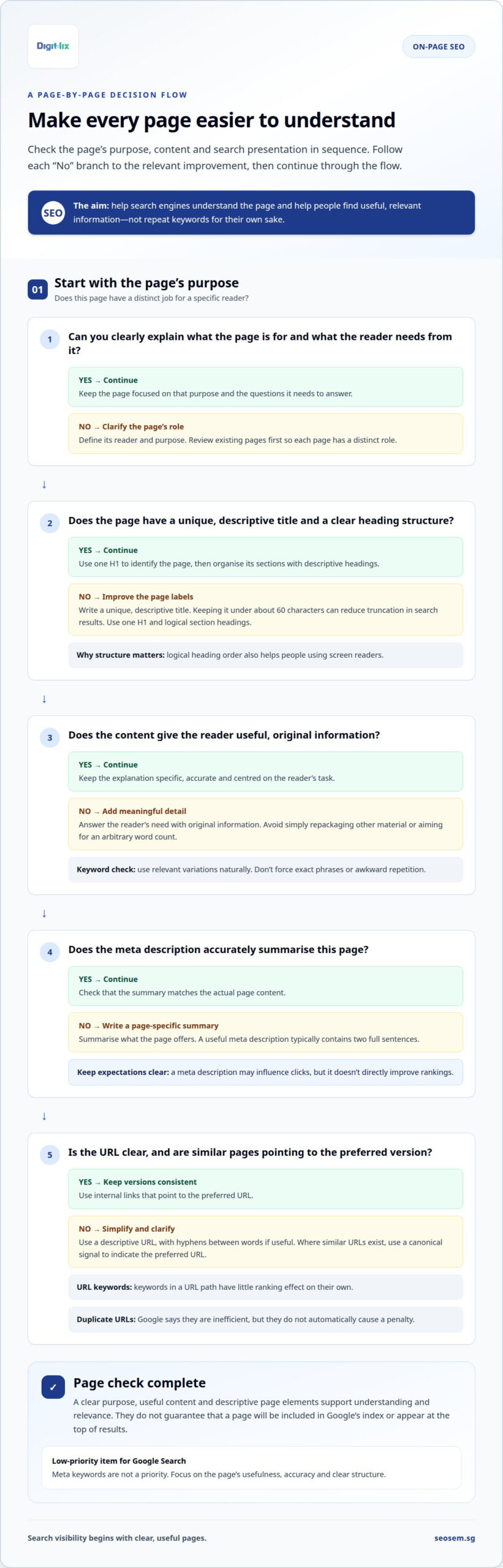
On-page SEO aligns a page’s title, headings, copy and metadata with its subject. Give every page a unique, descriptive title; keeping it under about 60 characters can reduce truncation in search results. Use one H1 to identify the page, then organise sections with descriptive headings. Logical heading structure also helps people using screen readers.
A meta description summarises a page and may influence clicks, although it doesn’t directly improve rankings. A useful description typically contains two full sentences and should match the page. Descriptive URLs can use hyphens between words, but keywords in a URL path have little ranking effect on their own. Meta keywords are not a priority for Google Search.
Content planning connects research with each page’s purpose. A Singapore service business might create a dedicated page for each core service, with copy that clearly answers customer questions. Use relevant keyword variations naturally in titles and content, and avoid awkward repetition. Review existing pages before creating new ones so each has a distinct role.
Google’s Search rules do not offer a secret that automatically puts a website first. Prioritise useful, accessible pages that accurately describe the business. For Singapore audiences, local wording and the areas served can clarify relevance. A coordinated SEO approach for Singapore businesses can connect those on-page decisions to broader content planning.
SEO pricing in Singapore depends on a website’s condition, competition, content workload and project scope. Fees reflect the work involved, such as technical changes, page improvements and ongoing analysis. The right scope depends on the site’s priorities and the outcomes the business wants to achieve.
2. Clear, useful and authoritative webpage content
Useful content gives visitors a reason to choose a page over a brief search result. A Singapore accounting firm, for example, can explain which business situations its service addresses and what clients can expect. Specific explanations help readers make decisions; broad claims such as “we provide quality service” offer little practical guidance.
People-first writing starts with the reader’s task and provides the detail needed to complete it. A clinic page, for example, might explain the appointments available, who they suit and how to enquire. Google recommends original content with clear value, rather than pages that simply repackage existing material. Answer the reader’s need instead of aiming for an arbitrary word count.
Review published pages when their subject changes. If a Singapore business updates its service terms, for instance, revise the relevant page and remove outdated details. Google recommends keeping content up to date. Regular editorial reviews can also identify thin pages that need more useful information and old articles that no longer reflect the business’s expertise.
Google’s automated systems assess pages for possible inclusion in its index, but discovery does not guarantee inclusion. Content that is difficult to interpret or offers little distinct value may not serve searchers well. Check whether each page has a clear purpose, gives a complete answer and connects logically to related information on the site.
Canonical signals help search engines understand which URL a publisher prefers when similar pages exist. For example, a product page with tracking parameters can point to a preferred, clean URL. Keep internal links consistent with that version and avoid creating multiple pages for the same purpose. Google says duplicate URLs are inefficient, but they do not automatically cause a penalty.
Authoritative content demonstrates expertise through relevant detail and careful attribution. A Singapore business guide can name the process it explains, distinguish established facts from commentary, and credit a qualified author where appropriate. Google advises site owners not to treat E-E-A-T as a ranking factor to optimise directly. Prioritise accuracy, usefulness and a clear reader experience.
A technical SEO audit can review page access, indexing status, duplicate URL patterns and site structure. Findings should be grouped by business impact, with barriers affecting key pages addressed before lower-impact refinements. A useful report connects each recommended fix to the affected URLs and explains how the change supports visibility or usability.
Risks include copied articles, keyword stuffing and manipulative backlinks. These tactics can undermine trust and may violate Google’s guidelines. A safer editorial process checks originality, verifies claims and ensures each page serves a distinct purpose. For Singapore organisations, accurate descriptions of services and locations also help prevent misleading visitors.
A focused review can turn these findings into a practical improvement plan. If your site needs support, contact Digitalix.
3. Keyword research and natural keyword use
Keyword research identifies the terms people use when looking for information, products or services. Group related queries by customer need instead of treating every wording variation as a separate opportunity. For a Singapore retailer, product names, brand comparisons and local delivery questions may point to different content needs.
Search intent clarifies what a query is asking for. Someone searching “compare standing desks” likely wants options and differences, while “buy standing desk Singapore” suggests a purchase goal. These queries may need different page formats. Research whether searchers want to learn, compare, find a particular business or take action.
Reviewing a SERP, or search engine results page, helps reveal the intent Google appears to serve. Look at the types of pages shown for a query, such as product listings, guides or local business pages. If results consistently answer a specific question, that pattern can inform your page format without copying another publisher’s content.
Long-tail keywords are usually three to five words long and often express a specific need. A query such as “quiet desk fan for bedroom” gives a retailer a clearer topic than “fan”. Specificity alone doesn’t make a phrase valuable; its relevance to the audience and the business’s offering matters more.
Build a keyword map that assigns each distinct intent to the most suitable page. This helps prevent two pages from competing for the same purpose. For example, a product category page can target broad shopping comparisons, while a buying guide covers selection criteria. The map also reveals content gaps.
Use keywords naturally by writing for clarity first. Include the language customers use when it accurately describes the subject, but don’t force exact matches into every paragraph. Searchers may describe the same product in different ways. Related wording can make a page more comprehensive while keeping it readable.
Search Console data can refine keyword research after pages appear in Google Search. Review the queries associated with a page and compare them with its purpose. If a page receives impressions for an unexpected query, assess whether that topic belongs on the page or needs a separate, more relevant one.
For Singapore audiences, queries may include local place names, delivery expectations or familiar product terms. A retailer serving Tampines and Woodlands, for example, can assess whether local intent belongs on its location pages or broader service information. Target locations only where the business genuinely serves customers.
Revisit the keyword map as products, services and customer questions change. Search patterns can reveal emerging topics, while page performance can show mismatches between intent and content. Use these signals to prioritise updates, clarify page roles and connect organic visibility to relevant business outcomes.
4. How crawling, indexing and ranking work
Search visibility involves discovering pages, processing them for possible inclusion and deciding which results to show. Googlebot is Google’s automated crawler, software that discovers pages across the web. It follows links and processes page information to help Google understand what a URL contains. A page needs to be discovered before Google can assess it for inclusion in search results.
Discovery often starts with links. A new service page linked from an established, relevant page is easier for Googlebot to find than an isolated URL. Grouping related pages into directories can also help Google understand how frequently URLs change and crawl them at different frequencies. A sitemap can identify important URLs, but submitting one to Google is optional.
Crawling does not guarantee indexing. During indexing, Google processes information about a discovered page and decides whether to include it in its index. Google Search does not guarantee that any website or URL will be indexed. Clear page content, accessible links and consistent technical signals give Google useful information to process.
Ranking happens when Google selects and orders eligible pages for a search. Its systems assess which pages seem relevant and useful for the query, then display results on the search engine results page. A page can be indexed without ranking prominently: inclusion and placement are different outcomes. Visibility depends on how well the page serves the query alongside other relevant results.
Technical SEO supports each stage. A Singapore retailer might organise product categories and pages so crawlers can follow clear paths. Site speed, structured data, sitemap configuration, robots.txt files and hreflang can also be part of technical work. Their role depends on the site’s structure and audience, so improvements should address specific access or interpretation problems.
Preventing access and preventing indexing are not identical. Google treats the robots exclusion standard as a hint rather than a directive, a change it made in 2020. A robots.txt instruction alone is therefore not an adequate way to ensure a page stays out of Google’s index. A page-level robots meta tag is needed to adequately ensure that page is not indexed.
Marketing teams should decide which pages need organic visibility before applying restrictions. A private staging page, for example, has a different purpose from a public product category. A technical review can map important URLs, check whether Googlebot can access them and identify conflicting signals that may undermine indexing. This makes visibility decisions deliberate rather than accidental.
Allow weeks to assess whether SEO work has beneficial effects in Google Search results. Track impressions, clicks, rankings and conversions, then relate changes to the pages and technical updates involved. A clear report helps distinguish crawling or indexing issues from ranking changes, so the next action addresses the actual constraint.
5. SEO and generative engine optimization
Generative engine optimization, or GEO, adapts content for AI-powered search experiences. Google’s AI Overviews show how generative features can change the way people encounter information. GEO doesn’t replace SEO: it builds on discoverable, useful pages and aims to make their answers clear enough for AI systems to interpret and cite.
The practical shift is from targeting rankings alone to creating content that answers identifiable questions. A Singapore accounting firm, for example, can explain how a service works, who it suits and what the process involves. A direct answer near the start helps readers understand the page and gives search systems a clear passage to interpret.
Structure matters. Use descriptive headings, short sections and precise wording to distinguish topics. A page about GST registration, for instance, should separate eligibility, documents and filing steps instead of blending them into one dense block. Logical structure supports the reader experience and makes key details easier to find, understand and potentially reference.
Authority also depends on substance. Support claims with relevant evidence, identify the expertise behind advice and link to trustworthy sources where appropriate. A Singapore financial guide should distinguish general information from professional advice and use current, accurate details. Clear sourcing helps readers assess credibility and gives generative systems better context.
Structured data describes page elements in a format search engines can process. It should accurately reflect visible content, such as an organisation’s name or an article’s author. Mark-up is not a shortcut to AI citations or rankings. It helps search engines interpret information when structured data aligns with page content.
Internal links connect related answers across a website. An article explaining business tax terms, for example, can link to a relevant service page or a deeper guide. Use descriptive anchor text so readers know what the destination covers. This creates useful paths through the site and connects related information without forcing every answer onto one page.
Measure GEO alongside familiar search outcomes, not instead of them. Track organic visibility, clicks and conversions, then review whether important pages appear in relevant AI-generated responses. Because generative answers can vary, use recurring query themes and page-level patterns to guide improvements instead of treating a single result as proof of performance.
A sound search engine optimization strategy combines crawlable pages, helpful content and clear evidence. GEO adds a focused question: can a search system identify the answer, understand its context and recognise its sources? Improving these fundamentals benefits readers first and supports visibility in conventional search results and emerging AI experiences.
Digitalix: Search Engine Optimization (SEO)
Digitalix helps Singapore businesses turn search insights into a focused SEO plan. Its Search Engine Optimization (SEO) work can address technical barriers, content gaps and opportunities to improve relevant organic visibility. It’s a practical next step if your website attracts the wrong searches, important pages struggle to appear or content needs a clearer connection to customer intent.
The work can combine keyword research, on-page improvements and ongoing performance reviews. If paid visibility is also a priority, Search Engine Marketing (SEM) can complement organic search through a separate channel. The right focus depends on your goals, website and the pages your audience needs.
Learn more about SEO services.
Turn search visibility into your next growth step
Connect search performance with the outcomes your business needs. A search engine optimization strategy should guide decisions about which audiences to reach, which pages to improve and how to assess progress. Set priorities around business goals, then use performance data to refine the direction over time.
Digitalix offers Search Engine Optimization (SEO), Search Engine Marketing (SEM) and Shopee Management. These services support different routes to discovery, from organic and paid search to marketplace management. The right focus depends on where your customers look and what your business wants to achieve.
Bring your priorities, key services and current website challenges into the discussion. This gives planning a practical starting point, whether you’re building organic visibility or coordinating search with other channels.
Frequently Asked Questions
What is search engine optimisation (SEO)?
SEO improves a website’s visibility in unpaid search results. It involves decisions about content, technical access and a site’s reputation, all connected to what potential customers need. For a Singapore business, this might mean helping a service page appear in relevant local searches. Strong SEO connects visibility with useful information and a clear next step for visitors.
How can an SEO professional manage SEO for my business, and what information should I provide?
An SEO professional can assess your site, identify opportunities, prioritise improvements and report on performance. To guide the work, share your business goals, services, target customers and priority locations. For a business serving Singapore, Orchard, the CBD, Jurong, Tampines, Woodlands, Buona Vista or Paya Lebar, clarify which areas matter most. Existing content and business priorities also help shape the plan.
How long until I see impact in search results?
SEO develops over time, and the pace depends on your site’s condition, competition and the work required. Digitalix states that significant SEO results typically take around six months. Early performance changes and business outcomes may follow different timelines, so assess progress using relevant indicators, such as qualified enquiries, alongside visibility. A reporting plan connects SEO activity with outcomes that matter to your business.
Is SEO dead now with AI?
No. AI-powered features, including Google’s AI Overviews, change how people encounter information, but search still relies on content that can be discovered and understood. Keep publishing clear, accurate pages that answer real questions. A Singapore retailer, for example, can explain product differences and delivery details plainly. This serves customers and gives search systems specific information to interpret.
What Makes an SEO Strategy Work?
An effective plan links business goals to the pages customers need. It sets priorities, gives each page a clear purpose and uses performance reporting to guide improvements. For example, a service business might assess whether visitors from an informational article later reach a relevant service page. This helps distinguish content that merely attracts attention from content that supports meaningful business outcomes.
What are the four types of SEO?
A common framework groups SEO into on-page, technical, off-page and local SEO. On-page work improves page content and elements; technical SEO supports crawling and indexing. Off-page SEO focuses on signals beyond the site, such as relevant links. Local SEO helps businesses reach nearby searchers through location-relevant information. These categories overlap, so a Singapore business may need coordinated work across several areas.
What does SEO mean?
SEO stands for search engine optimisation, also written as search engine optimization. The term describes efforts to make a website easier for search engines to understand and more useful to people arriving from search. It covers more than rankings: a well-matched page helps visitors find relevant information and take an appropriate next step, such as making an enquiry or viewing a service.
What is the most effective SEO strategy?
The most effective search engine optimization strategy is built around customer intent and business priorities, not a single ranking trick. It combines relevant keyword research, useful pages, sound technical foundations and ongoing measurement. For a Singapore SME, priorities depend on its services, audience and website. Reviewing which pages attract qualified visitors can show where further content or improvements will have the greatest value.