Google Search doesn’t find pages by chance. Its automated crawlers, including Googlebot, explore the web and discover pages, while website search engine optimization helps make a site’s content accessible, understandable and relevant to the people searching for it.
It’s easy to assume that adding keywords is enough to improve visibility. In practice, search performance also depends on whether pages answer people’s needs and present their information clearly. For businesses in Singapore, website search engine optimization means building an organic presence around how potential customers search, not simply repeating popular terms.
This article explains how Google Search works and how SEO helps people discover websites in search results. You’ll learn how keyword and competitor research guide content, how titles and headings organise a page, and how images and video add useful context. It also covers accessible, helpful content and how these elements work together in a considered SEO strategy.
Key Takeaways
- Understand how Googlebot discovers web pages and how that process affects their visibility in search results.
- Use keyword and competitor research to shape content around what potential customers are looking for.
- Improve page clarity with relevant titles, headings, descriptive links and naturally placed search terms.
- Make images and video more understandable with useful context and descriptive alternative text.
- See how accessible, well-structured content supports visibility across search and AI-powered experiences.
What is search engine optimisation (SEO)?
SEO improves a website so search engines can discover, understand and present its pages to relevant users. For a Singapore business, it connects useful content and accessible page structure with the searches potential customers make.
Useful, People-First Content
People-first content answers a visitor’s need clearly, accurately and with enough detail to establish authority. It matters because a page should help someone make progress, not simply repeat keywords for visibility. For example, a Singapore accountancy firm can explain which services it provides and who each service suits. Google recommends helpful, reliable content made for people, rather than pages created mainly to manipulate rankings.
Keyword Placement and Content Optimisation
On-page keyword research identifies the terms people use, then aligns each page with a clear subject. An SEO professional can review search terms, existing pages and competing results before improving a page’s title, introduction, headings and copy. Use natural variations, such as “funding opportunities” and “funding schemes,” when they fit the topic. Google says content length alone does not determine rankings, and excessive repetition can become keyword stuffing.
For a Singapore business, a relevant Singapore SEO strategy can connect local service pages with the needs they address. An SEO audit can assess crawl access, indexing, page content, mobile usability and Google Search Console data; useful inputs include website access, business priorities and existing analytics. Pricing depends on the site’s size, technical needs and content scope, with the fee given after a quote request. A professional builds safer backlinks through relevant, useful content and evaluates potential sources, rather than relying on paid link schemes. For Google Maps visibility, local SEO makes business details and location-specific pages clear and consistent. Avoid keyword stuffing, hidden text, cloaking and paid link schemes, which can violate search engine guidelines and risk penalties.
Duplicate Content and Canonical URLs
Duplicate content occurs when substantially similar pages are available at different URLs, such as tracking-parameter versions of one product page. Google says this does not automatically cause a penalty, but it can make crawling less efficient. A canonical URL signals which version is preferred; redirects can also consolidate duplicates. Clear internal links help users and crawlers reach the intended page.
Website Speed and Mobile Usability
Fast-loading pages and responsive layouts make information easier to access on phones, tablets and desktops. A slow page or difficult mobile layout can interrupt a visitor’s journey before they reach service details or a contact option. Working with a team like Go Mylo Web Design helps ensure a site is built with clean architecture and mobile responsiveness from the start. Technical SEO can address image compression, unnecessary requests, caching and responsive design. Professionals assess these issues alongside content and crawl access, then prioritise fixes according to their effect on usability and search visibility.
Competitor analysis and keyword research
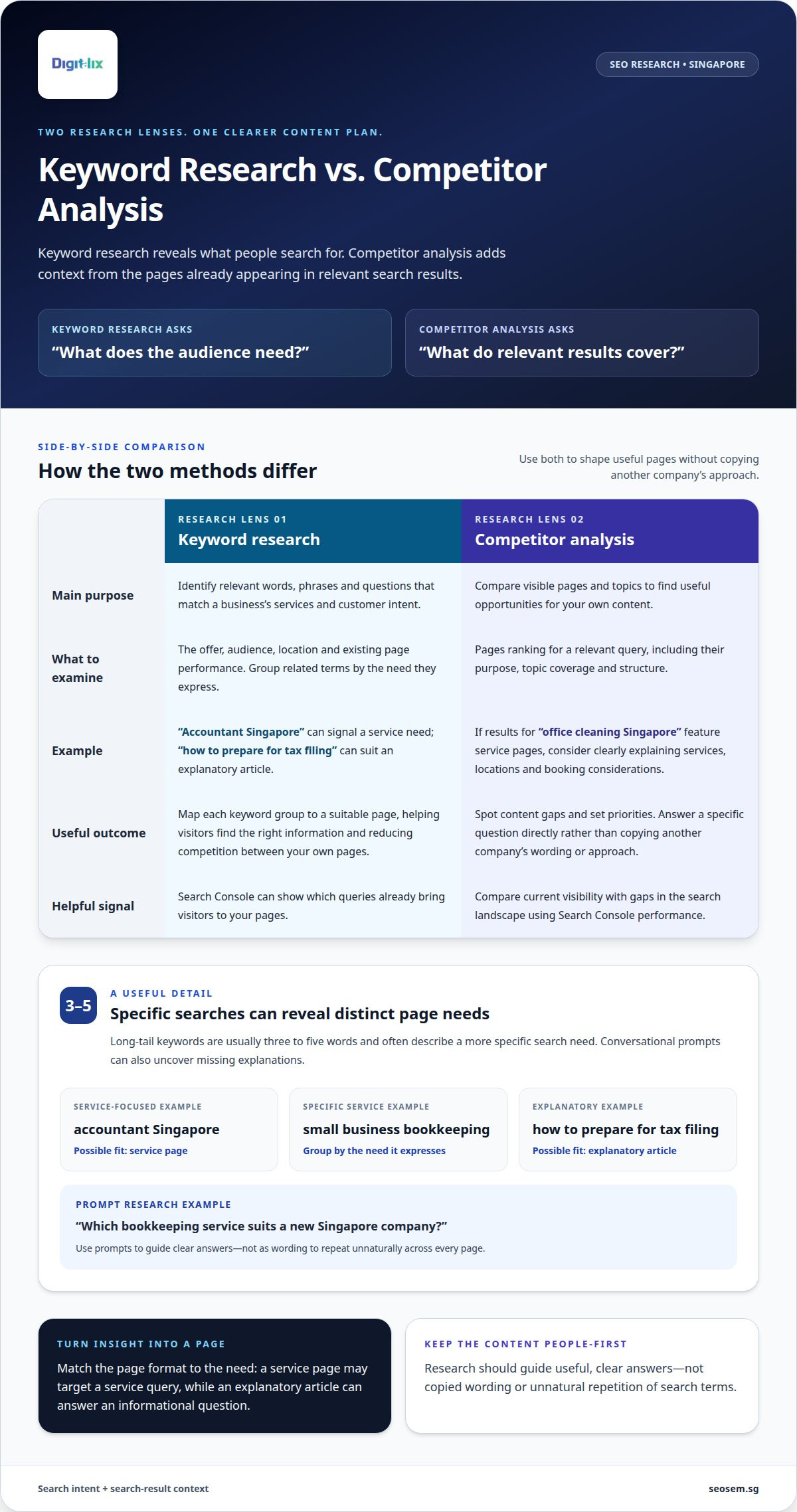
Keyword research connects the language people use with the pages a business needs. Competitor analysis adds context by showing which topics already appear in relevant search results.
Competitor Analysis
Competitor analysis compares other websites’ visible pages and topics to identify useful opportunities for your own content. A Singapore business can use it to find gaps without copying another company’s wording or approach.
An SEO professional reviews pages ranking for a relevant query, then considers their purpose, coverage and structure. For example, if search results for “office cleaning Singapore” feature service pages, a useful page should clearly explain services, locations and booking considerations. A blog post about the history of cleaning would likely meet a different need.
This review also helps set realistic content priorities. A competitor may cover a broad topic, while your business can answer a specific question more directly. Search Console performance can show which queries already bring visitors to your pages, helping an SEO professional compare current visibility with gaps in the search landscape.
Search Terms and Keyword Research
Keyword research identifies relevant words, phrases and questions that match a business’s services and customer intent. An SEO professional considers the offer, audience, location and existing page performance, then groups related terms by the need they express.
For example, “accountant Singapore,” “small business bookkeeping” and “how to prepare for tax filing” signal different needs. A service page may target the first phrase, while an explanatory article can address the third. Long-tail keywords are usually three to five words and often describe a more specific search need.
Prompt research adds conversational questions people may ask search engines or AI tools, such as “Which bookkeeping service suits a new Singapore company?” These prompts can reveal missing explanations. Use them to guide clear answers, not as repeated wording inserted unnaturally into every page.
Professionals also map each keyword group to a suitable page. This helps visitors find the right information and reduces competition between a business’s own pages. Google says meta keywords are not a focus for Search optimisation, so time is better spent creating useful page content.
A page title should describe its subject and include relevant wording naturally. A meta description summarises the page in search results and can help visitors decide whether to click. Metadata does not directly improve rankings, but an accurate, engaging description can support click-through.
Keyword metadata should not be confused with visible page content. Google does not use the meta-keywords tag as a focus for Search optimisation. Instead, an SEO professional aligns the page title, description, headings and copy with the query’s intent, then reviews performance in Search Console after publishing.
For example, a Singapore consultancy could target “business accounting services” on its main service page and answer “what records should a new business keep?” in a separate guide. Discuss keyword research priorities when your pages need a clearer connection to relevant searches.
Image alt text and video optimisation
Images and video can make a webpage more useful, but search engines need clear context about media. Descriptive text, captions and structured data help explain how each asset relates to its page.
Image Alt Text and Captions
Alt text briefly describes an image’s meaningful content, while a caption gives visitors visible context. These details help people understand an image and support accessibility when it cannot be viewed.
Write alt text for the specific image, not as a list of keywords. For example, a photograph showing a café counter could be described as “barista preparing kopi at a Singapore café counter.” If an image is purely decorative and adds no information, don’t force search terms into its description.
Captions can explain details that alt text does not need to repeat. A caption might identify the item shown or clarify why it matters to the page’s audience. Keep both descriptions accurate: a product photograph should describe the product shown, not claim features the image cannot establish.
Video also benefits from clear descriptions that explain its subject. A page featuring a tutorial about choosing office furniture, for instance, should make that topic clear in nearby text. Keep the description aligned with the video so visitors know what they will learn before watching.
Image Optimisation and Markup
Image optimisation makes media easier to understand and more efficient to use on a webpage. Descriptive file names, relevant surrounding copy and suitable formats help connect each asset to the page’s subject.
Use concise file names that identify the content, such as “Singapore-office-interior” rather than a string of camera-generated characters. A simple page URL should describe its subject and separate words with hyphens. Keep filenames and URLs readable, and avoid unrelated keywords added just to influence rankings.
Schema.org markup is structured data that labels information on a webpage for search engines. On an e-commerce product page, structured data can describe product details in a consistent format. It complements visible page content rather than replacing accurate descriptions, captions or relevant media.
Review each asset in context: does it support the page’s purpose, and can a visitor understand its relevance? For a Singapore retailer, a product image, its description and nearby product information should all refer to the same item. This consistency helps search engines interpret the webpage and gives visitors a clearer experience.
For video, describe the subject accurately in page text and use a relevant title. Present a short product demonstration as a demonstration, not as a broader guide it does not contain. These practices make media clearer without treating keywords as a substitute for useful information.
On-page elements such as titles, headings, and alt text
On-page elements give each webpage a deliberate structure, from its browser label to the sections visitors read. Their value lies in precision: each element should serve a distinct role rather than duplicate nearby text.
Page Titles and Headings
Page titles and headings create a hierarchy that helps visitors scan a page and understand how its ideas fit together. For a Singapore consultancy, a service page might use headings to separate its specialisations, client sectors and engagement process.
Keep the main heading focused on the page’s central subject, then use subheadings for supporting details. A section about accounting services could have one subheading on bookkeeping, followed by another on financial reporting. This structure helps people navigate longer pages without repeating the same keyword in every heading.
Semantic heading order also supports screen-reader users, although heading order itself does not affect Google Search. Choose heading levels for their structural role, not simply to make text larger. Visual styling can be adjusted separately from the underlying hierarchy.
Title Tags and Meta Descriptions
Use page-level metadata as a quality-control layer across a website, especially when several pages cover related services. A distinct title for each page can help prevent pages from competing with one another or appearing interchangeable in browser tabs.
For example, a consultancy could distinguish a page about bookkeeping from one about payroll support, even if both sit under the same services menu. A consistent review process can catch copied titles, outdated descriptions and page labels that no longer match the business’s current offer.
A meta description typically contains two full sentences. Use that space to specify the page’s scope and a useful detail, such as its audience or the information it covers. For a Singapore business guide, the description can distinguish advice for new businesses from guidance for established companies.
Title Links and Search Snippets
In search results, a title link and its supporting snippet give users a compact preview of a page. The practical test is whether that preview sets an accurate expectation for the visit.
Google can generate title links and snippets using page content, so consistency matters beyond metadata fields. If a page’s title refers to payroll services but its main content focuses on bookkeeping, the mismatch can confuse searchers. Align the page’s visible language and metadata, then review how the result appears for relevant queries.
Search Console can help identify queries associated with a page. Use that information to assess whether the displayed wording reflects what visitors need. A well-aligned preview makes it easier for the right audience to choose the right result.
How search engines and AI platforms work
Google Search is an automated system that discovers web pages, processes their content and presents relevant results. AI platforms use information from sources to generate responses, so businesses need content that is accessible and clear to people and automated systems alike.
Discovery comes first. Googlebot, Google’s crawler, follows links between pages and explores the web. A page linked from an established, relevant page is easier to discover than one with no clear path. A sitemap can describe a site’s pages, but submitting one is optional and isn’t required for Google to find a website.
Discovery doesn’t mean a page is indexed. Google processes a discovered page and decides whether to include it in its index, the stored collection used to produce results. A page that blocks crawling or relies on content search engines cannot understand creates barriers. Clear navigation, accessible text and links between related pages help Google interpret a site’s structure.
When someone searches, Google evaluates indexed pages and orders results according to relevance and other systems. The search engine results page, or SERP, can include organic listings and other features. For example, a Singapore user searching for “accounting services for small businesses” needs results that match both the service and the purpose of the query.
AI-powered search adds a response-generation layer. Rather than only listing pages, an AI feature can present a summary and identify sources supporting its answer. It needs understandable, well-organised content specific enough to support a claim. A page explaining how a service works, who it suits and what it involves gives an answer system clearer material to interpret than a vague promotional statement.
That changes the practical target, but doesn’t replace sound search fundamentals. Businesses still need pages crawlers can reach, content that answers real questions and information that supports its claims. Structured data can label page details, while clear headings and descriptive internal links show how topics connect. These signals help systems interpret content, but they don’t guarantee a particular position or citation.
For example, a Singapore retailer publishing a detailed guide to choosing a product can connect it to relevant category and product pages. Google can follow those links, while a generative system can draw on the guide’s clear explanations. The useful takeaway is to build a source worth finding: answer a specific need, support claims with meaningful detail and make the page easy to navigate.
Digitalix: Search Engine Optimisation (SEO)
Digitalix helps Singapore businesses strengthen their organic search visibility through Search Engine Optimisation (SEO). Turn to its team when your website needs a clearer content strategy, stronger keyword alignment or improvements to how search engines discover and understand its pages.
The work can connect keyword research, competitor analysis, on-page content and technical checks to your business priorities. A professional approach also helps identify which pages need attention first and how to measure progress using relevant search and conversion data. Explore SEO services in Singapore when you’re ready to make search visibility part of your growth plan.
Contact Digitalix to discuss your SEO needs.
Turn search visibility into a growth plan
The next step is to connect search activity with the business outcomes that matter to your Singapore operation. A focused website search engine optimization programme should support clear priorities, such as attracting qualified enquiries, helping customers understand your offer or growing online sales. That focus gives decisions a commercial purpose, rather than treating rankings as the end goal.
Set a direction based on your audience, capacity and growth plans. A business entering a new market may prioritise awareness, while an established retailer may focus on product discovery and sales. As priorities change, the search strategy can evolve too. Digitalix helps translate your goals into a practical SEO approach that fits your business.
Frequently Asked Questions
Why is SEO important for your business?
SEO can help a Singapore SME attract customers researching a product or service before making contact. For example, a furniture retailer can use its website to explain delivery options, product materials and care guidance, while Shopee supports marketplace discovery. A useful website can answer questions a product listing may not address. Measure value through relevant enquiries, bookings or sales, not traffic alone.
How is SEO different from paid search?
SEO and paid search can serve different business priorities. A Singapore retailer might use Google Ads to promote a time-sensitive sale while developing website content for ongoing product research. Compare the channels by the customer action each supports, the campaign or content investment involved, and the quality of resulting enquiries. Reviewing outcomes together helps SMEs allocate marketing resources as priorities change.
How long until I see impact in search results?
SEO impact usually develops over weeks to months, and significant results typically take around six months. Timing depends on the site’s starting condition, competition and the work required. For a Singapore SME, useful early indicators include whether target pages are being discovered and whether relevant impressions change. Later, assess qualified enquiries or sales to see whether increased search visibility supports business outcomes.
What are the three main types of SEO?
The three commonly used types are on-page, technical and off-page SEO. For a Singapore SME, these are three parts of one growth plan: improve the information on a service page, address barriers that prevent search engines accessing it, and build the site’s reputation through relevant external references. The right balance depends on the website’s specific gaps and business priorities.
What does SEO mean?
SEO stands for search engine optimisation. In practical terms, it describes work that helps a business become easier to find through search. For a local Singapore service business, the work may begin by clarifying which services it provides and which customer questions its website should answer. That shared understanding helps business owners, writers and marketers make consistent decisions about the site’s content and priorities.
What is SEO?
SEO is an ongoing business activity, not a one-off website launch task. It involves aligning pages with customer needs, maintaining a site search engines can access and reviewing performance as the business changes. For example, an SME that adds a service can create a dedicated page, connect it to relevant existing content and monitor whether it attracts enquiries from the intended audience.
What is website search engine optimisation (SEO)?
Website search engine optimization focuses on a business’s own website, including its service pages, navigation and content. That differs from optimising a Shopee or Lazada store, where product listings and marketplace features shape discovery. A retailer selling through both its website and Shopee may need distinct content for each channel, with the website supporting broader product education and the marketplace serving shoppers browsing listings.
How do search engines rank websites in Singapore?
Search results in Singapore can reflect a query’s wording and local intent. Someone seeking a service in Tampines may value information that clearly explains the provider’s relevant services and location. Businesses serving Orchard, Jurong or other areas should make their actual coverage clear in useful page content. Avoid adding place names when they do not help customers understand the business.