You can run Instagram ads without posting on your account every day. Your actual spend depends on the campaign goal, audience and competition.
It’s reasonable to want a clear budget before you launch, especially if your account isn’t publishing content regularly. Paid campaigns can reach people beyond your existing followers, but your ad creative and landing page still need to give them a clear reason to act.
This guide explains how to estimate spending for traffic, leads, ecommerce and retargeting. You’ll also see which factors influence costs, how to set a test budget and when to adjust your campaign based on performance.
Key Takeaways
- Set your campaign objective first, then estimate spend using the metric that matches it, such as clicks, leads or purchases.
- Refine audience targeting and creative together; competition, audience size and relevance can all affect delivery costs.
- Use a controlled test to compare ad formats and messages before making larger budget changes.
- Assess ecommerce and retargeting campaigns against their distinct roles: generating purchases and reconnecting with people who already showed interest.
- Use Instagram Marketing support when you need a structured approach to campaign setup, optimisation and performance measurement.
How Much do Instagram Ads Cost?
Estimate Instagram ad spend by matching the campaign objective to the cost per result. In Singapore, audience choice, competition and creative all influence delivery costs.
For GST and invoicing, review the billing entity and tax details shown on the platform’s billing documents. Keep records of those documents and distinguish ad spend from any separate agency invoice.
-
Choose Audience Targets and Campaign Objectives
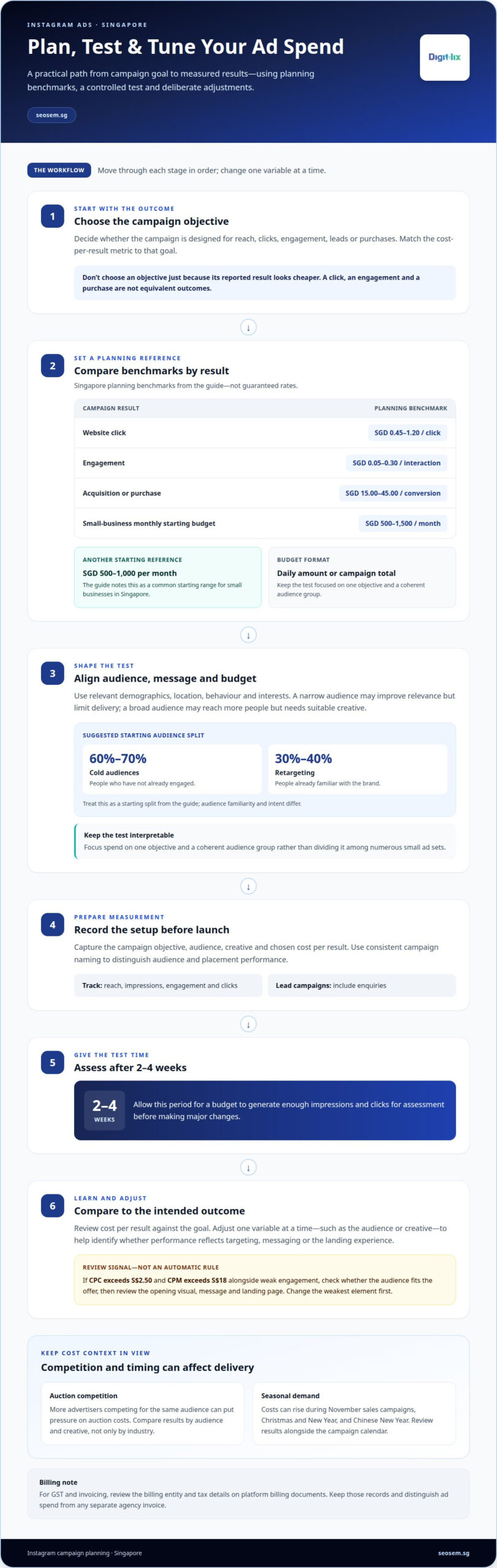
Define the action first: reach, clicks, engagement, leads or purchases. Then select audiences using relevant demographics, location, behaviour and interests. A narrow audience can improve relevance but limit delivery; a broad audience may reach more people but needs suitable creative. Avoid choosing an objective simply because its reported result appears cheaper. The objective should reflect the business outcome the campaign is designed to achieve.
-
Review Cost Benchmarks by Objective
Use Singapore market benchmarks as planning references, not guaranteed rates. Costs differ because each objective asks the platform to find a different kind of response. Compare like with like: an engagement is not equivalent to a purchase, and a click doesn’t prove a visitor became a customer.
Campaign result Singapore planning benchmark Website click SGD 0.45 – SGD 1.20 per click Engagement SGD 0.05 – SGD 0.30 per interaction Acquisition or purchase SGD 15.00 – SGD 45.00 per conversion Small-business monthly starting budget SGD 500 – SGD 1,500 per month - Choose a test budget that can produce useful campaign data. Small businesses in Singapore commonly start with SGD 500 to SGD 1,000 per month. Budgets can be set as a daily amount or a campaign total. Focus the test on one objective and a coherent audience group rather than dividing spend among numerous small ad sets.
- Configure measurement before launch. Record the campaign objective, audience, creative and chosen cost per result. Track reach, impressions, engagement and clicks; for lead campaigns, include enquiries. Consistent campaign naming helps distinguish audience and placement performance when reviewing results.
- Allow 2-4 weeks for a budget to generate enough impressions and clicks for assessment before major changes. Compare the cost per result with the intended outcome, then adjust one variable at a time, such as audience or creative. This helps identify whether results reflect targeting, messaging or the landing experience. Businesses wanting structured campaign support can explore Facebook and Instagram marketing with Digitalix.
Targeting, objective, industry and creative cost factors
Audience size, competition and ad relevance shape delivery costs in Singapore. Use these steps to refine targeting and reduce wasted spend.
-
Select Audiences for Instagram Advertising in Singapore
Separate people who already engaged from new prospects before building ad sets. As a starting split, allocate 60%-70% of budget to cold audiences and 30%-40% to retargeting. Retargeting focuses spend on people familiar with your brand, while lookalikes help reach similar prospects. Avoid treating these groups as interchangeable; their familiarity and intent differ.
-
Optimise Instagram Ad Targeting, Creative and Funnel
Match each audience to creative and a landing experience suited to its stage. Show product details to new prospects and a direct purchase prompt to previous visitors. Test one major change at a time, such as the opening visual or audience definition. This makes optimisation clearer than changing creative, targeting and funnel together.
- Choose targeting options that reflect the offer and customer location. Instagram targeting can use demographics, location, behaviour and interests. A retailer serving Singapore may focus on Orchard, CBD, Jurong, Tampines, Woodlands, Buona Vista and Paya Lebar where relevant. Keep the audience aligned with where customers can buy or receive the service.
- Account for competitive conditions in your industry. A high-demand vertical can attract more advertisers for the same audience, putting pressure on auction costs. Compare results by audience and creative, not only by industry. A specific message can make an offer clearer, while a generic image may earn less attention from a relevant audience.
- Plan around seasonal demand when timing permits. Instagram advertising costs in Singapore can rise during November sales campaigns, Christmas and New Year, and Chinese New Year. Review results alongside the campaign calendar, because higher costs during peak periods may reflect increased competition. Avoid scaling solely because reach or impressions increased.
- Use performance signals to decide what to adjust. Consider a targeting or creative problem when CPC exceeds S$2.50 and CPM exceeds S$18 alongside weak engagement. Check whether the audience fits the offer, then review the opening visual, message and landing page. Change the weakest element first to make the next result easier to interpret.
- Record audience, placement, creative and cost per result for each test. This can reveal whether a particular vertical responds to one message or format. For structured help with campaign decisions, discuss your Instagram campaign goals with the team.
Ad auction bidding and pricing factors
Meta’s real-time auction determines which Instagram ads compete for placements and what delivery your budget can support. Ads shown in Singapore must comply with Meta’s advertising policies and applicable local requirements; minimum-budget guidelines are S$5 per day for clicks, engagement or views, and around S$40 per day for lower-frequency actions such as app installs or offer claims.
-
Review Meta’s Instagram Advertising Auction in Singapore
Match your bid approach to the campaign objective before launch. Meta evaluates competing ads in real time, and the highest bid alone doesn’t determine delivery. The system also considers the likelihood of the desired action and the ad’s relevance. Check whether the selected objective reflects the result you value, then compare delivery and cost per result against that goal.
-
Set Instagram Ad Budgets and Bidding Options in Singapore
Choose a daily budget or a campaign-total budget, then select bidding controls that suit your cost priorities. Automated bidding can let Meta seek results within your budget, while a bid limit sets a ceiling for auction bids. A restrictive limit may reduce delivery, so weigh cost control against the volume needed to evaluate the campaign.
- Keep the budget distinct from the bid. The budget sets your planned spend; the bid influences how the campaign competes for available placements. For example, an engagement campaign and a purchase campaign pursue different outcomes, even if both use the same budget. Avoid comparing their costs as though they were identical results.
- Check campaign performance using the metric tied to its objective. For engagement, review engagement cost; for sales, examine purchase results and value. If results become more expensive, inspect audience competition, creative relevance and the chosen optimisation event before changing bids. Raising the bid alone may not solve a mismatch between the ad and the intended action.
- Account for changes in auction competition over time. Singapore sales periods can attract more brands bidding for attention. Compare performance across similar campaign periods and keep the audience and objective stable when possible. If you change several settings together, you may not identify whether the bid, creative or competing demand affected delivery.
- Build a policy review into campaign preparation. Check Meta’s requirements for the advertised product, claims, creative and destination page. Keep the offer and landing page consistent, and avoid misleading wording or unsupported claims. Policies can vary by product category, so review the relevant rules before publishing rather than assuming every ad type follows identical requirements.
- Test bidding changes methodically. Hold the audience and creative steady while comparing bid approaches, then record spend and the selected result. This gives you a clearer comparison than changing bids, targeting and content at once. Use the resulting evidence to decide whether to keep the current bidding approach or refine the campaign setup.
Ad creative and formats, including Stories and Reels
Creative affects whether an Instagram ad earns attention and action. Choose formats for the placement, then assess each version against the campaign objective.
-
Choose Ad Formats and Placements
Match the format to the placement and message. Use Feed ads for product details, Stories for a direct, full-screen message, and Reels for short-form video. Feed and Stories campaigns commonly achieve a click-through rate of 0.7%-2.5%. Compare each placement’s results separately, so strong performance in one format doesn’t hide weak results elsewhere.
-
Design Creative for Mobile-First Ads
Build the main idea for a phone screen: lead with the product or benefit, keep copy brief, and make the next action obvious. For example, a local café can show a signature drink before displaying its booking prompt. Check that text remains readable and the key visual stays clear when viewed vertically.
- Use a strong opening in video creative. Instagram video ads can achieve twice the engagement level of other types of posts. Show the product, service or problem quickly, then use captions and on-screen text to support the message. A Reel introducing a skincare routine, for example, can demonstrate the first step before inviting viewers to learn more.
- Produce versions suited to the placement rather than stretching one asset across every format. Keep essential text and product details visible in vertical Stories and Reels, and check that Feed crops preserve the main subject. Avoid placing calls to action near edges where interface elements may compete for attention.
- Connect creative to the audience’s stage. A first-touch ad can explain what the offer does; a retargeting ad can feature a product detail or customer question. Keep the promise consistent between the Instagram ad and its landing page. If the ad promotes a limited-time offer, make the same offer clear after the click.
- Test one creative variable at a time. Compare an opening product shot with a people-focused image, or a demonstration with a static visual. Keep the audience and objective stable during the comparison. This makes it easier to see which creative change affected engagement or clicks, rather than confusing creative impact with targeting changes.
- Review placement-level results before refreshing assets. Track impressions, engagement, clicks and cost per result for each format. If a Reel earns attention but few site visits, strengthen its call to action or landing-page continuity. Treat each adjustment as a digital marketing test, especially during Singapore sales periods when competition can intensify.
Traffic, lead generation, e-commerce, and retargeting costs
Estimate spend against the outcome each campaign must generate. For regulated products and services, review Meta’s advertising policies and Singapore’s applicable requirements before launch; restrictions depend on the product category and claims.
- Estimate traffic spend. Treat this as a planning estimate, not a guaranteed result.
- Budget for leads. Estimate spend by multiplying your expected lead volume by a realistic cost per lead.
- Assess ecommerce performance. Instagram campaigns can optimise for conversions, including purchases. Compare this with your margins, fulfilment costs and average order value.
- Use retargeting deliberately. Retargeting campaigns often have lower costs, but their scale is limited by the size of the engaged audience. Reach people who viewed products or interacted with previous ads, then measure purchases or enquiries. Avoid allocating the entire budget to retargeting if the audience pool is small.
- Separate awareness from direct response. Awareness campaigns focus on reach and impressions, while traffic campaigns seek clicks and lead campaigns aim for enquiries. Compare cost per result only between campaigns with matching objectives.
- Reduce avoidable waste. Match the landing page to the ad promise, remove irrelevant audience segments and test one creative change at a time. For a Singapore retailer, a product ad should lead directly to the promoted product, not a general homepage. Review clicks and conversions together to spot drop-offs.
- Scale based on business value. Review lead quality, purchase value and cost per result before increasing spend. If a campaign generates clicks but few conversions, investigate the offer and landing experience first. A lower click cost alone doesn’t show whether the campaign supports profitable commerce.
Review Meta’s advertising policies and Singapore’s applicable requirements before launching; restrictions vary by product category and the claims made.
Check Meta’s advertising policies and Singapore’s applicable requirements before launch. Restrictions depend on the product category and the claims in the ad.
Digitalix: Instagram Marketing
Digitalix helps Singapore businesses plan and manage Instagram Marketing when campaign costs, audience choices or performance tracking become difficult to handle internally. The work connects your objective, audience, creative and landing experience, so campaign decisions focus on measurable results rather than clicks alone.
Turn to Digitalix when you need a clearer testing plan, more consistent optimisation or support aligning Instagram ads with broader digital marketing activity. If your customers also shop on Shopee, Shopee Management can complement the channel strategy; Search Engine Marketing (SEM) can support demand from search.
Share your business goals, target audience and current campaign challenges with Digitalix to discuss a practical next step.
Turn your campaign plan into a growth system
Build your next decision around what happens after someone sees an ad. A useful Instagram advertising strategy in Singapore connects the campaign to a clear customer journey, from discovery through to purchase or enquiry. That perspective helps you decide where creative, landing pages and follow-up need attention next.
Digitalix can help align Instagram Marketing with other channels when your growth plan extends beyond social media. Search Engine Marketing (SEM) can capture active search demand, while Search Engine Optimization (SEO) supports longer-term visibility. For businesses selling through Shopee, Shopee Management can connect marketplace activity with broader marketing priorities.
Choose the next step that addresses your biggest growth constraint, whether that’s campaign execution, channel alignment or a stronger route from click to conversion. A focused plan gives your team a practical direction for improving performance over time.
Move forward with a clear objective and a strategy built around your business. Your next campaign can be a sharper step towards sustainable growth.
Frequently Asked Questions
Can I run ads without posting on my IG account regularly?
Yes, you can run paid campaigns without publishing feed posts frequently. Build the ad around a clear offer, strong creative and a useful destination, such as a product page or enquiry form. Before launch, make sure your Instagram profile accurately represents the business; interested viewers may visit it after seeing an ad. A consistent posting schedule can support trust, but it isn’t the only way to reach potential customers.
How are the Costs of Instagram Ads Determined?
Instagram ad costs depend on the campaign objective, audience, competition, creative and bidding settings. A campaign optimised for website visits seeks a different result from one seeking purchases, so their costs shouldn’t be compared as if they were equivalent. For a useful assessment, track the cost per result alongside the outcome’s business value. For example, compare lead costs with qualified enquiries, not clicks alone.
Is Instagram still worth advertising on in 2025?
It can be worth testing if your target customers use Instagram and your offer suits visual formats such as Reels, Stories or Feed ads. Since 2025 has passed, use current campaign performance rather than an old forecast to judge its value in 2026. Start with one defined business objective, then assess whether the traffic, enquiries or purchases justify continued spend compared with your other marketing priorities.
What’s a good starting budget?
For a small Singapore business, a practical starting range is . Another planning guideline is at least S$5 per day for campaigns billed on clicks, engagement or views; low-frequency actions, such as app installs or offer claims, may need around S$40 per day. Choose a budget that lets you test one objective and interpret its results without spreading spend across too many campaigns.
How much does Instagram advertising cost in Singapore?
Instagram advertising in Singapore has no single fixed rate. Typical market benchmarks include , , and about S$20-S$60 or more per acquisition or purchase. These ranges vary with audience and campaign conditions. Use them as estimates for planning, then compare actual results with your campaign’s goal and the value of each action.
What are the Instagram ad formats available in Singapore?
Common Instagram ad formats include Feed ads, Stories and Reels. Choose based on how people should experience the message: a Feed placement can present product details, while a vertical Story or Reel can deliver a mobile-first visual sequence. Prepare creative that fits each placement and keep the offer consistent. Compare format performance using the same objective, so placement differences don’t obscure the result.
What Instagram ad targeting options are available for Singapore audiences?
Instagram audience targeting can use demographics, location, behaviour and interests. A local service business could focus its campaign on relevant Singapore locations, while an online retailer might prioritise interests connected to its products. Retargeting can reach people who previously engaged with the business or its ads. Keep each audience aligned with the offer, and avoid dividing a limited budget across overly narrow groups.
What benchmarks are available for Instagram ad CPM, CPC, CTR, and conversion rates in Singapore?
Feed and Stories campaigns commonly record a 0.7%-2.5% click-through rate.