Digital Marketing Solutions: A Practical Growth Framework for Singapore Businesses start with a simple question: what if your next growth opportunity is not another marketing channel, but a clearer connection between the ones you already use? Search, paid ads, social media and marketplaces can each play a role, but disconnected activity makes it harder to see what is contributing to enquiries and sales.
The answer is not to invest in every channel. Prioritise according to customer behaviour and business goals, then connect campaigns to useful content, focused landing pages and reliable measurement. This guide shows you how to choose where to focus, link channels where they fit, and track indicators tied to business outcomes. You will have a practical way to assess performance and plan improvements without treating marketing as a collection of disconnected tactics.
Key Takeaways
- Choose channels according to your business objective and how customers discover and evaluate your offer, not popularity alone.
- Build a practical digital marketing solutions strategy by defining an outcome, audience, channel roles and tracking plan before launching activity.
- Use leading indicators to monitor progress, but connect them to outcomes such as qualified enquiries and completed purchases.
- Set a baseline, address conversion barriers and focus on one or two priority channels before expanding to more platforms.
- Match your marketing scope to your team’s capacity, then bring channel specialists together around a shared growth plan.
What digital marketing solutions include, and why Singapore businesses need a connected plan
Digital marketing solutions are coordinated online channels and activities designed to achieve measurable business objectives. They can include search engine optimisation (SEO), paid search, social media, content, websites and marketplace activity. The right combination depends on what a business needs to accomplish and how its customers make decisions. A coherent plan does not require every business to use every channel.
Adding platforms can increase the workload without improving the customer journey. Social posts might attract attention but lead to an unclear page. Paid search might promote an offer that the website does not explain well. In either case, activity is disconnected. The broader field of digital marketing includes many channels, but their value depends on how well they support a shared objective.
How discovery connects to conversion
Customers may encounter a business at several points before they enquire or buy. Give each touchpoint a useful role:
- Discovery: SEO can help a business appear when someone searches for a relevant product or service. Paid campaigns can introduce an offer to a defined audience.
- Consideration: Useful content answers questions, explains differences and gives potential customers reasons to explore further.
- Conversion: A clear landing page helps visitors understand the next step, whether that is submitting an enquiry or completing a purchase.
- Retention: Relevant follow-up content can support an ongoing relationship after the first interaction.
For example, a Singapore SME offering professional services might use search visibility to reach people comparing providers, publish content that answers common questions, and direct interested visitors to a focused page with a clear enquiry option. A search impression, page visit or social interaction is a touchpoint, not a business outcome. Track enquiries and completed sales separately. Businesses building organic visibility can connect SEO services in Singapore with content and pages that help visitors take the next step.
Why Singapore SMEs need focus before adding channels
Every channel draws on an SME’s time, budget and team capacity. Managing more platforms can mean creating more content, responding to more interactions and maintaining more pages. Prioritisation helps teams direct effort towards the business objective instead of spreading work across channels without a clear reason.
Singapore’s continuing digitalisation makes online discovery and transactions relevant to many businesses, but it does not make every platform equally suitable. An SME selling products online may find Shopee or Lazada relevant because customers can discover products within those marketplaces. A business that depends on considered service enquiries may need to focus instead on search visibility and a clear website journey. Start with where customers are likely to find and evaluate your offer. Then select channels your team can support consistently. Expand when existing activity has a defined role and can be assessed against the objective.
How a digital marketing solutions strategy turns goals into measurable activity
A useful strategy translates a business priority into actions the team can track, review and adjust. Before choosing channels, decide what progress should look like. A marketing KPI is useful when it is tied to a specific business objective. If the goal is to generate qualified enquiries, for example, track enquiry submissions and assess whether they come from the intended audience. Do not treat every website visit as success.
Set objectives and KPIs before launching digital marketing solutions
Use SMART goals as a planning tool: make objectives specific, measurable, achievable, relevant and time-bound. This clarifies what to measure and when to review it, but does not guarantee a result. A business aiming to increase suitable service enquiries can define what counts as qualified, which actions indicate intent and how the team will report progress.
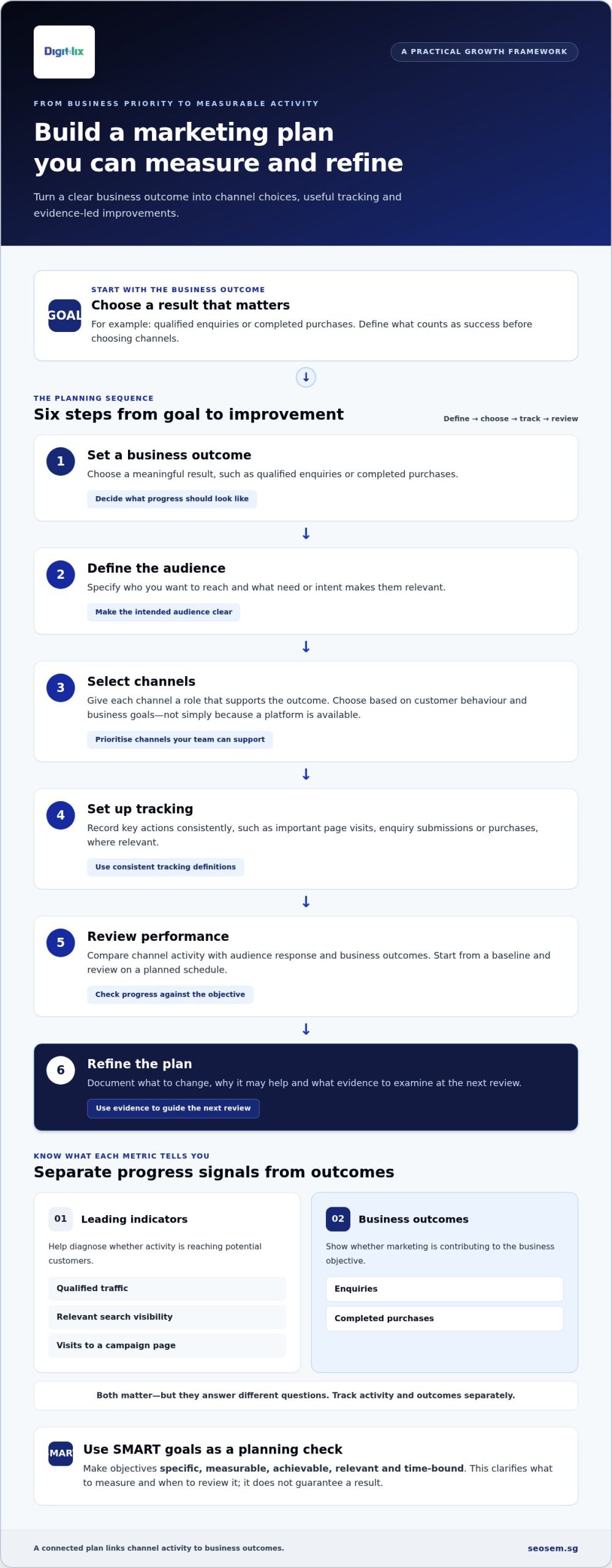
Build the plan in sequence:
- Set a business outcome. Choose a meaningful result, such as qualified enquiries or completed purchases.
- Define the audience. Specify who you want to reach and what need or intent makes them relevant.
- Select channels. Give each channel a role that supports the outcome instead of choosing it simply because it is available.
- Set up tracking. Record key actions consistently, including important page visits, enquiry submissions or purchases, where relevant.
- Review performance. Compare channel activity with audience response and business outcomes.
- Refine the plan. Document what to change, why it may help and what evidence to examine at the next review.
Separate leading indicators from outcomes. Qualified traffic, relevant search visibility and visits to a campaign page can show whether activity is reaching potential customers. Enquiries and completed purchases are outcomes. Both matter, but they answer different questions: leading indicators help diagnose progress, while outcomes show whether marketing is contributing to the business objective.
Build a measurement loop from campaign data to optimisation
Start with a baseline so future comparisons have context. Use consistent tracking definitions across campaigns, then review performance on a planned schedule. Record what you observed, what you changed and what the change is intended to test. This creates a learning loop rather than a series of disconnected campaign adjustments.
Interpret results in context. A campaign may attract relevant visitors, but an unclear offer or next step on the landing page can affect what they do afterwards. Analytics setup matters too: if enquiry events are not recorded consistently, reported conversions may not reflect the full journey. Assess paid search management alongside the landing page and tracking used to interpret campaign activity.
Attribution helps organise evidence about the touchpoints associated with an enquiry or purchase. It does not always prove that one channel caused the sale. A customer might discover a business through search, return through an ad and convert later through a direct visit. Treat attribution as a decision aid, then weigh it alongside campaign data and business outcomes. For a practical discussion of your objectives, visit Digitalix’s contact page.
Which digital marketing solutions fit your goals: SEO, paid search, social, or marketplaces?
No channel is universally best. Choose according to how your audience discovers and evaluates your offer, the action you want them to take, the resources available to maintain each channel and whether you can measure the next step. A business with an established website may prioritise search, while a product seller may need marketplace visibility. The right mix follows the customer journey and business objective.
| Channel | Best-fit objective | Useful indicators | Key dependencies |
|---|---|---|---|
| SEO | Build organic visibility for relevant searches over time. | Search impressions, organic visits, relevant page engagement, enquiries or purchases. | Technical website health, useful content and ongoing optimisation. |
| SEM and paid search | Reach people searching for a relevant service or product. | Ad impressions, clicks, landing-page actions and tracked conversions. | Clear targeting, suitable ad messaging, landing pages and conversion tracking. |
| Facebook and Instagram marketing | Support audience engagement, campaign reach and product or service discovery. | Reach, engagement, link visits and relevant enquiries or purchases. | Audience fit, consistent creative and a clear next step. |
| Content | Answer questions, explain an offer and support awareness, consideration and search visibility. | Content visits, engagement, assisted enquiries and relevant search visibility. | Audience needs, useful topics and links to relevant pages. |
| Web and landing-page design | Help visitors understand an offer and take action. | Important page actions, form submissions or completed purchases. | Clear messaging, usable page structure and reliable analytics. |
| Marketplace management | Support product discovery and purchases within platforms such as Shopee or Lazada. | Product views, listing engagement and marketplace orders. | Accurate listings, relevant product information and platform activity. |
When SEO or paid search supports demand capture
SEO builds organic visibility for searches that match a business’s expertise or products. It relies on relevant pages and ongoing optimisation. Search indicators help show whether the site appears for useful queries and attracts relevant visitors. SEO services in Singapore can bring technical work, content and reporting together around that visibility objective.
SEM uses paid search placements to reach people searching for relevant terms. It offers more direct control over campaign targeting and messaging, while requiring active management of ads, landing pages and tracking. Clicks show that an ad attracted attention, but they do not establish whether it contributed to a qualified enquiry or purchase. Assess paid activity against the action the campaign is meant to support.
When social media, content or marketplaces support discovery
Facebook and Instagram can help a business engage audiences and extend campaign reach. Content can answer questions that arise after discovery, support consideration and strengthen relevant search pages. For Singapore sellers whose customers browse marketplaces, Shopee and Lazada provide a platform-based discovery path. Marketing on these platforms fits that objective more directly than adding marketplace activity without a product-led reason.
Channel choice is also a resource decision for SMEs. The OECD’s Singapore digitalisation support framework provides context for digital adoption, but each business still needs to match its plan to its audience and capacity. Start with the channel closest to the desired customer action, then expand when your team can maintain it and evaluate its contribution.
How to implement digital marketing solutions in Singapore without spreading resources too thin
A practical rollout starts with what is limiting growth now, not with a long list of channels. For a Singapore SME, that might be low visibility for an important service or a website that attracts visitors but makes the next step hard to understand. Address the most direct barrier first, then add activity your team can manage and measure.
Prioritise a first phase around your business and customer journey
Use this staged roadmap to create a focused plan:
- Establish a baseline. Record current visibility, relevant website activity, enquiries or purchases, and how those actions are tracked. Note data gaps so you do not mistake missing measurement for weak performance.
- Fix conversion barriers. Check that the offer is clear, key information is easy to find and the next step works. A page that needs clearer messaging may be a higher priority than another campaign.
- Prioritise one or two channels. Choose activities that address the main bottleneck and match how customers discover or evaluate your offer. Assign an owner, select indicators and set review dates.
- Expand based on evidence and capacity. Review what the first phase shows, document what needs improvement, and add another channel only when the team can support it without weakening existing work.
Keep the scope realistic. A small team may maintain search optimisation and a focused landing page more consistently than frequent activity across several social platforms, paid campaigns and marketplaces. Another business may already have strong website foundations and need to test a paid channel. Set the sequence according to available skills, time and budget rather than assuming every SME needs the same plan.
Singapore’s digitalisation context includes work associated with IMDA and Smart Nation 2.0, but broad initiatives do not determine which marketing channel suits an individual business. Base that decision on customer behaviour, the business objective and the team’s ability to execute. When evaluating external support, look for a scope, measurement approach and working plan that fit your company’s needs.
Build compliance and trust into Singapore campaigns
Trust is part of implementation, not a final check. Make campaign claims clear and supportable, and ensure landing pages accurately explain the offer, relevant conditions and next step. Handle customer data responsibly, limit collection to what the activity needs and make the purpose clear to people providing their details. This helps keep the experience consistent from ad or post to enquiry form.
Financial promotions may require careful review against applicable MAS requirements. Do not assume the same rules apply to every business or campaign. Verify current requirements and their applicability before publication. Keep a record of the claims, pages and tracking used so your team can review both performance and customer experience.
How Digitalix connects digital marketing solutions to a Singapore growth plan
A growth plan should start with the business constraint, not a preset bundle of channels. Digitalix tailors digital marketing solutions to the objective, whether the priority is improving organic visibility, reaching people already searching, building audience engagement, supporting marketplace discovery or making a website easier to use. Each activity should have a defined role, a relevant indicator and a clear connection to the customer journey.
Match Digitalix services to the growth constraint
If potential customers struggle to find a business through search, SEO can support organic visibility and technical website improvements. Digitalix’s SEO management includes technical audits, backlink building, monthly reporting and strategy adjustments. These are service activities, not promises of rankings or a particular return. They help keep optimisation informed by the website’s condition and the available performance signals.
Other priorities call for different work. SEM and Google Ads management can support paid search activity, while Facebook and Instagram marketing can help a business engage audiences and extend campaign reach. Content creation can answer customer questions or explain an offer. Web and landing-page design can make key information and next steps clearer. For product sellers, Shopee or Lazada management can fit a marketplace-led discovery journey. Not every business needs every channel.
The useful question is how each specialist activity contributes to the same business objective. If a campaign attracts relevant visitors but the offer is difficult to understand, improving the landing page may matter more than increasing campaign activity. If the website supports enquiries but search visibility is limited, SEO may be a more relevant focus. This keeps the plan tailored instead of treating a range of services as a reason to do everything at once.
Turn the first conversation into a focused next step
Digitalix is based at Paya Lebar Square in Singapore and works with businesses on plans shaped around their needs. To make a discussion practical, set out your growth objective, the audience you want to reach, the channels already in use and any difficulty connecting campaign activity with enquiries or sales. These details help clarify the constraint and where coordinated work could support it.
A focused scope might centre on SEO and technical improvements, a paid search campaign with a suitable landing page, or content and social activity for a specific audience. The right combination depends on the business goal, existing digital assets and capacity to maintain the work. Plan measurement early so the team can assess activity against the intended objective without assuming that a channel guarantees results.
Make your next marketing decision count
Growth rarely starts with doing more. It starts with choosing a useful next move and giving it enough focus to learn from the result. For your business, that could mean clarifying a conversion path, strengthening visibility for a priority service or aligning campaign reporting with the outcomes your team needs to see.
Treat the plan as a working system, not a fixed checklist. Customer behaviour, business priorities and internal capacity can shift, so review the evidence and adjust the sequence. The value of digital marketing solutions comes from connecting decisions over time: each channel has a role, each activity has an indicator, and each review informs what to improve next. Progress is easier to direct when your team knows what it is testing and why.
You do not need a perfect forecast to begin. A clear objective and a practical first step can focus your effort, make future decisions more deliberate and build momentum towards sustainable growth. Keep learning from the data and use each improvement to guide the next.
Frequently Asked Questions
What are digital marketing solutions?
Digital marketing solutions are coordinated online activities that help a business reach customers and work towards measurable objectives. They may combine SEO, paid search, social media, content, web design and marketplace management. For example, a Singapore retailer could connect a product page, useful buying guidance and a marketplace listing around one customer need. The strategy comes from deciding how each activity supports that need, not simply collecting services in a list.
Which digital marketing solutions are best for a small business in Singapore?
No single channel is best for every small business. Start with a specific priority, such as getting discovered by customers in Orchard or the CBD, then consider how they search, compare and enquire. A neighbourhood service business may need a different mix from a seller serving customers across Jurong, Tampines, Woodlands, Buona Vista and Paya Lebar. Choose work your team can maintain and measure, then review before adding more.
How do businesses measure whether digital marketing solutions are working?
Measure progress against the action you want customers to take. A service firm could compare relevant search visits with completed enquiry forms, while an online seller could monitor product-page activity alongside completed orders. Keep campaign names and conversion definitions consistent so reports can be compared over time. Review trends alongside lead or order quality, since a rise in clicks alone may not mean the activity is contributing to a useful business outcome.
Is SEO or paid search better for a Singapore business?
Neither is automatically better; the choice depends on the business’s situation. SEO can be appropriate when a company wants to strengthen organic visibility for relevant searches, while paid search can help place ads against selected queries. To compare them, review existing search demand, the quality of your landing pages and your capacity for ongoing optimisation. If you use both, give each a distinct role so its contribution can be assessed clearly.
Can digital marketing solutions help a Singapore e-commerce business on Shopee or Lazada?
Yes, marketplace activity can support product discovery when customers already browse Shopee or Lazada for relevant items. Make sure product information, imagery and the purchase path are clear within the platform, then assess listing engagement and orders. Other channels may support discovery outside the marketplace, but give them a distinct role. Marketplace visibility does not guarantee purchases, so interpret activity alongside the broader customer journey and your operational capacity.
Do businesses in regulated sectors need to review digital marketing claims in Singapore?
Yes. Review marketing claims and applicable requirements before publishing, especially for financial promotions. MAS requirements may be relevant depending on the activity and context, so a general checklist may not settle the question. Verify current requirements and applicability with appropriate compliance expertise. Also make sure claims are accurate, supporting information is easy to understand and campaign pages match the message customers saw in the advertisement.
How should a business choose its first digital marketing channel?
Choose a first channel by identifying the biggest obstacle between customer interest and action. If relevant customers are not finding the business, discovery may be the issue. If visitors arrive but do not understand the offer, the page may need attention first. Check that the intended action can be tracked and assign someone to review it. A narrow, manageable first step gives the team evidence for its next decision without overloading resources.