The era of “guessing” your way to the top of the SERP is officially over. If your brand isn’t leveraging machine learning SEO strategies, you’re essentially fighting a high-speed data war with a paper map. With the 2026 rollout of Smart Nation 2.0 and the IMDA’s latest transparency guidelines for GenAI, the Singaporean digital landscape has shifted from creative intuition to a rigorous science of relevance. You’ve likely noticed organic traffic dipping as AI Overviews take up more real estate, leaving many SMEs feeling sidelined by the complexity of NLP and entity-based search.
We understand the frustration of watching your rankings fluctuate while competitors seem to move with predictive speed. This guide provides a clear, data-backed roadmap to reclaim your visibility and drive measurable growth in high-quality leads. You’ll master the intersection of data science and search to future-proof your brand against shifting algorithms. We’ll break down how to optimise for both traditional search and AI chatbots, ensuring your business remains the definitive answer in an AI-driven market.
Key Takeaways
- Understand how machine learning shifts SEO from manual keyword matching to predictive intent analysis, allowing for automated and precise content optimisation.
- Leverage Natural Language Processing (NLP) to identify hidden topical gaps and satisfy the deep semantic requirements of modern search algorithms.
- Master Generative Engine Optimization (GEO) to secure citations and high-authority visibility within AI chatbots like ChatGPT, Claude, and Gemini.
- Implement a 5-step data-driven framework specifically designed for Singapore SMEs to align digital growth with national Smart Nation 2.0 initiatives.
- Adopt advanced machine learning SEO strategies to transition your brand from reactive marketing to a proactive, science-led model of market dominance.
Why Machine Learning SEO Strategies are the New Standard for 2026
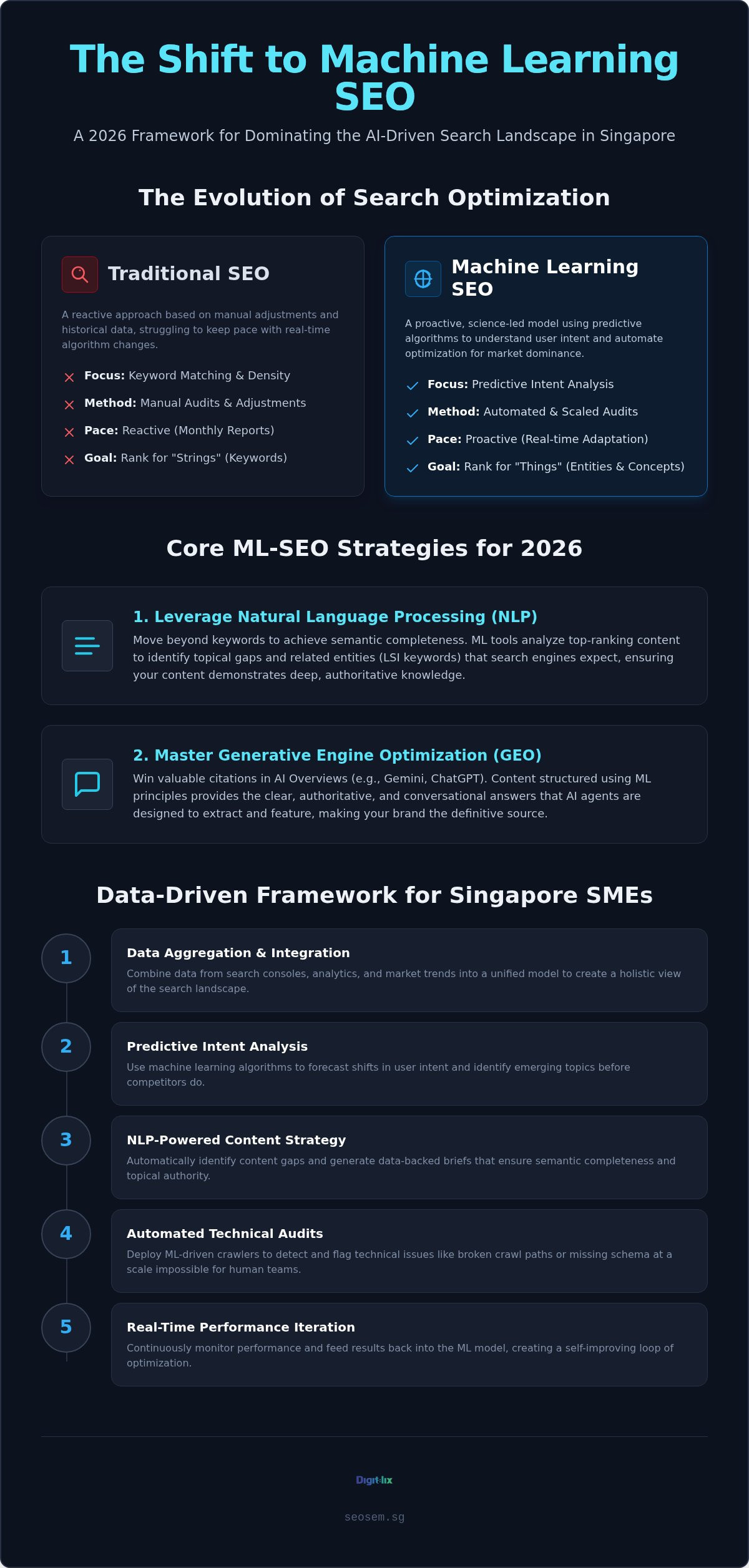
Machine learning SEO strategies represent the fundamental shift from manual keyword optimisation to automated, predictive ranking systems that use deep-learning algorithms to understand user intent and topical context. In 2026, these strategies are no longer optional for Singaporean brands. The sheer volume of data processed by search engines has rendered traditional, human-led adjustments obsolete. Success now depends on your ability to treat search as a rigorous science, using data-driven methodologies to stay ahead of real-time algorithm shifts.
Transitioning from Keyword Matching to Machine Learning SEO Strategies
Modern search engines have moved beyond simple “strings” or literal word sequences. They now focus on “things” or entities. This evolution means algorithms now understand the “why” behind a query from a user in Jurong or Orchard. Context is the most valuable currency in 2026 search. When a user searches for business solutions, the system analyses intent factors like MAS regulations or current PSG funding eligibility to provide the most relevant local result. To survive this shift, your Search Engine Optimization (SEO) must demonstrate deep topical authority through conceptual relevance rather than literal word matching. Adopting machine learning SEO strategies allows your content to meet these deep semantic requirements automatically.
Winning AI Overviews with Machine Learning SEO Strategies
The rise of AI Overviews has transformed the Singaporean SERP into a zero-click environment. Users frequently find answers directly in the AI-generated summary without clicking a single link. This shift threatens traditional traffic models for many SMEs. However, content built using machine learning SEO strategies is significantly more likely to be cited as a primary source in these summaries. To win these citations, your content must provide authoritative, conversational answers that AI agents can easily extract. Our SEO services in Singapore focus on building this entity-based authority to ensure your brand remains the definitive answer for both humans and bots.
Manual SEO cannot keep pace with the current velocity of AI-driven updates. Algorithms now adjust in real-time based on user behaviour patterns that no human analyst could track. Relying on monthly reports is no longer sufficient when search intent shifts in hours. Implementing these advanced methodologies allows businesses to move from a reactive posture to a proactive one. This transition is a core component of the broader digitalisation push seen in Singapore’s Smart Nation 2.0 framework. It’s about survival in a landscape where the Infocomm Media Development Authority (IMDA) encourages rapid AI adoption across the private sector. By treating SEO as a data science, brands achieve a level of precision that manual tactics simply can’t match.
Core Machine Learning SEO Strategies for Enhanced Visibility
Modern search environments demand a level of precision that manual tactics cannot provide. Implementing machine learning SEO strategies allows Singaporean brands to move from basic optimisation to predictive performance. This methodology relies on algorithms to identify topical gaps, automate site structure improvements, and conduct large-scale technical audits that are physically impossible for human teams to manage efficiently.
For e-commerce leaders managing thousands of SKUs on platforms like Shopee or Lazada, ML-driven audits are essential. These automated systems can detect:
- Broken crawl paths on high-volume product pages.
- Duplicate content across localised product variants.
- Missing schema markup for local entity verification.
Leveraging NLP for Content Depth and Authority
Natural Language Processing (NLP) has redefined how we approach content creation. It’s no longer about keyword density; it’s about semantic completeness. We use ML tools to identify Latent Semantic Indexing (LSI) keywords that search engines expect to see within a high-authority piece. To satisfy both human readers and ML algorithms, we employ the “Three-Property Sentence Test.” This requires each sentence to clearly state an entity, its specific attribute, and its relationship to the topic. This rigorous approach is supported by academic research on machine learning for SEO, which demonstrates how classification models prioritise structured relevance over simple word frequency.
Entity-Based SEO and Knowledge Graph Integration
Establishing your brand as a verified entity is the cornerstone of 2026 search dominance. Search engines use Knowledge Graphs to connect people, places, and things. For local businesses, this means maintaining a flawless Name, Address, and Phone (NAP) profile across all digital touchpoints. Uniformity across Singaporean business directories and marketplaces like Carousell signals trustworthiness to ranking algorithms. Our SEO Services in Singapore focus on this entity-based framework to help SMEs outrank larger competitors by proving their local relevance.
Automation also extends to site architecture. ML algorithms now handle internal linking by identifying pages with high conversion potential and suggesting links from relevant high-traffic content. This creates a logical flow that search bots can crawl with minimal friction. If your current site structure feels fragmented, you can consult our team to see how a data-driven audit can streamline your path to lead generation. By treating site structure as a mathematical problem, we ensure that every internal link serves a strategic purpose in your growth funnel.
Generative Engine Optimization (GEO) and Machine Learning SEO Strategies for the AI-First Era
Generative Engine Optimization (GEO) is the strategic process of preparing your website to be cited and summarised by Large Language Models (LLMs) such as ChatGPT, Claude, and Gemini. Unlike traditional search which focuses on user clicks, GEO is the next logical evolution of machine learning SEO strategies that prioritises “citability” and conversational authority. To win in this era, Singaporean brands must ensure their data is easily extractable by autonomous agents that synthesise information from across the web to provide a single, authoritative answer.
Source diversity is the primary metric for AI trust in 2026. If your data appears consistently across reputable local platforms like the Straits Times, industry journals, and government portals, AI agents are more likely to cite you as the definitive source. This requires a shift in technical writing toward “quotability.” Your content must provide clear, concise, and fact-dense statements that an LLM can easily repurpose. We’ve identified five key GEO factors that determine your visibility in AI-generated responses:
- Citations: The frequency and quality of third-party references to your brand’s data.
- Quotability: Using high-impact, definitive sentences that serve as ready-to-use “soundbites” for AI agents.
- Statistics: Integrating hard data from verified sources like SingStat or MAS to ground your claims.
- Professional Tone: Maintaining an authoritative, objective voice that aligns with AI training data.
- Entity Density: Including a high concentration of related concepts and local identifiers.
Optimizing for LLMs and AI Chatbots using Machine Learning SEO Strategies
AI models prefer structured data because it reduces the “hallucination” risk during the synthesis process. Following the IMDA transparency guidelines for GenAI chatbots introduced on July 20, 2026, businesses should provide clear information cards within their content. This digitalisation of brand facts helps AI agents perceive your SME as a reliable entity. When you format your content with clear headers and bulleted lists, you make it easier for machine learning models to parse and verify your expertise within the Singaporean market.
The Role of Advanced Schema in Machine Learning SEO Strategies
Structured data acts as a translator for machine learning models, bridging the gap between raw text and machine understanding. Moving beyond basic Schema, you must implement “SameAs” and “About” properties to connect your digital presence across different platforms. For a business in Orchard or the CBD, this means linking your website to your Shopee profile, Lazada store, or LinkedIn page within the code. Our SEO services in Singapore utilise these advanced Schema types to boost local relevance. This ensures that when an AI agent looks for a service in a specific district, your brand is the most logically connected entity in the Knowledge Graph.
How to Implement Machine Learning SEO Strategies: A Framework for Singapore SMEs
Implementing machine learning SEO strategies requires a structured 5-step framework: Audit, Data Collection, ML Analysis, Implementation, and Iteration. This science-first approach allows Singaporean SMEs to move from reactive “best practices” to a proactive, data-led model of market dominance. By leveraging ML-lite tools, businesses can automate complex data processing and focus on high-level strategic growth without requiring an in-house data science team. This methodology ensures your digital presence is built on mathematical certainty rather than creative guesswork.
The framework begins with a technical Audit to identify crawl barriers and entity gaps that prevent machine understanding. We then move to Data Collection, gathering local intent signals from search engines and marketplaces like Shopee or Lazada. ML Analysis uses algorithms to recognise patterns in user behaviour and competitor shifts, leading to Implementation where structured content and technical fixes are executed based on predictive insights. Finally, Iteration involves continuous campaign optimisation using real-time performance data to maintain your competitive edge.
Aligning Machine Learning SEO Strategies with Smart Nation 2.0
Singapore’s Smart Nation 2.0 initiative has accelerated the national digitalisation programme, providing a fertile ground for tech-savvy SMEs to thrive. Aligning your machine learning SEO strategies with these national goals involves more than just using new software. It requires leveraging local datasets to improve the accuracy of your predictive models. By understanding how Singaporeans search during specific fiscal cycles or local festivals, you can tailor your content to meet exact demand. This local relevance, paired with global technical standards, creates a dominant digital presence that resonates with the Infocomm Media Development Authority (IMDA) vision for an AI-ready economy.
Measuring ROI through Machine Learning SEO Strategies and Predictive Analytics
Traditional SEO often relies on lagging indicators like keyword rankings which only tell you what happened in the past. In 2026, we focus on leading indicators such as intent signals and entity strength. Machine learning allows us to predict which keywords will drive the highest conversion value before you invest in content creation. This shift ensures that every dollar spent on your digital strategy is tied to a measurable return on investment. It’s about moving beyond traffic metrics to focus on high-quality lead generation and bottom-line growth.
As your Strategic Growth Partner, we interpret these complex metrics to provide clarity. We don’t just report on traffic; we analyse how ML-driven optimisations impact your scalability. By identifying high-intent clusters and automating internal linking, we ensure your site remains a high-performance engine. This data-driven approach removes the guesswork, allowing you to scale your business with the precision required in an increasingly competitive AI-driven market.
Strategic Partnering: How Digitalix Executes Machine Learning SEO
Execution is the bridge between theory and market leadership. At Digitalix, we don’t treat machine learning SEO strategies as a standalone tactic. We view them as the core engine of a rigorous, ROI-focused framework. Our methodology prioritises strategic confidence, ensuring that every algorithmic adjustment serves a specific business objective. We help Singaporean SMEs navigate the technical complexities of 2026 by providing a transparent, data-backed roadmap to sustainable growth.
A key differentiator in our approach is the integration of organic data with our SEM services. By combining insights from paid search and machine learning SEO, we gain a holistic view of the local market. This allows us to identify high-converting intent signals faster than competitors who silo their data. We use these predictive insights to outsmart the competition rather than simply trying to outspend them.
Our Proprietary ROI-Focused Framework
Our framework is built on calculated optimism. We avoid marketing fluff in favour of mathematical certainty. By leveraging the Enterprise Innovation Scheme (EIS) AI Booster, which offers a 400% tax deduction on qualifying AI expenditure as of 2026, we help clients maximise their digital investments. We focus on three pillars:
- Predictive Intent Mapping: Identifying what your customers will search for before the trend peaks.
- Algorithmic Efficiency: Automating repetitive technical tasks to focus on high-level strategy.
- Transparent Attribution: Proving exactly how ML-driven changes impact your bottom line.
Scaling Your Digital Presence with Data Science
Science-first SEO ensures long-term sustainability. In a recent project for a local retail brand, we used machine learning to identify high-intent clusters that manual audits had missed. This resulted in a measurable increase in lead quality by aligning content with specific user journey entities. This isn’t about chasing temporary algorithm updates; it’s about building a digital asset that grows more intelligent over time. Partnering with a performance-driven ally like Digitalix, headquartered at Paya Lebar Square, gives you the technical precision needed to dominate the Singaporean landscape.
The complexity of the 2026 digital market requires more than just a service provider. It demands a Strategic Growth Partner that values precision and scalability. By treating search as a science, we demystify the algorithm and turn your data into a measurable return on investment. Let’s build your digital presence together.
Future-Proof Your Market Leadership in 2026
The Singaporean digital landscape has reached a point of no return. Relying on manual, reactive SEO tactics will only lead to declining visibility as AI Overviews and generative chatbots redefine user behaviour. Dominating the 2026 market requires a decisive shift toward entity-based authority and deep semantic relevance. By aligning your digital presence with Smart Nation 2.0 initiatives and the latest IMDA guidelines, you position your brand as a citable, trusted entity in an AI-first world.
Implementing advanced machine learning SEO strategies ensures your brand remains authoritative across both traditional SERPs and emerging generative engines. This science-first approach provides the technical precision needed to outrank competitors who are still guessing at intent. We focus on continuous campaign optimisation and transparent, data-backed assurance to drive a measurable return on investment for your business.
Let’s build your digital presence together and secure your brand’s future in this dynamic landscape.
Frequently Asked Questions
What is the difference between AI and Machine Learning in SEO?
AI is the broad science of machines mimicking human thought; machine learning is the specific application that allows systems to improve from experience. In SEO, machine learning processes vast datasets to identify patterns that human analysts might miss. It’s the difference between a static rulebook and a dynamic system that adapts to every Google algorithm update in real time. This technology turns raw data into actionable ranking insights.
How much does a machine learning SEO programme cost in Singapore?
Investment levels for a machine learning SEO strategies programme depend on your website’s scale and data requirements. While we don’t provide fixed industry pricing, many Singaporean SMEs utilise the Productivity Solutions Grant (PSG) or the Enterprise Innovation Scheme (EIS) to support their digitalisation. These government initiatives can significantly offset the cost of adopting advanced AI-enabled marketing tools in 2026. It’s about investing in measurable ROI.
Can AI-generated content rank well in Google in 2026?
Content can rank well regardless of its origin if it provides genuine value and demonstrates expertise. Google’s 2026 algorithms prioritise helpful, reliable information that satisfies user intent. For Singaporean brands, integrating local context and following IMDA transparency guidelines for GenAI is essential. You must ensure your content includes a clear information card to maintain trust with both users and AI-powered search engines that evaluate your site’s credibility.
Do I need a data scientist to implement machine learning SEO strategies?
You don’t need a data science degree to benefit from these technologies. Most machine learning SEO strategies are delivered through specialised tools or agency partnerships that handle the technical heavy lifting. This allows business owners to focus on high-level strategy and ROI rather than coding. Partnering with a performance-driven agency ensures you gain the competitive edge of data science without the overhead of an in-house team.
How does GEO (Generative Engine Optimization) differ from traditional SEO?
Traditional SEO aims for high rankings in standard search results; GEO focuses on securing citations within AI-generated responses. AI chatbots like ChatGPT or Gemini synthesise data from multiple sources to provide one definitive answer. To succeed in GEO, your site must have high entity density and authoritative, fact-dense content. This makes your brand more citable for the machine learning models that power modern generative search engines.
Will machine learning replace human SEO specialists?
Machine learning won’t replace human specialists; it augments their capabilities. Algorithms excel at processing data and identifying technical gaps, but humans are required for strategic decision-making and creative brand positioning. A human specialist understands the nuances of the Singaporean market, such as MAS regulations or local consumer sentiment, that a machine cannot yet fully replicate. It’s a partnership between machine precision and human strategic confidence.
How long does it take to see results from an ML-driven SEO strategy?
You can expect to see initial intent signals and technical improvements within the first 30 to 60 days. However, sustainable organic growth typically requires three to six months of continuous campaign optimisation. This timeline allows the machine learning models to gather enough data to accurately predict user behaviour and establish your brand’s authority. It is a rigorous science that rewards long-term consistency over short-term, manual tactics.
Is machine learning SEO suitable for small businesses in Singapore?
Machine learning is highly suitable for SMEs because it levels the playing field. Smaller brands can use these tools to identify high-intent keyword clusters that larger competitors might overlook. Whether you’re selling on Lazada or managing a local service site, ML helps you outsmart the competition rather than trying to outspend them. It’s an efficient way to maximise your marketing budget and drive high-quality leads with mathematical certainty.