With the average cost-per-click in Singapore’s competitive finance and tech sectors now exceeding S$12, over 70% of local businesses are watching their customer acquisition costs spiral, directly eroding profit margins. You’re right to be concerned. Relying solely on paid channels for growth is an unsustainable gamble, especially when Google’s algorithm updates can render an entire strategy ineffective overnight. The volatility of paid media demands a more permanent, asset-building approach to digital growth, and that is precisely what a sophisticated seo marketing framework provides.
This guide delivers the strategic antidote. We will equip you with a proven, ROI-focused framework designed specifically to dominate the Singaporean SERPs and drive measurable, long-term business growth. Prepare to move beyond inconsistent traffic and high acquisition costs as we break down the exact strategies required to achieve market leadership and sustainable organic lead generation by 2026.
Key Takeaways
- Implement the foundational three-pillar framework of Technical, On-Page, and Off-Page SEO to systematically build a competitive advantage in Singapore’s SERPs.
- Optimize your Google Business Profile to capture high-intent “near me” searches and dominate the local Singapore map pack results.
- Develop a balanced seo marketing and SEM strategy that leverages the strengths of both channels for maximum market penetration and long-term ROI.
- Utilize Google Analytics 4 and Search Console to measure performance accurately and make data-driven decisions for scalable business growth.
Defining SEO Marketing for Singapore Businesses in 2026
SEO marketing is not digital advertising. It’s a rigorous, technical methodology engineered to achieve two primary business objectives: dominant visibility on search engines and a predictable stream of customer conversions. Unlike traditional media buys in The Straits Times or a S$50,000 campaign on Mediacorp, which deliver transient exposure, a strategic SEO campaign builds a permanent digital asset. While a print ad’s value evaporates the day after publication, high-value organic rankings on Google generate qualified traffic and leads for years. For a deeper academic overview of the field’s history and methods, Wikipedia offers a comprehensive resource on What is SEO Marketing, but for a Singaporean CEO, the practical definition is more direct: it is the science of connecting your business with customers at the precise moment they are searching for a solution you provide.
This distinction frames the critical shift in perspective required for 2026. The market no longer has room for “SEO service providers” who simply report on keyword movements. Instead, businesses need a Strategic Growth Partner who integrates SEO into the core P&L of the company—a philosophy embodied by digital strategy specialists like AHS Digital. A provider executes tasks; a partner architects growth. The digital landscape in Singapore has reached a saturation point where basic tactics yield diminishing returns. Google’s algorithms, updated over 4,500 times in 2022 alone, now prioritize deep user-centric signals over simple keyword matching. Success in 2026 demands a sophisticated, multi-faceted approach that combines technical site architecture, content that demonstrates genuine expertise, and a data-driven strategy focused squarely on commercial outcomes.
The Economic Impact of Search Visibility in SG
With Singapore’s internet penetration rate exceeding 93% as of early 2024, your primary marketplace is online. Failing to secure a top position on Google’s search engine results page (SERP) is equivalent to operating a retail store with no signage on a back alley. Organic rankings build immense long-term brand equity and consumer trust in the competitive local market, serving as a powerful, 24/7 sales channel that operates without a per-click cost. For Singaporean SMEs, strategic SEO is not a marketing expense; it is the development of a compounding digital asset that appreciates in value.
Moving Beyond Rankings to Revenue
Tracking keyword rankings is a tactical checkpoint, not a strategic goal. A number one ranking for a term that generates zero revenue is a “vanity metric” that drains resources. The modern focus of performance-driven seo marketing has shifted entirely to measurable ROI. This begins with a clinical analysis of search intent within the Singaporean buyer journey. We identify and target keywords used by prospects with high commercial intent-those ready to make a purchase or formal inquiry-ensuring that the traffic driven to your site directly contributes to the bottom line. This is the core of our “science-first” narrative: we replace marketing guesswork with a data-driven framework that systematically converts search visibility into tangible revenue.
The Scientific Framework of SEO: Technical, On-Page, and Off-Page Optimization
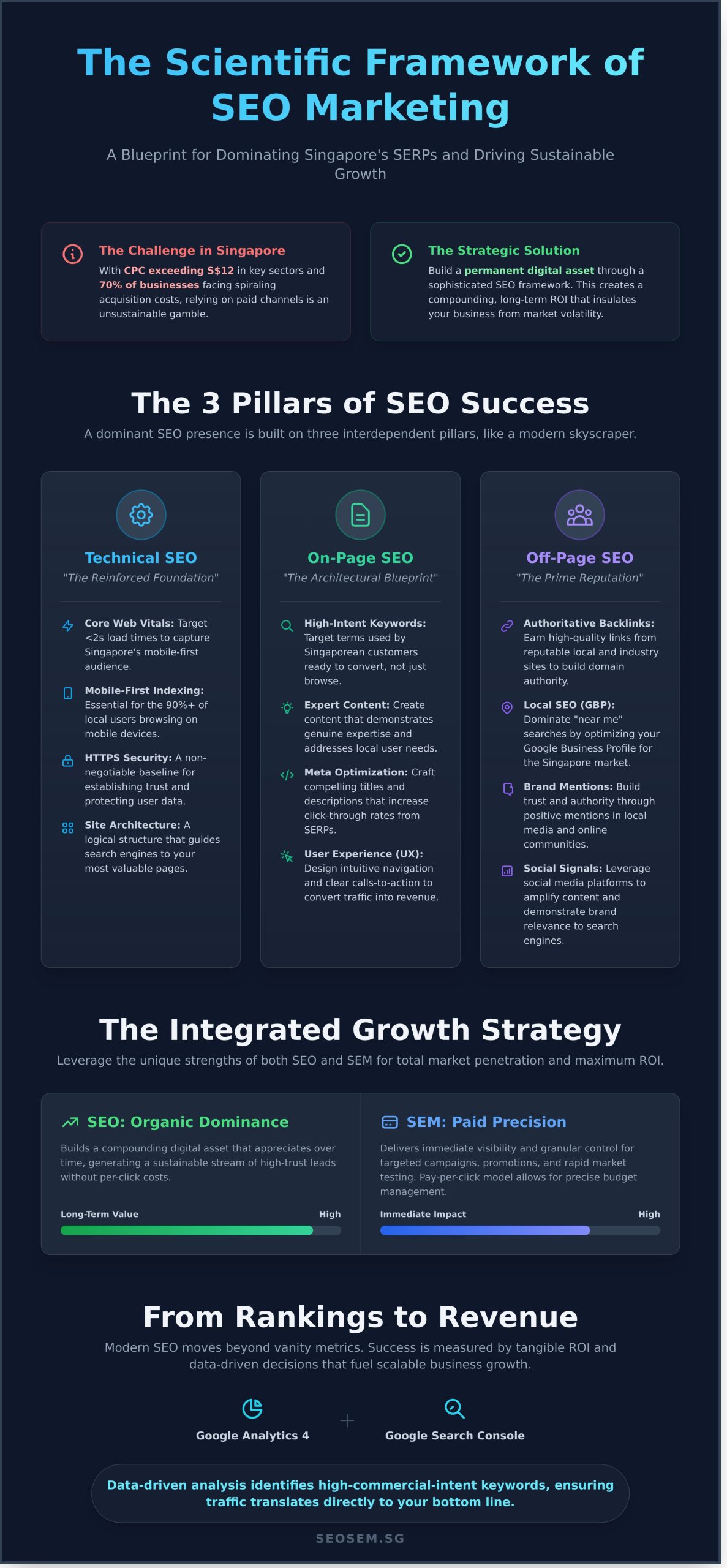
Effective seo marketing is not a collection of disparate tactics; it’s a scientific framework built on three core pillars: Technical SEO, On-Page Optimization, and Off-Page SEO. For Singaporean businesses aiming for market leadership, mastering these interdependent disciplines is non-negotiable. Think of it as constructing a skyscraper. Technical SEO is the reinforced foundation, On-Page is the architectural blueprint and interior design, and Off-Page is the building’s reputation and location in a prime district. Neglecting one pillar compromises the entire structure, especially in hyper-competitive Singaporean niches where precision execution separates market leaders from the rest.
Technical SEO: The Foundation of Strategic Dominance
Technical SEO ensures that search engines can efficiently find, crawl, and index your website. It’s the silent, foundational work that enables all other efforts to succeed. In Singapore, where over 90% of internet users access the web via mobile, optimizing for Google’s Core Web Vitals (CWV) is paramount. These metrics-Largest Contentful Paint, First Input Delay, and Cumulative Layout Shift-directly measure user experience. A Singaporean professional browsing on the MRT expects your site to load in under two seconds; failing this test means losing a potential customer before they even see your offer. A well-defined site architecture also dictates crawl budget efficiency, ensuring Googlebot prioritizes your most valuable pages. For local trust, implementing HTTPS is a baseline requirement. Since 2018, Google has flagged non-secure sites, a critical deterrent for any Singaporean consumer about to enter payment details. A comprehensive technical audit is the mandatory first step to ensuring your digital foundation is unshakeable.
On-Page Optimization and Content Science
On-Page SEO is the science of aligning your website’s content with what your target audience is actively searching for. This goes far beyond rudimentary keyword stuffing. It involves strategic keyword mapping, where we align specific commercial and informational queries to dedicated pages, satisfying user intent at every stage of the buyer’s journey. We leverage HTML tags (H1-H6) to create a logical hierarchy, serving as a structural roadmap that helps both users and search engines understand your content’s importance and context. The goal is to create content that not only ranks but also converts, positioning your brand as the definitive authority in your sector. For businesses looking to enhance their visual appeal, working with a creative studio like Jinx Design can ensure that branding and graphic design effectively support these conversion goals. This data-driven methodology transforms content from a creative expense into a measurable revenue-generating asset.
| Search Intent | Example SG Keyword | Optimal Content Type |
|---|---|---|
| Informational | “how to apply for BTO” | In-depth blog post or guide |
| Commercial | “best aircon servicing singapore” | Comparison page or service page with reviews |
| Transactional | “buy iPhone 15 Pro Max SG” | E-commerce product page |
The success of such transactional pages hinges on a robust technical foundation. For businesses looking to capitalize on this high-intent traffic, it’s beneficial to explore E-commerce Website Development to ensure the platform is optimized for both search engines and user conversions.
Off-Page SEO: Building Authority in the Singapore Ecosystem
Off-Page SEO builds your website’s authority and credibility through external signals, primarily high-quality backlinks. In the Singaporean market, this means executing localized digital PR to earn mentions and links from authoritative domestic sources like CNA, The Business Times, or respected industry-specific portals—a strategy crucial for any business, whether it’s a local service, a global B2B manufacturer like Seacoat SCT, LLC, or a specialized enterprise platform like Intelli-EMS. For businesses focused on securing international clients, it’s insightful to learn more about 智匯家有限公司 and their approach to B2B web design and SEO for overseas markets. As outlined in official reports on Singapore’s digital economy, digital trust is a cornerstone of enterprise growth, and high-authority backlinks are the digital equivalent of a trusted referral. Looking ahead to 2026 and beyond, the governing principle is “quality over quantity.” A single, editorially given link from a top-tier publication holds more SEO value than hundreds of low-quality directory listings. Furthermore, social signals from platforms like LinkedIn, which is critical for B2B engagement in Singapore, contribute to your brand’s overall digital footprint, driving referral traffic and reinforcing your market presence.
The principle holds true across different industries and markets. For example, an online guide for tourism in Japan like Jasumo builds its authority not just through comprehensive content but by earning trust signals and backlinks from the travel community, demonstrating how niche expertise translates into digital credibility.
In the same way, a specialized tourism operator in a competitive destination like Cozumel, Mexico, must build a strong digital presence to attract an international clientele. You can learn more about Cozumeldivehub to see how a niche business in this sector markets its unique offerings online.
SEO vs. SEM: Balancing Organic Dominance with Paid Precision
Singaporean CEOs often view Search Engine Optimisation (SEO) and Search Engine Marketing (SEM), primarily Google Ads, as an either/or decision. This is a strategic miscalculation. The real path to market dominance lies in their integration. SEM delivers immediate visibility and invaluable market data, while SEO builds a sustainable, long-term corporate asset that generates compounding returns. A sophisticated digital presence doesn’t choose between them; it leverages their synergy within a unified seo marketing plan to outmaneuver competitors and maximize return on investment (ROI).
The ROI-Focused Framework for Search Marketing
The most common objection to SEO is its perceived speed; it doesn’t deliver overnight results. While true, this perspective ignores the long-term ROI curve. An SEM campaign for a competitive keyword might generate leads from day one, but at a consistent Cost Per Acquisition (CPA) of, for example, S$65. You pay for every click, and when the budget stops, the traffic vanishes. SEO operates differently. The initial investment in months 1-4 is significant, with a high effective CPA. However, as your organic rankings climb, your CPA plummets. By month 12, a well-executed SEO campaign can drive a CPA below S$10, turning your website into a lead-generation machine that works 24/7 without per-click costs. This long-term value is built upon a scientific framework of SEO, encompassing technical site health and content authority. The data from your SEM campaigns directly fuels this process; high-converting ad copy and keywords from Google Ads provide a proven blueprint for what your target audience wants, eliminating guesswork in your SEO content strategy. Securing the #1 organic position while simultaneously running a top-of-page ad creates a powerful ‘halo effect’, dominating SERP real estate and boosting brand authority, which can increase total click-through rates by up to 10%.
Illustrative 12-Month CPA Curve: SEO vs. SEM
SEM (Paid Ads): Stable CPA ~S$65/month
SEO (Organic): Month 1 CPA: S$300+ → Month 6 CPA: S$40 → Month 12 CPA: < S$10
This demonstrates how initial SEO investment leads to a dramatically lower long-term acquisition cost.
Keyword Strategy: Capturing High-Intent Traffic
Effective search marketing hinges on understanding user intent. Search queries are not created equal; they fall into three main categories. Informational queries (“how to register a company in Singapore”) target top-of-funnel users. Navigational queries (“ACRA bizfile login”) are for users who already know your brand. The real revenue driver is transactional queries, which signal immediate purchase intent. For a Singaporean business, these high-intent keywords are specific and urgent, such as “best corporate lawyer in Raffles Place,” “emergency aircon repair Toa Payoh,” or “buy office furniture Singapore.” Your SEM campaigns are the perfect testing ground. By A/B testing different ad headlines targeting these keywords, you can quickly identify which value propositions resonate most with the market. The winning ad copy, proven by a higher click-through rate, becomes the data-driven foundation for your SEO page titles and meta descriptions, ensuring your organic listings are optimized for maximum engagement from the start. For businesses looking to complement their organic strategy with a rigorous paid media approach, our comprehensive guide to online advertising in Singapore provides a data-backed framework for maximising ROI across all digital channels.
Executing a Localized SEO Strategy for the Singapore Market
A generic, international SEO strategy will fail in Singapore’s unique digital ecosystem. The island’s high population density and 92% internet penetration rate, as reported by DataReportal in January 2024, create a hyper-competitive environment where proximity and immediacy drive conversions. A successful seo marketing campaign in Singapore hinges on hyperlocal precision. Consumers expect to find services and products within their immediate vicinity, a behaviour amplified by the prevalence of “near me” searches. Google Trends data confirms a 150% increase in such queries in Singapore over the past five years, transforming the Search Engine Results Page (SERP) into a localized battleground. Winning here requires a granular, Singapore-centric methodology that targets users not just by city, but by neighbourhood.
Mastering Local SEO in the Little Red Dot
Dominating the local search landscape starts with your Google Business Profile (GBP). This is your digital storefront and the engine behind your visibility in the coveted Google Map Pack. The foundation of a powerful GBP is absolute NAP (Name, Address, Phone Number) consistency. Every mention of your business online, from your own website to local directories like Streetdirectory.com and Yellow Pages Singapore, must display identical information. Any discrepancy erodes Google’s trust in your business’s location, directly impacting your ranking. Beyond consistency, your strategy must target specific planning areas. For example, a financial advisory firm in the CBD should optimize for “wealth management Raffles Place,” while a specialized B2B supplier like K-Tech Auto Solution might target industrial estates like Ubi to reach automotive workshops, and a home services provider like Home Expo Asia would focus on residential keywords such as “vinyl flooring BTO” to connect with new homeowners. This level of specificity aligns with user intent and signals local relevance. Finally, actively manage your online reputation. Singaporean consumers are meticulous researchers; a business with 40 reviews and a 4.7-star rating will consistently outperform one with 5 stars from only three reviews. Implement a system to generate a steady stream of reviews and respond to all feedback within 24 hours to build trust and improve visibility.
Mobile-First Optimization for the SG Commuter
Consider the daily journey of your target customer on the MRT, scrolling their phone between Jurong East and City Hall. This is the new frontier of customer acquisition. In these moments, your website’s mobile performance is not just a ranking factor; it’s a direct driver of revenue. By 2026, a flawless mobile user experience will be non-negotiable. This means your site must load in under 2.5 seconds on a 4G network, a key metric in Google’s Core Web Vitals. The technical requirements extend beyond speed to include a conversion-centric design: tap targets must be at least 48×48 pixels for easy use, phone numbers must be click-to-call, and addresses should integrate directly with Google Maps. This mobile-first approach ensures you capture high-intent users at their exact moment of need, demonstrating that your mobile strategy is a critical component of modern seo marketing.
Use this checklist to benchmark your mobile readiness:
- 	⚡; Lightning-Fast Load Speed: Largest Contentful Paint (LCP) under 2.5 seconds.
- 👆 Thumb-Friendly Design: All interactive elements and buttons are easily tappable.
- 📞 Click-to-Engage Functionality: Phone numbers and emails are clickable for instant contact.
- 🔍 Legible Typography: Base font size of at least 16px to prevent pinching and zooming.
- 🚫 No Intrusive Interstitials: Avoid full-page pop-ups that disrupt the user experience.
To dominate your local market and capture these high-intent mobile customers, you need a strategy built on precision and performance. Schedule a complimentary local SEO audit with our strategists to identify your competitive advantages.
Measuring ROI and Scaling Your Strategic Growth with Digitalix
An investment in SEO is an investment in your company’s future market share. At Digitalix, we reject ambiguity. Our entire methodology is built on a foundation of performance tracking and absolute transparency, transforming your SEO expenditure from a cost centre into a predictable, revenue-generating engine. We operate on a science-first, ROI-focused framework designed to provide C-suite executives with the clarity needed to make confident strategic decisions. We achieve this by leveraging enterprise-grade analytics platforms, primarily Google Analytics 4 (GA4) and Google Search Console, to move beyond vanity metrics and focus exclusively on data that impacts your bottom line. GA4 provides granular insights into user engagement and conversion pathways, while Search Console offers a direct diagnostic of your website’s performance and visibility on the SERPs. This dual-data approach ensures every action we take is deliberate, measurable, and aligned with your core business objectives.
The strategic power of seo marketing lies in its inherent scalability. A Singaporean startup might initially focus on capturing hyper-local search intent and niche long-tail keywords to secure early traction. As your business scales, so does our strategy. We transition to targeting broader, more competitive commercial keywords, expand content production to establish industry authority, and implement advanced technical SEO to support a more complex website architecture. This phased approach ensures your investment grows in lockstep with your business, from a lean startup securing its first 1,000 organic visitors to an enterprise dominating national search results and driving over 100,000 monthly sessions. This is not just growth; it’s a calculated escalation of your digital dominance. To understand how paid channels can accelerate this trajectory, explore our strategic guide to online advertising Singapore businesses can leverage for immediate market penetration alongside their long-term SEO investment.
For founders and entrepreneurs looking to stay ahead of market trends, check out Entrepreneurship SG to discover in-depth analysis and the latest news within the Singapore startup ecosystem.
Data-Driven Reporting and Strategic Adjustments
Our commitment to transparency is delivered through rigorous monthly performance reports. These are not data dumps; they are strategic executive summaries that translate complex metrics into clear business outcomes. We track the key performance indicators (KPIs) that matter most to your growth, including:
- 📈 Organic Traffic Growth: Month-over-month and year-over-year percentage increase.
- 🎯 Keyword Ranking Velocity: Number of target keywords entering Top 3, Top 10, and Page 1 positions.
- 💼 Organic Conversion Rate: Percentage of organic visitors completing a desired action (e.g., form submission, purchase).
- 💰 Lead & Revenue Attribution: Quantifying the direct revenue generated from the organic channel.
This data directly informs our agile strategy. If a competitor makes an aggressive move or algorithm updates shift the SERP landscape, our team pivots immediately. We analyze the data, re-calibrate our approach, and execute with precision to protect and expand your digital territory. To understand your current performance baseline, Contact Digitalix for a custom audit.
Leveraging Singapore Business Grants for Digital Growth
Accelerating your digital transformation is more accessible than ever for eligible Singaporean businesses. Government initiatives like the Enterprise Development Grant (EDG) and the Productivity Solutions Grant (PSG) can provide significant financial support for companies undertaking projects in core capabilities and strategic brand development. While we don’t process the applications, Digitalix serves as the essential strategic partner. We develop the comprehensive digital roadmap and project scope required for a robust grant proposal, ensuring your investment in SEO is positioned for maximum impact and aligns with the grant’s objectives. Let us help you build the strategic foundation for your digital growth initiative. Ready to outrank your competition? Connect with our SEO consultants today.
Activate Your 2026 SEO Strategy for Market Leadership
Mastering Singapore’s digital landscape by 2026 demands more than just tactics; it requires a scientific framework built on technical precision, on-page authority, and a hyper-localized off-page strategy. The path to scalable growth isn’t guesswork. It’s a calculated process of execution and measurement, ensuring every component of your digital presence delivers a quantifiable return on investment.
Don’t leave your market share to chance. It’s time to implement a proven seo marketing strategy designed to outrank the competition. Since our founding in 2016, our Singapore-based team at Paya Lebar Square has engineered success for local businesses using a rigorous, science-first methodology. We build systems for measurable ROI, not vague promises. The future of your market dominance is decided by the actions you take today.
Request Your Data-Driven SEO Strategy Audit and let’s engineer your blueprint for success in 2026 and beyond.
Frequently Asked Questions About SEO Marketing
What is the difference between SEO and SEM for a Singaporean business?
SEO (Search Engine Optimisation) focuses exclusively on earning unpaid, organic traffic from search engines, while SEM (Search Engine Marketing) is a broader discipline that includes both SEO and paid advertising (PPC). For a Singaporean business, SEO builds a long-term, sustainable asset by improving organic rankings. SEM provides immediate visibility through paid ads on platforms like Google, offering a direct but temporary solution to capture market share while your SEO strategy matures.
How long does it take to see results from SEO marketing in Singapore?
You can expect to see measurable results from a targeted SEO campaign in Singapore within 4 to 6 months. Initial traction, such as ranking improvements for less competitive keywords, often appears within the first 90 days. However, achieving first-page visibility and significant traffic growth for high-value commercial terms typically requires a sustained, data-driven effort over 6 to 12 months, depending on your industry’s digital competitiveness and your website’s initial authority.
Is SEO marketing still relevant in the age of AI search in 2026?
Yes, SEO is more critical than ever in 2026. AI-driven search experiences, like Google’s SGE, still rely on high-quality, authoritative web content to formulate answers. The strategic focus shifts from simply ranking a link to becoming the definitive source cited within the AI-generated response. This elevates the importance of E-E-A-T (Experience, Expertise, Authoritativeness, Trustworthiness), ensuring your content is the bedrock of future search results.
How much should a Singapore SME spend on SEO marketing per month?
A competitive Singapore SME should plan to invest between S$2,500 and S$8,000 per month for an effective seo marketing campaign. This budget supports the core pillars of success: in-depth technical audits, creation of expert-level content, and strategic acquisition of high-authority backlinks. Investments below S$2,000 per month typically lack the resources needed to generate a meaningful ROI in Singapore’s competitive digital landscape.
Can I do SEO marketing myself or should I hire a Singapore agency?
Hiring a specialised Singapore SEO agency is the most efficient path to achieving a measurable ROI. While a business owner can handle basic on-page optimisations, a professional agency provides a multi-disciplinary team, access to enterprise-level analytics tools costing over S$10,000 annually, and a proven, ROI-focused framework. This expert execution allows you to outmaneuver competitors and avoid critical technical errors that can stall growth for months. The principles of a strong agency are universal; for instance, a U.S. firm like DNA Digital Marketing, the Chilean agency Posicionar, an agency focused on strategic web development like PurpleCow Digital Marketing, or a top חברה לקידום אתרים אורגני (Hebrew for “organic SEO company”) will offer the same core benefits of expertise and data-driven strategy, regardless of the market.
What are the most important SEO ranking factors for 2026?
The most dominant SEO ranking factors for 2026 are helpful content that satisfies user intent and strong E-E-A-T signals. Google’s algorithms are now advanced enough to differentiate between generic content and true expertise. Foundational technical elements, including mobile-first performance, Core Web Vitals, and a robust backlink profile from authoritative industry sources, remain non-negotiable prerequisites for achieving top SERP positions.
How does local SEO differ from global SEO for brands based in Singapore?
Local SEO is engineered to capture customers within a defined geographic area, such as Singapore, while global SEO targets an international audience. For a Singapore-based brand, local SEO involves optimising your Google Business Profile, securing reviews from local clientele, and ranking for location-specific queries like “corporate law firm Orchard Road”. Global SEO requires a more complex strategy involving hreflang tags for language targeting and building a diverse international backlink profile.
Does social media marketing impact my SEO rankings in Singapore?
Social media does not directly influence your SEO rankings, but it acts as a powerful catalyst for SEO success. A strong social media presence amplifies your content’s reach, driving referral traffic to your website-a positive user signal to search engines. It also increases the probability of earning natural, high-authority backlinks when your content is shared and discovered by journalists, bloggers, and other industry leaders, thereby indirectly boosting your domain authority.