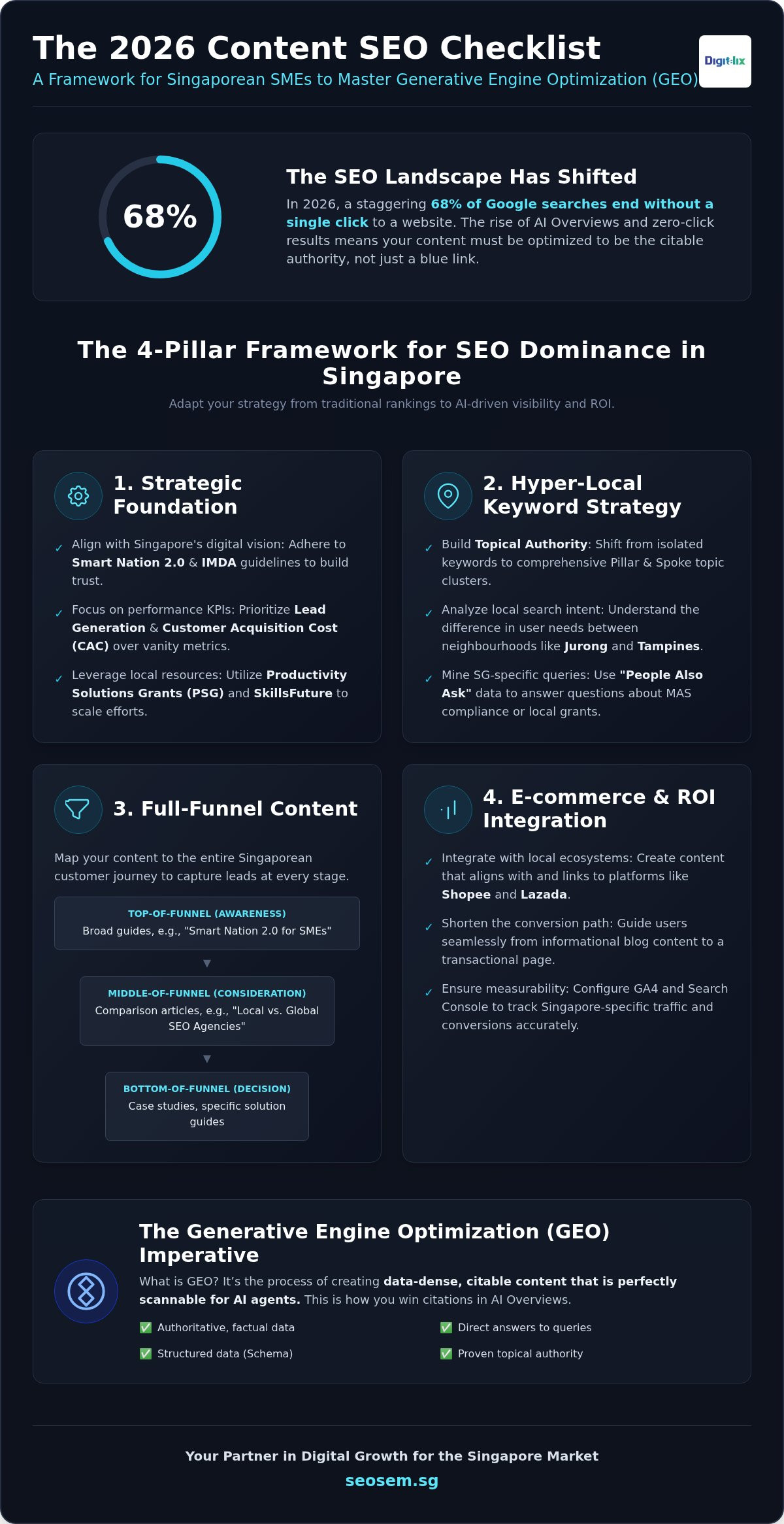
Did you know that 68% of Google searches in 2026 now end without a single click to a website? For Singaporean SMEs, this shift towards AI Overviews and zero-click results means that generic global advice is no longer enough to drive growth. You’ve likely noticed that even when your traffic looks stable, your conversion rates aren’t hitting the mark. To maintain strategic dominance, you need a localized content SEO checklist that bridges the gap between traditional search rankings and Generative Engine Optimization (GEO).
We understand the frustration of seeing your hard-earned visibility swallowed by AI summaries. This guide provides the exact framework you need to outrank competitors in the Singaporean digital landscape while satisfying both Google’s 2026 core updates and AI-driven engines like ChatGPT. You’ll gain a data-backed roadmap to transform your content into a citable authority that converts local leads into loyal customers. We’ll examine how to align your digitalisation efforts with Smart Nation 2.0 standards to ensure long-term scalability and measurable ROI.
Key Takeaways
- Align your digitalisation strategy with Smart Nation 2.0 by creating content that balances human intent with AI-scannable structures for maximum visibility.
- Build topical authority by shifting from isolated keywords to comprehensive clusters that reflect how Singaporeans search across specific neighbourhoods like Jurong and Tampines.
- Implement a 2026 content SEO checklist that prioritizes Generative Engine Optimization (GEO) to secure high-value citations in AI-generated search summaries.
- Drive higher ROI by integrating your blog content with local e-commerce ecosystems like Shopee and Lazada to shorten the customer conversion journey.
- Focus on performance-driven metrics such as Customer Acquisition Cost (CAC) and conversion rates to ensure your SEO efforts translate into measurable business growth.
The 2026 Content SEO Foundation: Strategic Alignment for Singapore SMEs
What is content SEO in 2026? It is the strategic process of creating data-dense, citable content that answers specific user intents while remaining perfectly scannable for AI agents. In a market where Google maintains a 92.42% dominance, your strategy must go beyond basic keyword stuffing. Modern Search engine optimization (SEO) requires a rigorous alignment with local authority signals and technical AI-readiness. This foundation ensures your brand isn’t just visible but is recognized as a primary source of truth by both human searchers and generative engines.
Aligning your content with Singapore’s Smart Nation 2.0 initiatives is no longer optional for digital excellence. This framework prioritizes trust and professional representation. Your content programme must adhere to IMDA guidelines to ensure your business reflects the high standards of Singapore’s digital economy. Calibration is essential. You must configure Google Search Console and GA4 to filter for Singapore-specific traffic patterns. This allows you to ignore global bot noise and focus on the 5.78 million local users who actually drive your ROI.
Defining Your Strategic Growth Objectives
Start by identifying high-intent keywords that resonate with Singaporean B2B and B2C audiences. A business searching for logistics solutions in the Jurong Innovation District has different triggers than a consumer looking for retail deals in Orchard. Your content SEO checklist must prioritize measurable KPIs like lead generation and customer acquisition costs over vanity rankings. Conduct a rigorous gap analysis against local competitors. Identify where their content fails to address specific SG regulations or cultural nuances to find your competitive edge.
The Role of Digitalisation in Content SEO
Digitalisation serves as the engine for scalable content production. You can leverage IMDA’s digitalisation grants, such as the Productivity Solutions Grant (PSG), which offers up to 50% co-funding for pre-approved IT solutions to streamline your workflows. Don’t neglect your human capital. Use SkillsFuture-aligned training to upskill your internal teams in modern SEO services in Singapore. By combining local data with professional expertise, you build the high-density factual content that AI Overviews crave. This science-first approach transforms your website from a static brochure into a performance-driven asset.
Keyword Research & Topic Clusters: Dominating the Singaporean Search Landscape
Search behavior in Singapore has shifted from fragmented queries to comprehensive topical exploration. To achieve strategic dominance, your brand must transition from targeting isolated keywords to building robust topic clusters. This methodology involves creating a “pillar” page that covers a broad subject and linking it to multiple “spoke” articles that dive into specific subtopics. This structure signals to Google and AI engines that you possess deep, authoritative knowledge within the Singaporean market. A modern content SEO checklist is incomplete without this architectural shift.
Local search nuances are the key to capturing high-intent traffic. Consider how search intent varies by geography. A user searching for “business consultancy” in Orchard is likely looking for high-level corporate advisory. Conversely, a similar search in Woodlands often targets industrial or logistics support. You must identify these distinctions. Analyzing “People Also Ask” (PAA) patterns specific to the SG ecosystem reveals what your audience truly cares about. Common queries often revolve around MAS compliance, IMDA grant eligibility, or SkillsFuture credits. Addressing these directly builds immediate trust with local decision-makers.
Mapping the Singaporean Customer Journey
Effective content SEO mirrors the local buyer’s journey. You need a mix of content types to capture leads at every stage:
- Top-of-Funnel (TOFU): Create guides on broad topics like “The future of digitalisation in Singapore” or “Smart Nation 2.0 for SMEs.” These attract users seeking information.
- Middle-of-Funnel (MOFU): Provide comparison articles. Help users evaluate their options by comparing the merits of a local SEO Agency Singapore against international competitors.
- Bottom-of-Funnel (BOFU): Target high-intent phrases such as “SEO packages in Singapore” or “marketing agency near Paya Lebar.” This is where conversion happens.
Semantic Search and AI-Prompt Engineering
The rise of Generative Engine Optimization (GEO) means your content must be “AI-prompt friendly.” Singaporeans increasingly use natural language queries when interacting with tools like ChatGPT or Gemini. They don’t just type “SEO”; they ask, “What is the best way for a local SME to improve search visibility?” Your content must mirror these conversational patterns. Use LSI variations that include local landmarks like “Paya Lebar Square” or professional terminology common in the CBD. Even subtle “Singlish-adjacent” phrasing can improve hyper-local relevance. Your content SEO checklist must prioritize these semantic variations to remain competitive in an AI-first search environment. If you want to refine your targeting, speak with our strategists to identify your most profitable topic clusters.
On-Page Optimization & GEO: Ranking for Humans and AI Agents
Mastering the dual-optimization framework is the central pillar of any modern content SEO checklist. In 2026, your pages must satisfy Google’s Core Web Vitals while remaining perfectly scannable for AI agents. This isn’t just about technical speed; it’s about structural clarity. Use a strict H1-H4 hierarchy to guide both human readers and crawlers through your narrative. Start every section with an authoritative, conversational introduction. This encourages AI engines to cite your brand as a primary source in their summaries. You’re not just writing for a click; you’re writing to be the definitive answer.
Adhere to the “First-Paragraph Rule” by directly answering the user’s query within the first 100 words. AI Overviews prioritize content that provides immediate value without unnecessary fluff. By placing the most critical information at the top, you increase the likelihood of being featured in zero-click results. This strategy ensures your expertise remains visible even when users don’t click through to your site. It’s a performance-driven approach that values information density over word count.
Traditional On-Page Essentials
Craft meta titles and descriptions that explicitly highlight your Singapore-based expertise. Local searchers value proximity and regional competence. Your internal linking strategy should connect related topics to high-value pages like SEO Services Singapore. This distributes link equity and helps search engines map your topical authority. Don’t overlook image optimization. Use modern formats like WebP for faster load times and include local alt-text descriptions. Mentioning specific SG landmarks or business hubs in your alt-text provides additional context for local image searches and AI image recognition.
GEO: Optimizing for AI Overviews
Generative Engine Optimization (GEO) requires a technical approach to content structure. Implement Schema Markup (JSON-LD) to help AI agents understand your local SG presence and service offerings. This structured data acts as a translator between your prose and machine-learning models. Focus on creating “Fact-Dense” sentences. AI engines prefer content that packs significant information into concise, verifiable statements. Use structured data for local business details, reviews, and FAQ sections. This makes it easier for AI to extract and present your data in conversational search results. A comprehensive content SEO checklist must integrate these GEO tactics to maintain strategic dominance in a landscape defined by five major Google algorithm updates in the first half of 2026 alone.
Local Relevance & E-commerce Integration: A 2026 Content SEO Checklist for the SG Ecosystem
Local relevance is the competitive advantage for Singaporean businesses in 2026. While global competitors target broad, generic terms, your strategy should zero in on the specific needs of residents in Jurong, Tampines, or Buona Vista. A comprehensive content SEO checklist must include a plan for hyper-local content that resonates with the unique demographic profiles of these heartlands. This approach ensures your brand appears in “near me” searches and establishes you as a trusted local authority. It’s about demonstrating that you understand the local context better than anyone else.
Cross-platform synergy is vital for modern retail success. Your blog content shouldn’t exist in a vacuum; it must act as a strategic bridge to your Shopee and Lazada stores. By capturing users during their research phase on Google and directing them to your marketplace listings, you shorten the customer journey. This integrated approach leverages the high trust levels of established platforms while maintaining the SEO benefits of your own domain. It’s a dual-track strategy designed for maximum conversion.
Hyper-Local SEO for SG Districts: Refining Your Content SEO Checklist
Creating location-specific landing pages for regional hubs is essential for capturing high-intent traffic. You should develop unique content for districts such as:
- The CBD and Orchard for corporate and high-end retail services.
- Jurong Innovation District for industrial and tech-focused SMEs.
- Tampines and Buona Vista for residential-focused service providers.
Reference local landmarks such as Paya Lebar Square to increase geographic relevance. This isn’t just about keywords; it’s about building off-page authority by participating in local digital community discussions. These signals tell AI engines that your business is deeply integrated into the Singaporean digital ecosystem. This geographic specificity is a core component of Generative Engine Optimization (GEO).
E-commerce Content Strategy and the Content SEO Checklist
Optimizing product descriptions for both Google and internal marketplace search engines is a technical necessity. Use professional content creation, including high-quality photography and videography, to lower bounce rates. Visual assets are data-rich signals that AI engines use to categorize your offerings. Integrating user-generated content (UGC) from local Singaporean customers provides the social proof necessary to convert hesitant leads on platforms like Carousell, Shopee, or Lazada. This authentic feedback is often cited by AI agents as a marker of trustworthiness.
Every piece of content must undergo a compliance check against MAS regulations or IMDA standards for professional representation. Leveraging testimonials from other Singaporean SMEs reinforces your reliability. By following this ROI-driven framework, you ensure your digitalisation efforts result in a measurable return on investment. You aren’t just creating content; you’re building a performance-driven asset.
Measuring ROI & Scaling Your Content SEO with Digitalix
Execution of a content SEO checklist only yields value when it translates into measurable business growth. Many SMEs fall into the trap of tracking vanity metrics like raw traffic or impressions. While these signals indicate visibility, they don’t necessarily reflect profitability. You must pivot your focus toward conversion rates and Customer Acquisition Cost (CAC). Digitalix operates as your Strategic Growth Partner, utilizing a data-driven methodology to ensure every piece of content serves a specific commercial purpose. We demystify the technical complexities of search algorithms to provide a clear view of your return on investment.
Continuous campaign optimization is mandatory in the volatile Singaporean digital landscape. With 98.4% internet penetration, the competition for attention is relentless. Scaling your strategy often requires moving from a purely organic focus to a hybrid SEO and SEM approach. This allows you to capture immediate high-intent leads through paid search while your organic content builds long-term authority and lowers your blended CAC over time. This performance-driven framework ensures your brand maintains strategic dominance across all search channels.
The Digitalix ROI Framework
Our reporting structure is designed specifically for C-suite executives who value precision and long-term sustainability. We provide monthly performance reports that bypass marketing fluff in favor of hard data. Strategy adjustments happen in real-time, based on keyword movement and shifts in the local search ecosystem. We also implement rigorous A/B testing for different content formats. This helps identify whether your audience in the CBD responds better to long-form whitepapers or punchy, data-heavy blog posts. This “science-first” narrative ensures your marketing spend is always allocated to high-performance assets.
Next Steps for Your Digital Presence
The first step toward strategic dominance is a comprehensive content audit of your existing website. We evaluate your current assets against 2026 standards for Generative Engine Optimization (GEO) and local relevance. Following this, we develop a 12-month content programme aligned with Singaporean peak seasons and major shopping events on platforms like Shopee and Lazada. This proactive planning ensures your brand is positioned as the definitive authority when demand spikes. If you’re ready to grow your leads, contact Digitalix today for a tailored strategy that transforms your digital presence into a scalable growth engine.
Securing Your Strategic Dominance in Singapore’s 2026 Digital Market
Mastering the 2026 digital landscape requires a shift from generic tactics to a rigorous, data-driven methodology. By implementing this content SEO checklist, you align your business with Smart Nation 2.0 initiatives while securing citable authority in AI search summaries. You’ve learned how to bridge the gap between traditional rankings and Generative Engine Optimization, ensuring your content resonates with audiences from Jurong to Tampines. This dual approach is essential for maintaining a competitive edge in an increasingly automated search environment.
As your Strategic Growth Partner, Digitalix delivers the Singapore-centric expertise and ROI-focused frameworks required to navigate these technical complexities. We prioritize measurable performance over vanity metrics; our focus remains on lowering your customer acquisition costs and maximizing long-term scalability. From our headquarters at Paya Lebar Square, we combine international standards with deep local market knowledge to ensure your digitalisation efforts yield a significant return on investment. We’re committed to transforming your digital presence into a high-performance asset that drives sustainable growth.
Frequently Asked Questions
How long does it take to see results from content SEO in Singapore?
Content SEO in Singapore typically takes 4 to 9 months to show significant ROI. This timeline depends on your niche’s competitiveness and current domain authority. While technical fixes might show movement in weeks, building topical authority requires consistent publishing. We focus on quick wins by targeting low-competition local clusters first to generate leads while the broader strategy matures. This ensures your business remains sustainable during the growth phase.
What is the difference between traditional SEO and GEO (Generative Engine Optimization)?
Traditional SEO focuses on ranking in the top ten blue links on a Search Engine Results Page (SERP). Generative Engine Optimization (GEO) prioritizes becoming the cited source for AI-generated summaries like Google AI Overviews or ChatGPT responses. GEO requires higher fact-density and structured data, ensuring your brand is the definitive answer rather than just another link. This dual approach is mandatory for strategic dominance in the 2026 search environment.
Do I need to use Singlish in my content to rank in Singapore?
You don’t need to use Singlish to rank, but understanding local search intent is vital. Professional content should remain polished to align with IMDA standards. However, including local phrasing or specific regional context in your content SEO checklist can improve hyper-local relevance. It helps search engines connect your services to specific Singaporean environments without compromising your brand’s authoritative tone. We recommend focusing on neighbourhood-specific keywords to capture high-intent traffic.
How does content SEO integrate with Shopee and Lazada marketing?
Content SEO drives external traffic to your marketplace listings by capturing users during the research phase. By optimizing blog posts for specific product categories, you can redirect high-intent searchers to your Shopee or Lazada stores. This strategy lowers your dependency on platform-specific ads and leverages Google’s massive reach to build a sustainable sales funnel outside the marketplace ecosystem. It effectively shortens the customer journey and increases your overall conversion rates.
Can I apply for IMDA grants to help with my SEO and content creation?
Yes, eligible SMEs can apply for the Productivity Solutions Grant (PSG) through the SMEs Go Digital programme. The PSG provides up to 50% co-funding for pre-approved digital solutions, which can include SEO tools or digitalisation consultancy. This support helps businesses offset the initial costs of implementing a professional content SEO checklist to scale their digital presence. It’s an excellent way to fund your transition toward a more data-driven marketing framework.
Why is local authority more important than global keyword volume for SG SMEs?
Local authority is superior because it targets users who can actually transact with your Singapore-based business. Global keyword volume often includes junk traffic that won’t convert into actual revenue. For an SG SME, ranking for a term with 100 local searches is more valuable than 10,000 global ones. Local signals like proximity and neighbourhood mentions ensure you attract high-intent leads from the CBD or heartlands who are ready to purchase.
How often should I update my content SEO checklist for the Singapore market?
You should review your checklist at least once every quarter to stay ahead of algorithm changes. Google released five major algorithm updates in the first half of 2026 alone, highlighting how fast the landscape shifts. A quarterly audit ensures your strategy accounts for new AI features, changes in local regulations, and evolving consumer habits. Regular updates prevent your content from becoming obsolete in a high-speed digital economy where precision is key.
What are the most important schema types for a Singapore-based service business?
The most critical schema types for local service businesses include LocalBusiness, FAQPage, and Review snippets. LocalBusiness schema helps search engines verify your physical presence at locations like Paya Lebar Square. FAQPage schema increases your chances of appearing in AI summaries and voice searches. Review schema builds immediate trust by displaying your star ratings directly in search results. These technical markers are essential for converting skeptical local leads into loyal, long-term customers.