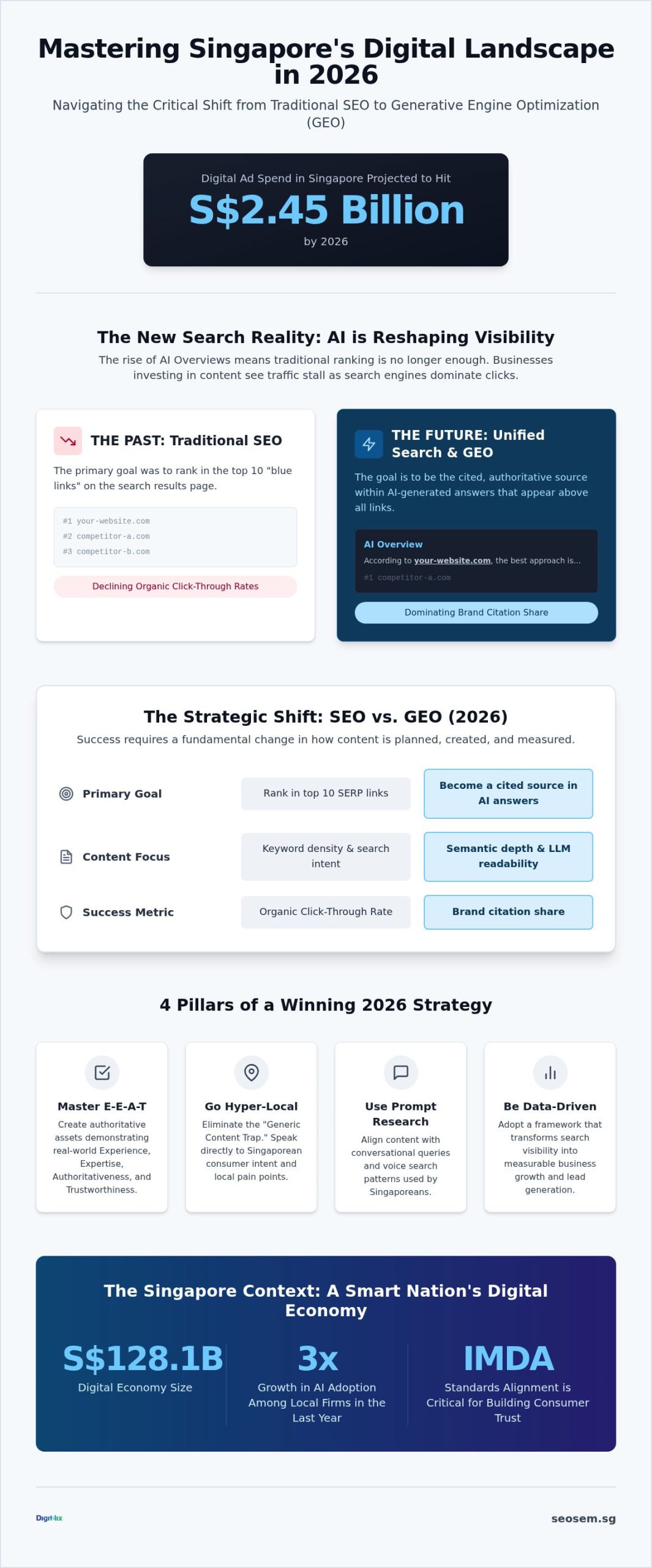
With digital advertising spend in Singapore projected to hit S$2.45 billion in 2026, the competition for online visibility has never been more aggressive. You’ve likely noticed that traditional ranking isn’t enough anymore. As AI Overviews dominate the top of the SERP, many local SMEs are watching their organic traffic stall despite increasing their production budgets. It’s frustrating to invest heavily in SEO content marketing when search engines seem to be keeping the clicks for themselves.
We understand the pressure to prove a measurable ROI while search algorithms undergo their most radical shift in a decade. This guide provides a science-first framework to master the 2026 digital environment and secure your market leadership. You’ll learn how to build brand authority that AI agents cite as a primary source while maintaining a dominant presence in local search results. We don’t just aim for impressions; we focus on strategic dominance.
We will explore the shift toward Generative Engine Optimization (GEO), the nuances of Singapore-centric search signals, and the exact steps to align your digitalisation efforts with Smart Nation 2.0 standards for maximum growth.
Key Takeaways
- Master the “Unified Search” framework to ensure your brand is cited by AI Overviews while maintaining top rankings in traditional search results.
- Evolve your SEO content marketing strategy from simple keyword placement to creating authoritative assets that meet 2026 E-E-A-T standards.
- Eliminate the “Generic Content Trap” by developing localised content that speaks directly to Singaporean consumer intent rather than relying on broad global templates.
- Conduct rigorous prompt research to align your digital presence with how users interact with both search engines and AI-driven recommendation agents.
- Adopt a data-driven digitalisation framework to transform search visibility into measurable business growth and lead generation.
What is SEO Content Marketing in the Age of Smart Nation 2.0?
In 2026, SEO content marketing is the strategic creation of authoritative digital assets designed to satisfy both human intent and the complex algorithms of search and AI recommendation engines. It’s no longer about mere visibility. It’s about being the definitive answer. The old days of keyword stuffing are dead. Today, Google and AI agents prioritise E-E-A-T (Experience, Expertise, Authoritativeness, and Trustworthiness). For Singaporean brands, this means your content must demonstrate real-world impact and local depth to win. It requires a move away from generic blogging toward high-value assets that search engines trust to recommend to users.
Under the Smart Nation 2.0 initiative, the Singapore government has accelerated the push for deep tech integration across all sectors. Digitalisation is no longer a choice for SMEs; it’s a structural requirement for participation in our S$128.1 billion digital economy. High-quality content serves as your digital handshake. It builds the trust required to convert a skeptical browser into a lead. You can explore our SEO services in Singapore to see how we align these technical requirements with your business goals. As AI adoption among local firms tripled to 14.5% in the last year, the gap between brands that provide value and those that just produce noise is widening.
The Shift from Search Engines to Recommendation Engines
Google, ChatGPT, and Gemini have evolved into digital concierges for Singaporean consumers. When someone in Jurong East or Tampines searches for a service, they don’t just want a list of blue links. They want a recommendation. Your content must be structured as the “training data” these engines trust. If your site doesn’t provide clear, authoritative answers, AI Overviews will simply cite your competitors. Maintaining a competitive edge in the CBD or the heartlands requires hyper-local relevance that global templates cannot provide. We focus on making your brand the primary source for these AI-driven answers.
Singapore’s Digitalisation Landscape in 2026
Aligning your strategy with IMDA standards is critical for building consumer trust in a mature market. Singaporeans are discerning. They value transparency and data privacy, especially under PDPA regulations. SME-friendly content must address local pain points directly, such as rising operational costs or manpower constraints. By providing data-backed solutions to these specific challenges, you position your brand as a Strategic Growth Partner rather than a mere vendor. This approach transforms SEO content marketing from a cost centre into a high-performance ROI engine. Working with a professional content marketing agency ensures your brand authority remains resilient against algorithm shifts while driving measurable leads.
Building Content for AI Overviews and Traditional Search
The “Unified Search” framework represents the most efficient way to capture traffic in a bifurcated search market. You must produce assets that satisfy the immediate curiosity of a human reader while providing the structured data required by crawlers. Generative Engine Optimisation (GEO) is the process of making brand content digestible for Large Language Models (LLMs). Integrating this into your SEO content marketing strategy allows you to win the “Featured Snippet” and “AI Overview” citations simultaneously, doubling your brand’s footprint on the SERP. This dual-path approach ensures that even as organic CTR for traditional links fluctuates, your brand remains the authoritative recommendation for every relevant query.
To understand the technical shift, we can compare the core differences between traditional search strategies and modern GEO requirements in 2026.
| Metric | Traditional SEO | GEO (2026) |
|---|---|---|
| Primary Goal | Rank in top 10 SERP links. | Become a cited source in AI answers. |
| Content Focus | Keyword density and search intent. | Semantic depth and LLM readability. |
| Success Metric | Organic Click-Through Rate. | Brand citation share. |
Structuring for Generative Engine Optimisation (GEO)
Your content must mirror the natural phrasing of Singaporeans. We see a significant rise in voice search and conversational prompts. Use headers that ask direct questions, such as “How do I apply for the PSG grant for digital marketing?” rather than generic titles. Follow the “Inverted Pyramid” model; answer the core query within the first 50 words to encourage AI models to scrape your response. This makes your content highly “citable.” Implementing local Schema Markup is also vital. It helps AI agents verify your Singapore business location and service availability across the island instantly, from Jurong to Changi. This technical layer ensures that AI concierges don’t just know what you do, but where and how you serve the local market.
Maintaining E-E-A-T in a Saturated Market
AI-generated fluff is everywhere, and search engines have become experts at penalising it. A “human-in-the-loop” production process is non-negotiable. This means using real subject matter experts to review every piece of content for accuracy and nuance. Use local case studies and Singapore-centric data to prove your expertise. For example, referencing specific MAS regulations or IMDA digitalisation updates adds a layer of authority that generic AI cannot replicate. Refining your SEO content marketing through human expertise ensures your brand voice remains distinct and trustworthy. You can see how our SEO services in Singapore pillar article structures this authority to drive results. If you want to ensure your content meets these rigorous standards, consider how a strategic partnership can refine your output.
Why Most Singapore SME Content Fails to Convert
Many local business owners mistake visibility for effectiveness. They invest in SEO content marketing but see zero movement in their lead pipeline. The primary culprit is the “Generic Content Trap.” When you use global templates or unedited AI drafts, you fail to resonate with audiences in Orchard or Jurong. These readers seek local reliability and cultural nuance. If your content doesn’t reflect the specific operational realities of the Singapore market, it won’t convert. Consumers here can spot generic, outsourced content from a mile away; it feels disconnected from their daily business challenges.
Another common failure is prioritising traffic volume over revenue potential. Ranking for a high-volume keyword like “digital trends” might bring visitors, but it rarely drives sales. Most Singapore SMEs ignore the Middle-of-the-Funnel (MOFU) and Bottom-of-the-Funnel (BOFU) stages. They fail to provide the detailed comparison guides, local pricing tables, or technical breakdowns that local B2B buyers require before signing a contract. Without a distinct brand voice and strategic intent, your SEO content marketing becomes a commodity that offers no competitive advantage.
The Importance of Local Context and Nuance
Building trust in Singapore requires more than just good grammar. You must reference local regulatory frameworks like MAS or the PDPC. This shows you understand the specific compliance environment your clients face. Even small details matter. Using “digitalisation” and “programme” instead of Americanised versions signals professional credibility and local presence. We also have to address the “kiasu” mindset. Singaporean consumers want the best value and the most information. They respond to comprehensive, value-packed guides that provide more depth and actionable data than any competitor. If your content is thin, you’re essentially handing your leads to the competition.
Technical SEO vs. Content Quality
Don’t let technical metrics blind you to the user experience. A fast, high-performance web design is a prerequisite, but it’s useless if the page content doesn’t solve a problem. Google’s 2026 algorithm places immense weight on Core Web Vitals, yet these are just the entry fee. “Technical SEO gets you to the race; high-quality content makes you win it.” If your content lacks substance or fails to answer the user’s query immediately, they’ll bounce. This signals to search engines that your site isn’t helpful, creating a negative feedback loop that erodes your authority over time. Precision in your technical setup must be matched by the quality of your insights.
Executing a Multi-Channel Content Strategy in Singapore
Success in the 2026 market requires a shift from isolated tactics to a cohesive ecosystem. Your SEO content marketing must function as a unified engine across multiple touchpoints to capture the S$13.8 billion e-commerce market opportunity. Digitalix employs a rigorous five-step roadmap to ensure every piece of content drives measurable business outcomes. First, audit your existing assets for AI-readiness. This involves checking if your technical structure allows LLMs to parse your data efficiently. Second, transition from traditional keyword research to “prompt research.” You need to identify the exact questions Singaporean users are asking tools like ChatGPT and Gemini. Third, produce content tailored for the specific nuances of web, social, and e-commerce platforms. Fourth, focus on distribution within the local digital ecosystem to build high-authority backlinks. Finally, implement a continuous optimisation cycle based on data-driven ROI performance. This science-first approach ensures your strategy remains resilient against algorithm shifts.
E-commerce SEO: Dominating Shopee and Lazada
For brands selling on Lazada and Shopee, internal search optimisation is only half the battle. High-intent shoppers often begin their journey on Google. Off-site content, such as expert blog posts or comparison guides, is the most effective way to drive this traffic to your marketplace store. Professional photography and video assets are essential to reduce friction and increase conversion rates for discerning Singaporean shoppers. By positioning your products within authoritative content, you build the trust necessary to win the “add to cart” click in a crowded marketplace. This creates a sustainable funnel that doesn’t rely solely on platform-specific ads.
Social Media Synergy: Facebook and Instagram
Social signals play a critical role in search authority. While social links are typically no-follow, the brand mentions and engagement they generate inform search engine trust models. We recommend repurposing long-form SEO content marketing assets into “snackable” social media marketing posts. This extends the lifecycle of your content and captures attention where Singaporeans spend most of their time. For a deeper look at integrating these channels, refer to our Social Media Marketing Singapore guide. A multi-channel presence ensures your brand remains top-of-mind across the entire search journey.
Partnering with Digitalix for Strategic Dominance
Digitalix positions itself as more than a service provider; we are your Strategic Growth Partner based in the Paya Lebar Square business hub. Our approach to SEO content marketing is built on a science-first, data-driven methodology that prioritises precision and long-term sustainability. We handle the entire lifecycle of your digital presence, from rigorous technical audits to professional content creation. By demystifying the technical complexities of the 2026 search landscape, we provide business owners with a clear path to a measurable return on investment. Our agency is built on transparency, ensuring you understand exactly how your digitalisation efforts translate into market leadership. We focus on the hard data that reassures you of a calculated return.
Our Performance-Driven Methodology
We reject vanity metrics like raw traffic in favour of conversion-centric results. Our ROI-focused framework ensures that every asset produced serves a specific business objective. To maximise impact, we often recommend the integration of SEM services alongside your organic strategy. This dual approach provides immediate visibility through Google Ads while building the long-term search authority needed to outrank competitors. Our custom reporting is designed for C-suite executives, focusing on the bottom line rather than technical jargon. We provide the mathematical certainty that your marketing spend is driving lead generation and revenue growth. This performance-obsessed mindset is what separates us from creative-leaning agencies.
Choosing a Growth Partner in 2026
Selecting a digital marketing agency in Singapore requires looking beyond mere vendor capabilities. In a mature market with 96.9% internet penetration, you need a partner that understands the local competitive landscape and regulatory requirements like the PDPA. Digitalix brings deep immersion in Singapore-centric expertise, allowing us to navigate the nuances of Smart Nation 2.0 initiatives effectively. We don’t just follow trends; we apply a rigorous science to your growth. This commitment to a science-first narrative ensures your SEO content marketing remains a resilient asset against future algorithm shifts. Let’s build your digital presence together with a focus on sustainable, scalable dominance.
Future-Proof Your Brand for the 2026 Search Economy
The shift toward a recommendation-based search market is no longer a prediction; it’s our current reality. Dominating the Singapore market in 2026 requires a rigorous commitment to high-authority assets that satisfy both Generative Engine Optimisation (GEO) and traditional search intent. Move away from generic templates and embrace a multi-channel framework to ensure your brand remains the primary choice for local consumers.
Digitalix applies a data-driven ROI framework to every SEO content marketing campaign we execute. Our team at Paya Lebar Square combines specialised Singapore SME expertise with international performance standards. Demystify the technical complexities of digitalisation and focus on measurable growth. You don’t have to navigate these algorithm shifts alone. We’re ready to act as your strategic growth partner in this technical landscape.
Secure your brand’s seat at the top of the SERP and within the AI citations that define modern commerce today.
Frequently Asked Questions
Does SEO still work in 2026 with the rise of AI search?
Yes, SEO remains a cornerstone of digital growth but now functions as a hybrid model. It focuses on providing the authoritative data that AI models need to cite your brand properly. You must adapt to Generative Engine Optimisation to stay visible in AI Overviews. High-quality content is still the primary signal that both humans and machines trust. It’s about becoming the definitive source for your niche.
What is the difference between traditional SEO and Generative Engine Optimisation (GEO)?
Traditional SEO targets link rankings; GEO aims for brand citations in AI-generated responses. GEO requires a focus on semantic depth and making your information easily digestible for Large Language Models. This is a critical evolution in SEO content marketing for 2026. You need both to capture users who still use traditional search and those who rely on AI concierges for recommendations.
How much does a professional content marketing agency cost in Singapore?
Agency rates in Singapore depend entirely on your specific business objectives and the complexity of the digitalisation strategy required. Most professional firms provide custom quotes based on the technical depth and content volume your industry demands. Treat this as a performance-driven investment rather than a fixed cost. It’s better to discuss your growth targets with a consultant to determine an appropriate budget for your needs.
How long does it take to see results from an SEO content strategy?
Most businesses see significant movement in their search visibility within three to six months of implementation. While technical optimisations can provide faster wins, building true brand authority is a cumulative process. It’s a commitment to quality and data-driven adjustments. We prioritise long-term sustainability over quick fixes to ensure your lead pipeline remains healthy and resilient against future algorithm changes during your digitalisation journey.
Can I use AI tools like ChatGPT to write my SEO content?
AI tools are useful for brainstorming and structuring, but unedited output often leads to search penalties for low-quality fluff. Professional SEO content marketing requires a human expert to provide the experience and local nuance that AI lacks. You’ll need a human-in-the-loop process to ensure your content meets 2026 E-E-A-T standards. This ensures your brand voice remains authentic and resonates with your specific target audience in Singapore.
Why is local Singapore context so important for SEO in 2026?
Local relevance is the primary trust signal for both search engines and Singaporean consumers. Referencing specific local frameworks, such as the PDPC or IMDA digitalisation initiatives, proves your expertise within the local landscape. Search algorithms now prioritise content that solves geographical-specific problems. If your assets feel too global or generic, you’ll struggle to convert visitors who are looking for a partner that understands the Singapore business environment.
How do I measure the ROI of my content marketing efforts?
You should measure success through conversion rates, lead quality, and brand citation share. Raw traffic is a vanity metric; the goal is to track how content influences the bottom line. Use a science-first approach to map the customer journey from discovery to closing. This transparency in data allows you to scale what works and cut what doesn’t. We focus on measurable ROI to justify every marketing dollar.
Is content marketing more effective than Google Ads for Singapore SMEs?
These channels are most effective when used together in a performance-driven framework. Google Ads delivers immediate traffic and leads; this is vital for short-term targets. Content marketing builds the long-term authority that reduces your reliance on paid media over time. Integrating both allows you to dominate the SERP and lower your overall customer acquisition costs. It’s a strategic balance between immediate results and sustainable growth.