Are you still paying thousands in monthly subscription fees for content SEO tools that fail to move the needle on your organic rankings? Many Singaporean SMEs find themselves trapped in a cycle of information overload; they’re paying for high-cost platforms that offer generic global advice without addressing the nuances of the local market. It’s a frustrating investment when your content remains buried on page two despite following every optimisation tip provided by your software.
We understand that your priority is a measurable return on investment, not a collection of vanity metrics. This article provides the definitive framework for mastering content science in the Smart Nation 2.0 era. You’ll discover a streamlined tech stack designed to outrank competitors on both traditional Google SERPs and emerging AI-search engines. We’ve curated the 20 best tools for 2026, focusing on their ability to drive efficient workflows and secure strategic dominance in the Singapore digital landscape.
Key Takeaways
- Understand the 2026 shift toward semantic density and AI-readability to align your copy with the latest search algorithms.
- Identify the most effective content SEO tools for your business by categorising software into research, optimisation, and measurement pillars.
- Learn how to calculate the ROI of your tech stack, balancing the cost of premium subscriptions against the performance limitations of free tools.
- Master a professional 5-step workflow to streamline your content production and identify high-value local keyword opportunities in the Singapore market.
- Discover why a data-driven strategy is essential to transform raw tool data into the strategic dominance required to outrank regional competitors.
What are Content SEO Tools and Why Do They Matter in 2026?
Content SEO tools are software solutions engineered to align your website copy with user intent and the complex logic of search algorithms. In 2026, the digital environment has moved past the era of simple keyword matching. Modern tools prioritize semantic density and AI-readability, ensuring your content satisfies both human readers and machine-learning filters. Generative Engine Optimization (GEO) tools are the next evolution of traditional SEO software, focusing on how AI models aggregate and cite information.
For Singaporean SMEs, these instruments are no longer optional. The local market is highly saturated; businesses in sectors like fintech, e-commerce, and professional services face intense pressure to capture limited attention. Using data-backed software allows you to identify exactly what your audience is searching for before your competitors do. It’s about turning raw data into a competitive edge that drives measurable growth.
The Evolution from Keyword Stuffing to Semantic Intelligence
A decade ago, tools focused on how many times a word appeared on a page. Today, platforms like Surfer and MarketMuse utilize Natural Language Processing (NLP) to guide writers through a more sophisticated process. These content SEO tools analyze the relationship between different topics to build topical authority. Search engines now categorize information through “Entities” rather than isolated strings of text. This means your content must demonstrate a deep, interconnected understanding of a subject to achieve strategic dominance in the SERPs. If your software isn’t identifying these semantic gaps, you’re leaving rankings on the table.
Why Singaporean Brands Need a Localised Tool Strategy
Global data often misses the nuances of the Singaporean market. Local search patterns frequently blend formal English with specific regional context, and consumer behavior in Orchard differs significantly from that in Jurong or the CBD. You need a toolkit that can track hyper-local performance and recognize specific regional intent. While software provides the raw metrics, achieving a measurable ROI requires a localized strategy. Partnering with experts for SEO services in Singapore ensures that your technical stack is tuned to the specific demands of the local audience, turning global insights into local conversions.
The Essential 2026 Tech Stack for Content SEO Tools
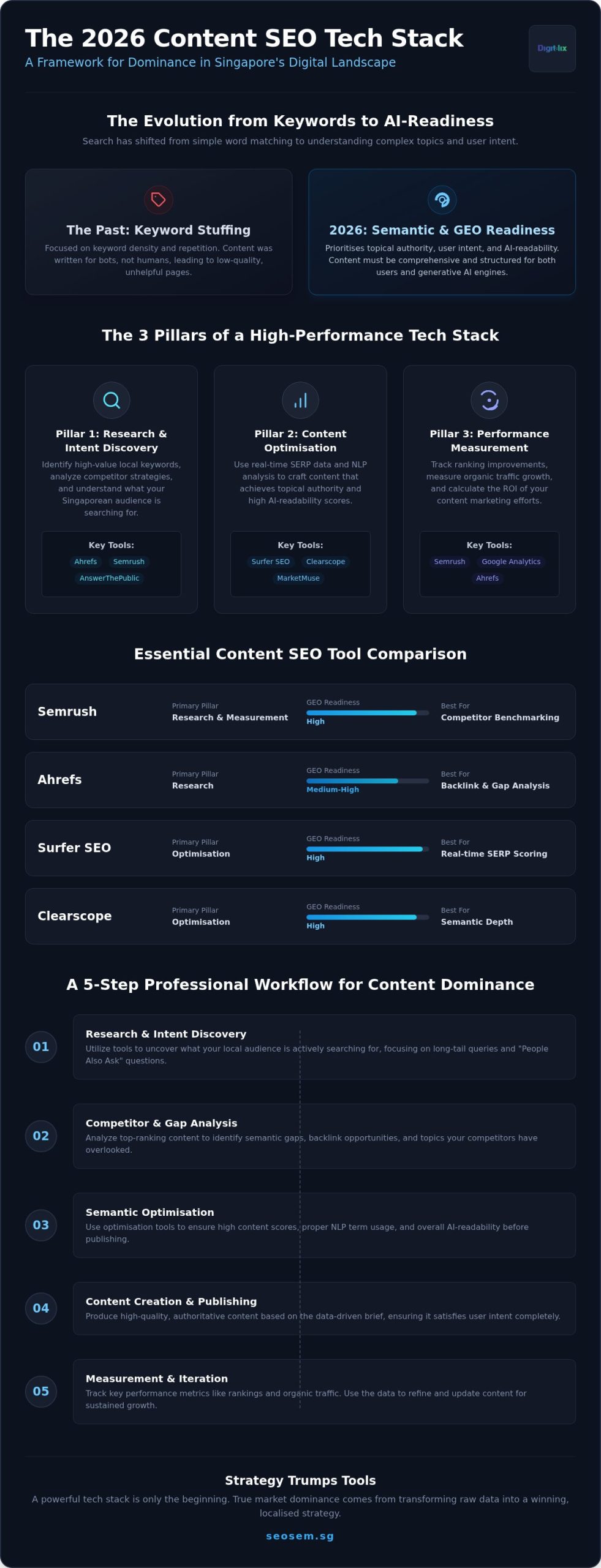
A high-performance tech stack for 2026 must integrate research, optimisation, and measurement capabilities to address both traditional search algorithms and generative AI engines. Selecting the right content SEO tools allows Singaporean businesses to align their digital assets with the “GEO Readiness” required for modern search visibility. This strategic selection is a cornerstone of any successful business digitalisation programme, ensuring that every piece of copy contributes to a measurable return on investment.
| Tool | Primary Pillar | GEO Readiness | Best For |
|---|---|---|---|
| Semrush | Research/Measurement | High | Competitor Benchmarking |
| Ahrefs | Research | Medium-High | Backlink & Gap Analysis |
| Surfer SEO | Optimisation | High | Real-time SERP Scoring |
| Clearscope | Optimisation | High | Semantic Depth |
| SEO Review Tools | Optimisation | Medium | SME Entry Level |
| Digitalix | Strategy & Execution | Maximum | ROI-Driven Performance |
Leveraging Content SEO Tools for Research and Intent Discovery
Ahrefs remains the gold standard for backlink-driven content gap analysis, providing the granular data needed to identify opportunities rivals overlook. For brands targeting the local market, AnswerThePublic is essential for capturing long-tail “People Also Ask” queries specific to Singapore. Semrush complements this by offering comprehensive competitor benchmarking in the local landscape, helping you identify which content clusters drive traffic on regional platforms like Shopee or Lazada. Using these content SEO tools together creates a 360-degree view of the market’s search intent.
Using Content SEO Tools for GEO and Search Visibility Optimization
Surfer SEO utilizes real-time SERP data to provide a “Content Score,” which is vital for maintaining a competitive edge in 2026. It analyzes top-ranking pages to suggest the ideal word count and NLP terms for AI readability. For SMEs starting their digitalisation journey, SEO Review Tools provides a robust free alternative for essential on-page checks. In 2026, content optimisation is a science of balancing human creativity with algorithmic precision. While these content SEO tools provide the raw data, you might need to consult with a strategic partner to translate these metrics into a scalable growth framework.
Free vs. Paid Content SEO Tools: Calculating ROI for Singaporean SMEs
Can you execute a search strategy without spending a cent on software? While the short answer is yes, the pragmatic answer for a growing business is rarely so simple. The primary hidden cost of free content SEO tools is the manual labour required to aggregate data. When your team spends five hours a week manually tracking rankings or copy-pasting keyword volumes from limited freemium versions, you’re losing more in salary costs than a premium subscription would ever charge. For most Singaporean SMEs, the goal is scalability, and manual processes are the enemy of growth.
Choosing the right content SEO tools involves balancing these upfront costs against long-term performance. A paid suite doesn’t just provide more data; it provides the automation necessary to turn that data into action. The trade-off between free and paid platforms isn’t just about features; it’s about the integrity of your business decisions and the speed at which you can respond to market shifts.
- Data Integrity: Free versions often hide the most valuable long-tail opportunities behind a paywall.
- Productivity: Time spent cross-referencing disjointed tools is time not spent on high-level strategy.
- Accountability: Professional platforms provide the historical data needed to prove a measurable return on investment.
When Free Content SEO Tools are Enough (and When They Aren’t)
Google Search Console and Bing Webmaster Tools are non-negotiable foundations for any site. They provide direct data from the engines themselves and should be the first step in any digitalisation programme. However, relying solely on freemium versions of third-party content SEO tools often leads to the “freemium trap.” These versions usually have strict data caps and lack the historical context required for deep competitive analysis. In high-stakes sectors like finance or healthcare, where precision is paramount to meet MAS or MOH standards, incomplete data can lead to strategic errors that damage your brand’s authority. Professional SEO packages in Singapore often include access to high-tier enterprise tools, providing a higher data-to-dollar ratio than individual SME subscriptions.
Leveraging Digitalisation Grants for Premium Content SEO Tools
Singapore’s commitment to Smart Nation 2.0 means there are often avenues to offset the cost of advanced tech. Initiatives from the IMDA or Enterprise Singapore frequently provide support for SMEs adopting approved digital solutions. Investing in premium content SEO tools isn’t just about keywords; it’s about multi-channel intelligence that informs your SEM and social media strategies. To understand how to structure these investments for maximum impact, consult a digital marketing agency in Singapore that focuses on ROI-driven frameworks. A professional partner ensures you aren’t just buying software, but implementing a methodology that delivers a measurable return on every dollar spent.
How to Build a Professional Workflow with Content SEO Tools
To build a professional content SEO workflow, you must integrate your tech stack into a structured five-step methodology: Discovering local search intent, Briefing with semantic maps, Drafting human-centric copy, Optimising for algorithmic precision, and Auditing for ROI. This rigorous framework ensures that your use of content SEO tools moves beyond mere data collection and translates into a repeatable system for capturing market share. By following this sequence, Singaporean businesses can maintain a consistent output of high-performing assets that satisfy both human readers and AI-driven search models.
Step-by-Step Execution: Deploying Content SEO Tools from Research to Live Page
The first stage involves identifying “low-hanging fruit” opportunities where your site already shows potential. Use Ahrefs to filter for keywords where you rank in positions 11 to 20 for competitive local regions like Paya Lebar or Jurong. These are terms your audience is actively searching for but where your content requires a final push to reach the first page. Once these targets are identified, the workflow moves to the briefing stage. Use Surfer SEO to generate a semantic roadmap that outlines the necessary word counts, heading structures, and NLP entities required to outrank current top performers.
During the drafting phase, your writers should focus on addressing the reader’s pain points first, using the brief as a structural guide rather than a rigid constraint. The optimisation phase follows, where you use your content SEO tools to refine the draft, ensuring all critical LSI keywords are naturally integrated. The final audit stage involves monitoring the live page’s performance against your initial KPIs, allowing you to make data-backed adjustments as the SERP landscape shifts.
Integrating AI-Driven Content SEO Tools without Losing Your Brand Voice
While automation can accelerate production, the danger of “set it and forget it” AI content is a loss of brand authority. In 2026, search algorithms are highly sensitive to E-E-A-T (Experience, Expertise, Authoritativeness, and Trustworthiness). To protect your brand, every AI-assisted draft must undergo a rigorous “Human Audit.” This involves checking for Singapore English standards and ensuring the tone aligns with local cultural expectations. You can use content SEO tools like Grammarly or Hemingway to polish the prose, but a human editor must verify that the content provides genuine, original value that a machine cannot replicate.
This hybrid approach allows you to scale your content production without sacrificing the unique perspective that drives conversions. By combining the efficiency of AI with human oversight, you ensure your content remains conversational and authoritative. This balance is critical for maintaining long-term sustainability in a market where consumers value transparency and authentic expertise over generic, automated responses.
Why Strategy Trumps Tools: The Digitalix Advantage
Software provides the raw data, but a data-driven methodology converts that data into market leadership. In 2026, access to premium content SEO tools is no longer a unique advantage; it’s the baseline. Strategic dominance belongs to the brands that can interpret complex metrics and pivot faster than their competitors. At Digitalix, we position ourselves as your Strategic Growth Partner, moving beyond mere reporting to deliver actionable insights that drive a measurable return on investment.
Operating from our headquarters at Paya Lebar Square, we possess a deep-seated understanding of the local SME landscape. We’ve seen how generic tool advice fails to account for the specific regulatory environments of the MAS or the nuances of the Smart Nation 2.0 initiative. We don’t just hand you a list of keywords. We build a comprehensive framework that aligns your digital presence with your long-term business goals, ensuring every piece of content contributes to your bottom line.
The Human Element in a Tech-Driven SEO World
AI tools excel at pattern recognition, but they cannot replace local market intuition or competitor psychology. A machine doesn’t understand the emotional triggers of a Singaporean consumer or the subtle shifts in local sentiment. While software identifies the gaps, professional Content Creation is what bridges them. High-quality copy must do more than just rank; it must convert traffic into leads by establishing trust and authority. Our team manages your entire tech stack, from technical audits to semantic optimisation, allowing you to focus on running your business while we secure your digital presence.
Ready to Dominate the Singapore SERPs?
The most successful brands in 2026 are those that combine the precision of premium content SEO tools with the strategic oversight of an expert agency. This synergy ensures your content is not only visible but also influential. We provide the technical certainty and mathematical rigour required to outrank the competition in a crowded marketplace. Tools provide the map, but Digitalix provides the engine that drives your growth. It’s time to stop guessing and start growing with a partner that values transparency and results above all else.
Securing Your Strategic Edge in the Smart Nation 2.0 Era
Mastering the modern search landscape requires more than just access to the latest content SEO tools; it demands a rigorous, data-driven methodology. You’ve seen how the shift toward semantic intelligence and Generative Engine Optimization has redefined what it takes to outrank competitors. By balancing a high-performance tech stack with a professional workflow, your business can turn search visibility into a scalable engine for growth. Success in 2026 relies on your ability to interpret raw data through the lens of local market psychology.
Digitalix provides the specialised Singapore market expertise necessary to navigate this technical complexity. We focus on data-driven performance monitoring to ensure every piece of content delivers a measurable return on investment. Our team offers flexible pricing plans for SMEs, making enterprise-level strategy accessible to growing local brands. We bridge the gap between software metrics and the strategic dominance your business needs to lead the market with confidence and precision.
Take the first step toward a more precise, performance-obsessed digital presence today. Your path to long-term sustainability in Singapore’s competitive digital economy starts with a proven framework and a partner committed to your bottom line.
Frequently Asked Questions
What are the best free content SEO tools for Singaporean SMEs?
Google Search Console and Bing Webmaster Tools are the most reliable free foundations for any local business. They provide direct performance data and indexing status straight from the search engines. For specific on-page analysis, SEO Review Tools offers a robust suite of free content SEO tools that check for basic technical errors and keyword density. While these are excellent for entry-level monitoring, they often lack the deep competitive intelligence found in premium platforms.
Can I use AI tools like ChatGPT for my content SEO strategy in 2026?
You can use generative AI as a productivity enhancer, but it shouldn’t replace your strategic methodology. In 2026, search engines prioritize Experience and Expertise (E-E-A-T). AI-generated drafts require a rigorous “Human Audit” to ensure they align with local market nuances and your specific brand voice. Relying solely on raw AI output risks a loss of authority and can lead to ranking penalties if the content lacks original value or local relevance.
How often should I use SEO tools to audit my existing content?
Aim for a comprehensive content audit at least once every quarter to maintain your competitive edge. This frequency allows you to identify traffic decay and update outdated information before it affects your ROI. High-competition sectors in the CBD or fintech space may require monthly monitoring to stay ahead of aggressive rivals. Consistent use of content SEO tools ensures your pages remain semantically relevant and technically sound as algorithms evolve.
Do content SEO tools work for local Singaporean dialects and slang?
Most global software lacks the cultural context to recognize Singlish or specific regional colloquialisms effectively. While these tools excel at technical structure and identifying search volumes, they cannot replicate the local intuition required for high-conversion copy. You must manually refine your content to ensure it resonates with the Singaporean audience. Use software for the algorithmic framework, but rely on local expertise for the final creative and cultural polish.
Is it better to buy one all-in-one SEO tool or several niche tools?
An all-in-one platform typically provides a higher ROI for SMEs by centralising data and reducing subscription overheads. Suites like Semrush or Ahrefs cover research, optimisation, and measurement within a single, integrated ecosystem. Niche tools are only necessary when you require deep, specialised analysis for high-stakes campaigns or specific technical challenges. Most businesses find that a consolidated tech stack improves workflow efficiency and simplifies the performance tracking process.
How do SEO tools help with Generative Engine Optimization (GEO)?
Modern software identifies the semantic entities and topical relationships that AI models use to generate search summaries. By optimising for these connections, you increase the likelihood of being cited as a primary source in AI-powered responses. Tools focusing on NLP analysis help you build the topical authority required for GEO. This ensures your content is visible in both traditional SERPs and the newer generative search interfaces used in Smart Nation 2.0.
Are there any Singapore government grants available for SEO software?
Eligible businesses can often access support through IMDA initiatives like the Productivity Solutions Grant (PSG). These programmes are designed to help SMEs adopt digitalised solutions to improve productivity and market reach. You should check the latest Enterprise Singapore or Smart Nation 2.0 guidelines for updated eligibility criteria and approved vendors. Leveraging these grants can significantly offset the cost of premium software subscriptions for your internal marketing team.
Why is my content not ranking even though my SEO tool score is 100?
A perfect tool score doesn’t guarantee a top ranking because algorithms consider hundreds of factors beyond on-page copy. Your content might lack sufficient backlink authority, or your site may have underlying technical issues that hinder performance. It’s also possible that your content, while technically “perfect,” doesn’t satisfy the actual intent of the searcher. Professional strategy helps interpret these data gaps to find a data-driven solution that moves beyond simple score-chasing.