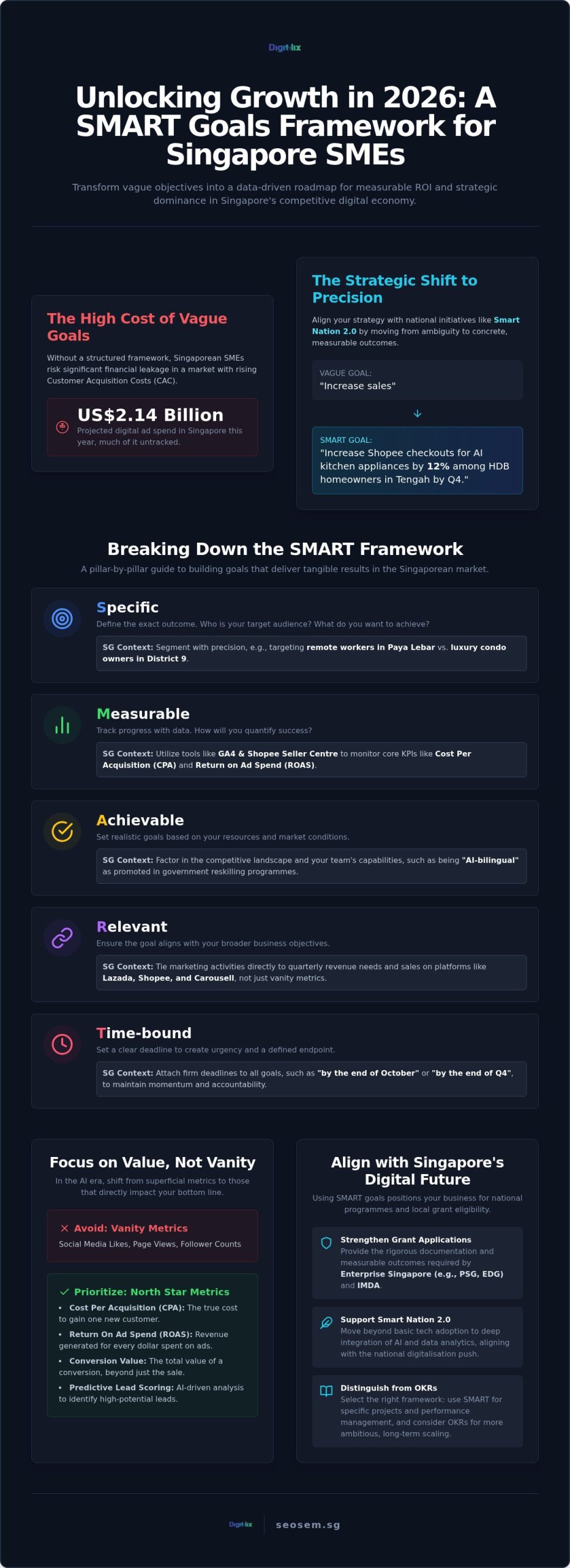
Did you know that digital advertising spend in Singapore is projected to hit US$2.14 billion this year, yet many SMEs still struggle to track their actual ROI? It’s a common trap in our competitive market where vague ambitions lead to drained budgets and missed opportunities. If you aren’t using smart goals to anchor your 2026 strategy, you’re likely losing ground to competitors who treat their growth as a rigorous science.
You’re probably tired of hearing marketing jargon that doesn’t result in more leads or higher revenue. You need a clear way to measure the success of your digitalisation programmes while staying aligned with Smart Nation 2.0 goals. This article provides a strategic roadmap to transform your digital presence into a measurable performance engine. we’ll break down how to align your marketing spend with actual business outcomes and ensure your digital transformation qualifies for essential local grants like the PSG or EDG. Let’s move beyond guesswork and build a roadmap for strategic dominance in the 2026 digital economy.
Key Takeaways
- Transition from vague objectives like “increasing sales” to smart goals that provide a data-driven roadmap for measurable ROI in the 2026 economy.
- Identify specific Singaporean KPIs such as CPA and ROAS to align your digital marketing spend directly with bottom-line revenue growth.
- Distinguish between SMART frameworks and OKRs to select the most effective methodology for your internal digitalisation programmes and long-term scaling.
- Leverage local market baselines and targeted demographics to ensure your SEO and SEM strategies remain achievable within the competitive SG landscape.
- Position your business for local grant eligibility by maintaining the rigorous documentation and measurable outcomes required by Enterprise Singapore and IMDA.
What are SMART Goals and Why Are They Critical for Singapore Businesses in 2026?
In the high-stakes environment of Singapore’s digital economy, understanding What are SMART Goals is the difference between strategic dominance and market irrelevance. This framework requires that every business objective is Specific, Measurable, Achievable, Relevant, and Time-bound. By 2026, the threshold for success has shifted significantly. A generic aim like “increasing sales” is no longer a viable strategy; it’s a financial liability. With digital advertising spend reaching US$2.14 billion, businesses that lack precision find their margins eroded by rising Customer Acquisition Costs (CAC). Smart goals provide the necessary guardrails to align your digital activities with the Smart Nation 2.0 digitalisation push. This national initiative demands that SMEs move beyond basic tech adoption toward deep integration of AI and data analytics. At Digitalix, we anchor our SEO services in Singapore within this framework to ensure that search visibility translates into tangible ROI.
The Evolution of Goal Setting in the AI Era
Traditional business targets often fail because they rely on historical data that AI-driven markets now disrupt in real-time. In 2026, your goals must account for the shift from vanity metrics, like social media likes, to North Star metrics like conversion value and predictive lead scoring. AI-driven analytics have simplified data collection, but they’ve added a layer of complexity to the “Measurable” component. You now need to track how agentic AI interacts with your brand across multiple touchpoints, from search engines to voice assistants. If your framework doesn’t account for these micro-conversions, your roadmap is already obsolete. The “Achievable” part of your goal now depends on your team’s ability to be “AI-bilingual,” which is why many organizations leverage professional development from Trainetics Academy to meet these evolving standards.
The High Cost of Vague Objectives for SG SMEs
For many local SMEs, the absence of a structured framework results in significant financial leakage. Running Google Ads campaigns without a strictly defined conversion target often leads to “click-happy” budgets that don’t translate to Shopee or Lazada sales. Manpower is frequently wasted on social media content creation that lacks a specific “Relevant” tie-in to the current quarterly revenue needs. This inefficiency is particularly damaging when competing against regional players who use data to optimize every cent of their spend. The “Specific” component requires you to define the exact outcome you want to achieve, such as increasing Shopee checkout completions for AI-enabled kitchen appliances among HDB homeowners in Tengah by 12% by the end of October. Partnering with a performance-driven digital marketing agency in Singapore that prioritises hard data over creative fluff is one of the most effective ways to eliminate this kind of budget leakage.
Breaking Down the SMART Framework: A Strategic Deep Dive for SG SMEs
Applying smart goals requires more than just filling out a template. It’s about translating the specific nuances of the 2026 Singaporean market into actionable data points. When breaking down the SMART framework, you must look beyond generic definitions to see how each pillar supports your bottom line in a high-cost environment like the CBD or Orchard Road. Precision in goal setting isn’t a luxury; it’s a fundamental requirement for survival in an economy where digital noise is at an all-time high.
Specific and Measurable: The Quantitative Core
Specificity in the local context means segmenting your audience with surgical precision. For instance, a campaign targeting HDB dwellers for energy-efficient appliances requires a completely different messaging set than one aimed at luxury condo owners in District 9. You’re not just “selling more”; you’re “increasing sales of premium ergonomic chairs by 15% among remote workers in the Paya Lebar area.” This level of detail prevents wasted ad spend and ensures your content resonates with the right demographic.
Measurement ensures your strategy isn’t based on guesswork. In 2026, we utilize a sophisticated stack of tools including GA4, Shopee Seller Centre, and integrated CRMs to track every dollar. You need to establish a baseline before launching any digitalisation programme. Key performance indicators (KPIs) like Cost Per Acquisition (CPA) and Return on Ad Spend (ROAS) provide the mathematical certainty needed to scale campaigns. If you aren’t sure where your current baseline lies, consulting with a performance partner can help clarify your starting point.
Achievable and Relevant: The Reality Check
The “Achievable” component of your smart goals must reflect the reality of Singapore’s competitive landscape. Attempting to outrank established giants in the Orchard retail sector for broad keywords within a month isn’t a goal; it’s a fantasy. We look at competitor benchmarking to set realistic milestones for SEO and SEM. Your objectives must also be relevant to the 2026 economic climate, perhaps by focusing on automation to solve the persistent local labor shortage. Aligning your goals with Enterprise Singapore (ESG) grant requirements ensures that your digitalisation efforts are financially sustainable and supported by national initiatives like Smart Nation 2.0.
Finally, your goals must be time-bound to align with Singapore’s unique retail rhythm. Setting quarterly milestones that coincide with major festive periods like Chinese New Year (CNY) or the Great Singapore Sale (GSS) allows for better inventory and budget management. On platforms like Lazada and Carousell, timing your “Specific” offers to these peaks can maximize conversion rates. This structured approach ensures your marketing spend delivers the highest possible impact during high-traffic windows.
SMART Goals vs. OKRs: Choosing the Right Framework for Digitalisation
Many Singaporean business leaders often confuse smart goals with Objectives and Key Results (OKRs). While both methodologies aim to improve performance, they serve different strategic functions within a digitalisation programme. Understanding What are SMART Goals involves viewing them as a precision tool for tactical execution. In contrast, OKRs are designed for high-level alignment and ambitious scaling. Choosing the wrong framework can lead to either a lack of ambition or a lack of accountability in your daily operations.
| Framework | Strategic Focus | Typical Duration | Best Use Case |
|---|---|---|---|
| SMART Goals | Operational Precision | Monthly or Quarterly | Campaign management and SEO audits |
| OKRs | Visionary Alignment | Quarterly or Annually | Market entry and company scaling |
For immediate performance wins, such as those found in SEM services, smart goals are the gold standard. They provide the necessary constraints to manage tight Google Ads budgets and ensure that every click has a measurable path to conversion. By hybridising these frameworks, you can use OKRs to define your long-term brand building in the Singapore market while relying on SMART criteria to execute the granular steps of your digital strategy. This dual approach ensures your business remains both visionary and grounded in data-backed reality.
When to Use SMART Goals in Marketing
Tactical execution requires the discipline that only smart goals can provide. This framework is ideal for monthly SEO audits or specific social media ad bursts on platforms like Instagram and Facebook. It helps SMEs stay focused when resources are limited, preventing the common trap of “spray and pray” marketing. A Jurong-based B2B firm recently applied this methodology to their lead generation strategy. Instead of a vague desire for “more leads,” they set a target to increase high-intent enquiries from their website by 18% within 90 days. By focusing on a specific outcome, they were able to optimize their landing pages and ad copy with mathematical precision, eventually exceeding their target by 4%.
When OKRs Might Be Better for SG Startups
In high-growth scenarios, the “Achievable” aspect of a SMART goal can sometimes stifle innovation. SG startups looking to disrupt a market often prefer OKRs because they encourage ambitious, qualitative objectives that push the boundaries of what is possible. This framework is superior for aligning multiple departments, such as Sales, Marketing, and Operations, within a larger Singaporean firm. Leadership typically sets the “Objective,” while individual teams determine the “Key Results” that define success. This empowers employees to find creative solutions to meet the company’s broader Smart Nation 2.0 aspirations without being bogged down by overly rigid constraints.
Practical Application: Setting SMART Goals for SEO, SEM, and Social Media
Moving from theory to execution requires a structured approach that respects the nuances of the 2026 Singaporean market. You can’t simply replicate global strategies and expect them to perform in a high-density, tech-savvy environment. Precision is everything. To transform your digital presence, follow these five steps to anchor your smart goals in data-backed reality.
- Step 1: Audit your baseline. Use GA4 or Shopee Seller Centre to extract your current conversion rates, organic traffic, and lead quality. Without a baseline, you can’t measure growth.
- Step 2: Define a Specific outcome. Narrow your focus. Instead of “more leads,” aim to “increase high-intent enquiries for luxury web design in the CBD.”
- Step 3: Assign Measurable metrics. Choose KPIs that impact your bottom line. Aim for a “15% increase in form submissions via organic search” rather than just tracking impressions.
- Step 4: Validate if it’s Achievable. Check your budget against the US$2.14 billion projected digital ad spend in SG. If you’re a small business with a S$3,000 monthly budget, competing for broad national keywords might not be realistic.
- Step 5: Set a Time-bound deadline. Create urgency. Your targets should be met “by the end of Q3 2026” to ensure your team remains focused and accountable.
SMART Goals for SEO and Content Marketing
SEO in 2026 isn’t just about keywords; it’s about topical authority and Generative Engine Optimization (GEO). A well-defined goal might be ranking in the top 3 for “best marketing agency Singapore” within six months. To achieve this, your content creation must link directly to business outcomes. For example, every blog post should be designed to move a reader from a “how-to” query to a “service-intent” action. You can find benchmarks for these targets in our guide on SEO services in Singapore, which outlines the current performance standards for local SMEs.
SMART Goals for E-commerce (Shopee and Lazada)
Success on platforms like Shopee and Lazada requires managing both visibility and inventory with surgical precision. You should set specific targets for “Add to Cart” rates and “Flash Sale” performance to avoid overstocking or missed revenue. Integrating professional e-commerce marketing services allows you to align your advertising spend with real-time stock levels. For instance, a local skincare brand launching on Shopee Mall might set a goal to “achieve a 10% conversion rate on the new Vitamin C serum during the 11.11 campaign by utilizing Shopee Ads and targeted influencer content.” This level of detail ensures that your marketing efforts are never disconnected from your operational capacity.
Executing Your SMART Strategy with Digitalix: From Framework to ROI
Setting smart goals is the blueprint; execution is the construction. Many firms fail because they treat the framework as a one-time administrative exercise. At Digitalix, we act as your Strategic Growth Partner, specifically handling the “Measurable” and “Achievable” components that often stall local SMEs. We don’t just promise growth. We engineer it through a rigorous, science-first approach that ensures every marketing dollar is accounted for in your bottom line. We move your business from vague ambitions to a performance-driven reality where data dictates every move.
Your conversion goals are only as strong as your digital foundation. High-quality web design is essential to making your targets “Achievable.” If your landing pages can’t convert the traffic we drive through SEO or SEM, your ROI will remain stagnant regardless of your search visibility. We optimize user journeys with surgical precision to ensure that “Specific” lead generation targets are met. By aligning your site’s technical performance with your business objectives, we turn your digital presence into a high-conversion engine that supports long-term scalability.
Our Data-Driven Methodology
We utilize 2026-grade analytics to provide a granular view of your performance across all channels. This isn’t about vanity metrics like impressions or surface-level engagement. We focus on conversion value, predictive lead scoring, and actual ROAS. Our monthly reporting serves as a strategic pivot point. We adjust your smart goals in real-time based on shifts in the Singaporean market, ensuring you maintain strategic dominance. This transparency is the backbone of our partnership, providing you with a clear view of how your investment translates into market leadership.
Ready to Build Your Digital Presence Together?
Navigating the complexities of IMDA and Enterprise Singapore (ESG) digitalisation standards is a significant hurdle for many local businesses. Whether you’re looking to leverage the Productivity Solutions Grant (PSG) or the Enterprise Development Grant (EDG), we provide the technical expertise and measurable outcomes required for eligibility. We help you meet the rigorous documentation standards necessary for these programmes while ensuring your digital transformation delivers a measurable return. With Singapore’s digital economy now contributing 18.6% to the national GDP, the cost of inaction is simply too high for ambitious firms. Choosing the right marketing agency near me is a critical decision that directly impacts your ability to meet these grant requirements and achieve your SMART goals.
Let’s build your digital presence together by mapping out a strategy that prioritizes precision over guesswork. We invite you to a strategic consultation at our office in Paya Lebar Square to discuss your specific challenges and opportunities. Contact Digitalix today to define your 2026 growth roadmap and secure your competitive edge in the digital landscape.
Secure Strategic Dominance in the 2026 Economy
Mastering the transition from vague marketing objectives to a precision-based framework is no longer optional for Singaporean SMEs. The use of smart goals provides the mathematical certainty needed to navigate rising ad costs and competitive SERPs. By aligning your digital spend with national digitalisation programmes and Smart Nation 2.0 initiatives, you ensure that every dollar invested contributes to measurable revenue growth. Thriving in the 2026 market requires more than just high visibility. It demands a seamless integration of technical SEO, high-performance web design, and data-driven execution. To ensure you’re working with the right partner to deliver these outcomes, our 2026 buying guide for choosing a digital marketing agency in Singapore outlines the key criteria for identifying a firm that prioritises predictable lead generation and local search dominance. Furthermore, for businesses looking to expand their global reach, ensuring your team meets international communication standards is vital; to support this, check out English Explorer for comprehensive IELTS training.
At Digitalix, we combine Singapore-centric expertise with international performance standards to deliver a clear ROI for our partners. Our team at Paya Lebar Square is ready to help you demystify the complexities of the digital market and build a roadmap for long-term sustainability. Let’s transform your business ambitions into a data-backed reality and secure your market leadership together.
Frequently Asked Questions
What is a SMART goal example for a Singaporean SME?
A practical example for a local business is increasing monthly lead generation from a corporate website by 20% within the next six months. For a retail SME, this could mean achieving a 15% uplift in Shopee checkout completions during the 11.11 and 12.12 festive periods. These targets ensure that your resources are focused on high-impact activities rather than vague brand awareness that doesn’t contribute to the bottom line.
How do SMART goals help with Enterprise Singapore grant applications?
Enterprise Singapore (ESG) and IMDA require clear, measurable outcomes for grant approvals like the PSG or EDG. By defining smart goals in your application, you demonstrate a disciplined approach to digitalisation that justifies the government funding. Providing concrete KPIs such as projected manpower savings or revenue growth through digital channels increases the likelihood of a successful claim and ensures compliance with audit requirements.
Can SMART goals be used for social media marketing on TikTok?
Yes, TikTok campaigns require specific constraints to prevent budget leakage in high-volume, fast-paced environments. Instead of aiming for “viral content,” a structured goal would be to drive 500 clicks to a specific landing page with a conversion rate of 2% within a 30-day window. This keeps your content creation aligned with actual business revenue rather than just chasing vanity engagement metrics that don’t convert.
What is the difference between a KPI and a SMART goal?
A KPI is a single metric used to track performance, while a SMART goal is the broader framework that gives that metric context and a deadline. For instance, Organic Traffic is a KPI, but increasing Organic Traffic by 10% for “web design” keywords by Q4 2026 is a goal. The framework ensures your KPIs are tied to a specific timeline and business relevance, making them actionable rather than just data points.
How often should a Singapore business review its SMART goals?
We recommend a formal review every quarter to align with Singapore’s seasonal retail cycles and quarterly economic shifts. Digital campaigns on platforms like Google Ads or Lazada often require monthly adjustments to optimize spend based on real-time performance data. Regular audits allow you to pivot your strategy if market conditions or competitor behaviors change unexpectedly in the CBD or heartland retail sectors.
Is the SMART framework still relevant in the age of AI and automation?
The framework is more critical than ever because AI requires precise instructions to deliver useful, high-ROI outputs. Without smart goals, AI-driven automation can generate vast amounts of content or data that lack strategic direction. Setting specific parameters allows your agentic AI tools to execute tasks that directly contribute to your North Star metrics and long-term scalability in a competitive digital landscape.
How do I set SMART goals if I have no historical data?
You should use local industry benchmarks or competitor analysis as your initial baseline for setting objectives. If you’re a new startup in Paya Lebar, look at average conversion rates for similar SMEs in the Singapore market to set your first targets. After three months of data collection, you can refine these objectives to reflect your actual performance and the reality of your specific niche. Our 2026 guide to choosing a Singapore marketing agency outlines how to evaluate a partner who can help you establish these benchmarks from day one.
What is the most important part of the SMART acronym for SEO?
The “Measurable” component is the most vital for SEO because search visibility and organic growth can be difficult to track without the right tools. You must identify specific metrics like SERP position, click-through rates (CTR), or conversion value to prove the success of your digitalisation programme. Without rigorous measurement, SEO becomes an art form rather than the data-driven science required for strategic dominance.